Physical Address
304 North Cardinal St.
Dorchester Center, MA 02124
Physical Address
304 North Cardinal St.
Dorchester Center, MA 02124


There is a peculiar problem at the heart of the Western mystery tradition. The more famous a path becomes, the easier it is to counterfeit. And few paths have been counterfeited as thoroughly as Rosicrucianism — a tradition whose very name conjures rose-entwined crosses, sealed vaults lit by artificial suns, and a brotherhood sworn to heal the sick for free and keep its existence hidden for a hundred years.

There is a moment in Suzanne Simon's story that lands like a stone dropped into still water. She is describing what an energy worker witnessed when she travelled, in her own awareness, to the place her son calls "the hill." Karai, a non-speaking young man who had spent twenty years in apparent silence, was not alone there. He was leading. The healer described millions of souls sprouting wings and rising behind him, and she put a number to it that has since become something of a signature in this circle: thirty-one million, all following Karai.
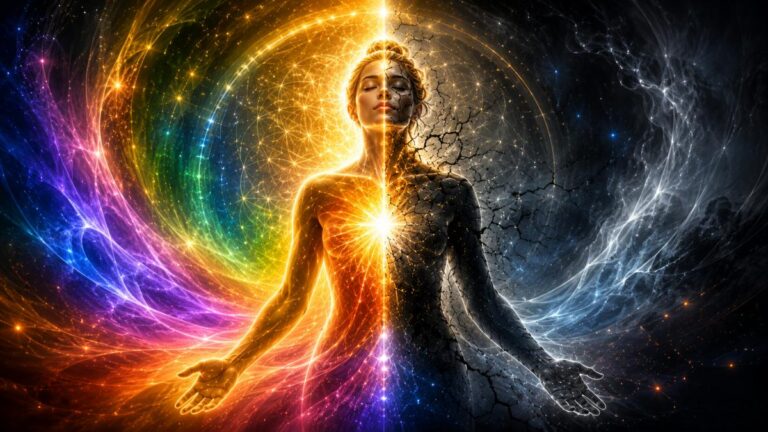
Most of what we are taught about auras is the watered-down version. We are handed a tidy chart that says blue means calm, red means passion, green means healing, and we are sent on our way. But the aura is not a mood ring floating around the body. It is a real-time readout of your consciousness. It shows where your vessel is intact and where it is cracked, where light is flowing and where it is leaking, and whether you are living from your highest frequency or running on the fumes of survival mode.

Raising your vibration is a popular topic on spiritual forums, and Reddit users often share personal experiences about which books actually helped them feel a tangible shift in energy. Below is a curated list of ten titles that repeatedly appear in Reddit threads where commenters describe feeling lighter, more energized, or noticing a physical change after reading or working with the material. Each entry includes a brief summary of why readers mention a vibrational lift, along with a link to a relevant Reddit discussion or external source so you can explore the conversation yourself.

For decades, the question of whether any non-human species possesses true language has been treated as more or less settled by mainstream science. Humans speak. Animals signal. The two are categorically different, and the boundary between them is fixed. That boundary is now dissolving — and artificial intelligence is the tool doing the dissolving.

Two animal communicators, working separately and with no connection to each other, recently sat down with very different cats and walked away with strikingly similar material. One channeled a cat who methodically explained the mechanics of energy manipulation and dream access. The other sat with a ginger cat who lectured his human about hidden history, her own suppressed spiritual power, and the difference between cats and dogs as spiritual workers. Neither cat was performing for the other. Neither human knew what the other had been told. Yet the picture they painted of feline consciousness lines up too cleanly to dismiss as coincidence, and what it suggests about the animal sleeping at the foot of your bed is worth sitting with.
In 1908 a slim book appeared in Chicago, published anonymously under the pen name "Three Initiates" and titled The Kybalion: A Study of the Hermetic Philosophy of Ancient Egypt and Greece. Religious scholarship now generally attributes it to William Walker Atkinson, a prolific pioneer of the New Thought movement who published under several pseudonyms. The book claims to transmit ancient teaching traceable to Hermes Trismegistus. Scholars are sceptical of that lineage, and the word Kybalion itself appears in no surviving Hermetic text. It was almost certainly invented by Atkinson.

There is a quiet act that humans have performed for roughly twelve thousand years. A farmer reaches into a harvested crop, sets aside a portion of the best, most resilient seed, and tucks it away for the next planting. It is the most ancient compact between a person and the living earth. The seed gives food. The farmer returns some of it to the soil. The cycle continues, generation upon generation, free of charge, free of permission, free of any authority above the sky.
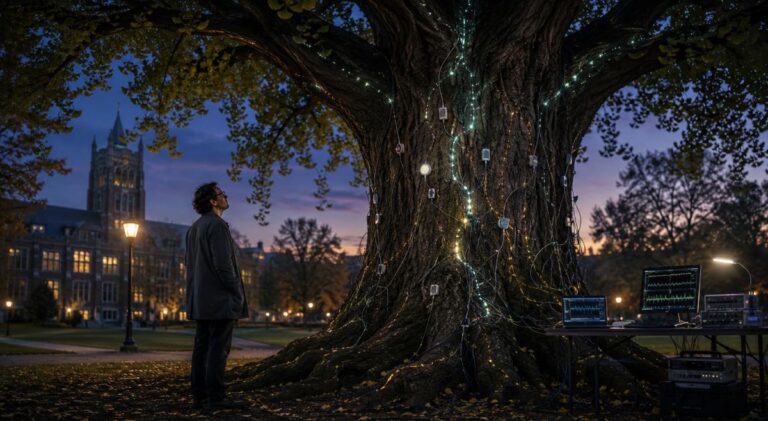
A ginkgo tree stands on a university campus. A neurologist who has spent his life mapping the electrical whispers of infant brains begins, very quietly, to wonder if that tree has whispers of its own. He sets up sensors. He runs visualizations. He does not become the tree's friend exactly, but he becomes something rarer in a Western scientist. He becomes curious without contempt.
There is a moment most people know well but few have ever named. It arrives somewhere between 2pm and 4pm, or after a long stretch of screen time, or simply at the end of a week where the mind has been working harder than the body. A heaviness settles over the top of the head. Thinking becomes slower, less precise. The inner world feels like it has been pressed down from above. Most of us reach for coffee, a walk, or simply push through. But according to Dr. Robert Gilbert, a researcher in sacred geometry and subtle body anatomy who spent time training at the Clairvision School of Australia, that familiar sensation of fatigue has a precise energetic cause and an equally precise remedy. He calls it the Pulling Up Practice, and it takes less than a minute to do.