Physical Address
304 North Cardinal St.
Dorchester Center, MA 02124
Physical Address
304 North Cardinal St.
Dorchester Center, MA 02124

There exists a plant so productive that one tuber can generate 200 offspring in a single season. It survives temperatures of minus 30 degrees Celsius, thrives without irrigation, and feeds the soil while feeding you. Native Americans cultivated it for thousands of years. Europeans embraced it as a famine solution. Then, after World War II, it disappeared from collective memory. This is the story of the sunchoke, also known as the Jerusalem artichoke, and why its abundance became a liability in systems designed around scarcity and control.
There exists a plant so productive that one tuber can generate 200 offspring in a single season. It survives temperatures of minus 30 degrees Celsius, thrives without irrigation, and feeds the soil while feeding you. Native Americans cultivated it for thousands of years. Europeans embraced it as a famine solution. Then, after World War II, it disappeared from collective memory. This is the story of the sunchoke, also known as the Jerusalem artichoke, and why its abundance became a liability in systems designed around scarcity and control.
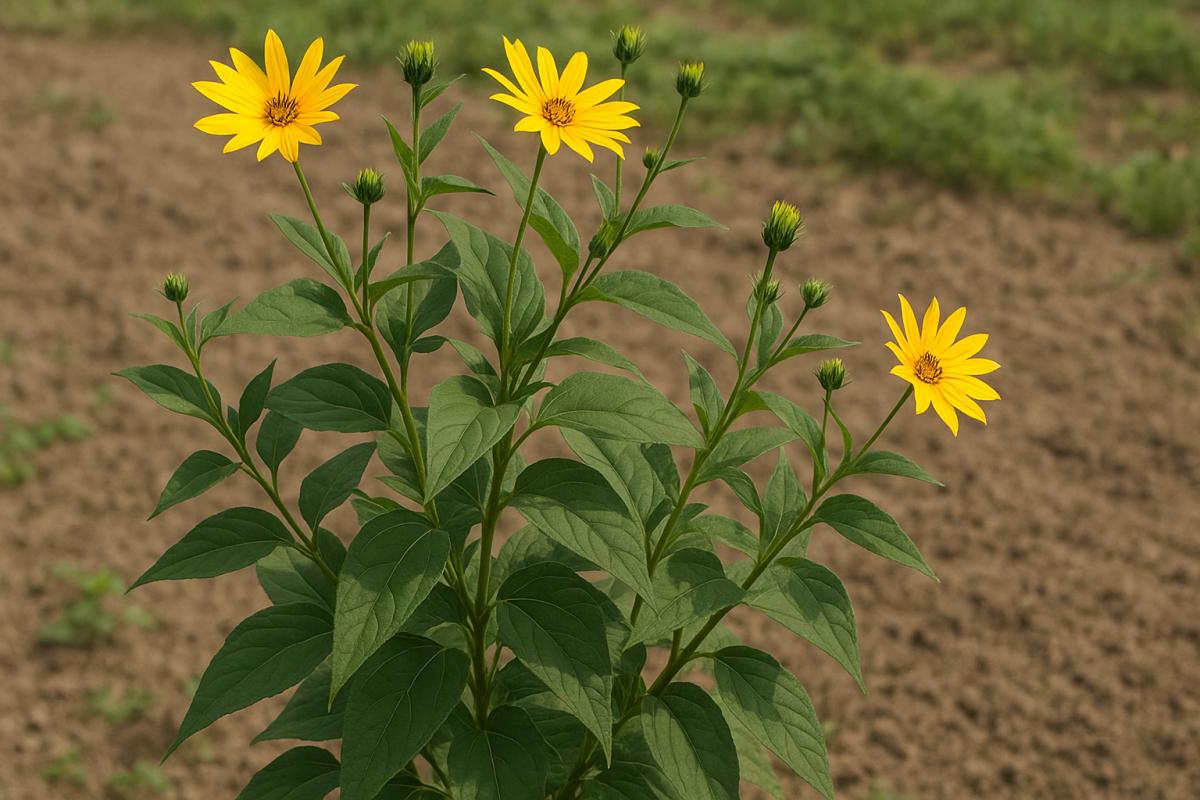
The sunchoke (Helianthus tuberosus) is a perennial member of the sunflower family, producing knobby, irregular tubers beneath the soil while sending up stalks that can reach 10 feet tall, crowned with bright yellow flowers in late summer. But unlike annual crops that require replanting each spring, the sunchoke operates on a different principle entirely.
Once established, sunchokes reproduce through underground rhizomes, creating an expanding network of tubers that overwinter in the soil and sprout new plants each spring. This perennial nature made it what indigenous peoples across the Great Lakes and eastern woodlands called “the ultimate insurance against famine.” You plant it once, and it feeds you indefinitely.
The productivity numbers defy the logic of conventional agriculture. A single plant can produce between 75 and 200 tubers in one growing season. The yield exceeds wheat and corn in cold climates and doubles that of potatoes, even without irrigation or fertilization. In marginal soils where modern crops struggle, sunchokes thrive and multiply.
This is precisely the characteristic that made it incompatible with industrial food systems. Agriculture built on annual seed purchases, chemical inputs, and controlled distribution cannot profit from a crop that replants itself for free, forever.
While potatoes store their energy as starch, sunchokes take a completely different biochemical approach. Between 50 and 60 percent of their dry weight consists of inulin, a prebiotic fiber that human digestive enzymes cannot break down. This makes sunchokes functionally different from every other common tuber.
According to research on Jerusalem artichoke nutrition, inulin passes through the stomach and small intestine intact, arriving in the colon where beneficial bacteria ferment it into short-chain fatty acids. These compounds nourish colon cells, reduce inflammation, and create an acidic environment that inhibits pathogenic bacteria like E. coli.
For diabetics, this characteristic transforms the equation entirely. Unlike potatoes with their high glycemic index that triggers rapid blood sugar spikes, sunchokes maintain stable glucose levels. The inulin doesn’t metabolize into sugar in the bloodstream. This makes them not just safe for diabetics but actively beneficial for blood sugar regulation and insulin sensitivity.
The tubers also provide substantial amounts of potassium (643 milligrams per serving), iron, copper, thiamine, and vitamin C. They deliver complex nutrition without requiring processing, packaging, or supplement extraction. The plant simply grows this profile naturally, asking for almost nothing in return.
There’s an important caveat: the same inulin that feeds beneficial gut bacteria can cause digestive distress and flatulence in people unaccustomed to it. This earned sunchokes the unfortunate nickname “fartichokes” and contributed to their reputation as a difficult food. Starting with small portions allows the gut microbiome to adapt, after which most people tolerate them well. But in a culture demanding instant gratification and zero inconvenience, this adjustment period became another mark against the plant.
Sunchokes demonstrate resilience that seems almost deliberately designed for unstable conditions. They tolerate cold down to minus 30 degrees Celsius, continuing to produce tubers while other crops freeze. They survive drought that would devastate annual plantings, requiring no irrigation even in dry years.
The deep root systems do more than extract moisture. They break up compacted soil, improve drainage, and add organic matter as older roots decompose. Where industrial monocultures exhaust soil fertility and require increasing chemical inputs, sunchokes actively improve the ground they grow in.
This tolerance for marginal conditions positioned sunchokes as ideal candidates for climate-stressed agriculture. As conventional crops fail with increasing frequency due to erratic weather, drought, and temperature extremes, perennial crops that improve rather than deplete soil offer obvious advantages.
But these advantages threaten the economic models that profit from crop failure, annual seed sales, and farmers’ dependence on external inputs. A food system built on control cannot accommodate plants that spread themselves freely and improve conditions for everything around them.
Native American tribes across the Great Lakes region and eastern woodlands cultivated sunchokes long before European contact. The plant was so widespread and well-established that historians cannot determine its original native range. It simply existed as part of functioning food systems throughout the region.
When French explorer Samuel de Champlain encountered sunchokes at Cape Cod in 1605, he recognized their value immediately and sent them back to France. Europeans quickly adopted them, particularly in the Netherlands and Mediterranean regions. They spread across the continent as a reliable food source that asked little and gave much.
The plant’s true strategic importance emerged during times of crisis. When Nazi forces occupied France during World War II, they commandeered approximately 80 percent of French food production, including potatoes. According to Atlas Obscura, vegetables like sunchokes and rutabaga, previously relegated to animal feed, became centerpieces of French tables and saved millions from starvation.
The Germans left sunchokes alone because they were considered inferior, difficult to harvest mechanically due to their irregular shape, and not worth requisitioning. This oversight allowed them to function as underground resistance crops, literally growing beneath the occupiers’ notice.
After nine years of wartime rationing ended in 1949, an entire generation of Europeans who survived on sunchokes refused to eat them again. The tubers became permanently associated with occupation, suffering, and deprivation. They were labeled “légumes oubliés,” the forgotten vegetables, and systematically removed from markets and memory.
This psychological association provided convenient cover for deeper structural reasons. The sunchoke’s irregular, knobby shape made mechanical harvesting difficult and labor-intensive. They spoiled faster than potatoes, complicating long-distance transport and storage. The inulin content caused digestive issues in people eating large quantities for the first time.
But most fundamentally, they violated the principles of industrial food production. Their aggressive self-replication meant no annual seed purchases. Their perennial nature disrupted crop rotation schedules optimized for annual plantings. Their nutritional independence threatened supplement markets. Their free availability undermined profit models requiring scarcity and control.
The post-war economic boom demanded standardized, controllable, profitable crops. Sunchokes offered abundance and independence instead. They were phased out not because they failed but because they succeeded too well at the wrong things.
The pattern becomes clear when examining the economics. Industrial agriculture profits from annual cycles requiring repeated purchases: certified seeds, chemical fertilizers, pesticides, herbicides, irrigation systems, mechanical harvesters designed for uniform crops. Each input generates revenue. Each season repeats the cycle.
Sunchokes break this model at every point. Plant them once and they replicate indefinitely. They need no fertilizer, no pesticides, no irrigation. Their irregular shape resists mechanical harvesting. They cannot be patented or genetically modified into proprietary varieties requiring licensing fees.
The supplement industry faces similar threats. Inulin is sold as a prebiotic supplement, extracted and packaged at significant markup. Blood sugar stabilizers, gut health products, and diabetic support formulas all duplicate what sunchokes provide naturally. If consumers understood this, entire product categories would become unnecessary.
The tubers must spoil quickly to prevent long-term storage and undermine fresh produce markets. They must cause flatulence to discourage widespread adoption. They must be difficult to clean to justify processed alternatives. Every characteristic that made sunchokes valuable for subsistence becomes a defect in commercial systems.
Sunchokes grow across North America right now, often dismissed as weeds or invasive plants. They thrive in disturbed soils, along roadsides, in abandoned lots. They require no permission to grow and no purchase to access for those willing to learn identification.
The tubers can be eaten raw, sliced thin into salads where they provide a crisp, nutty crunch. They roast beautifully, developing a sweet, caramelized exterior. They blend into soups and purees, adding body and subtle sweetness. They can be pickled, fermented, or stored in cool conditions for several months.
Starting with small portions allows the digestive system to adapt to the inulin content. Most people develop tolerance within days to weeks. The benefits of stable blood sugar, improved gut health, and prebiotic nutrition become accessible without supplements or medical interventions.
Sunchokes represent one example in a larger category of independence-enabling crops systematically marginalized by industrial food systems. These plants share common characteristics: extreme productivity, minimal input requirements, nutritional density, and resistance to commodification.
They were not eliminated through honest competition or superior alternatives. They were erased through deliberate economic structures that profit from dependence and recurring purchases rather than abundance and self-sufficiency.
The question isn’t whether sunchokes are difficult to harvest or cause flatulence. The question is who benefits from you never learning that a plant exists which feeds itself, improves soil, stabilizes blood sugar, and costs nothing after the first planting. And what you reclaim by choosing to know anyway.