Physical Address
304 North Cardinal St.
Dorchester Center, MA 02124
Physical Address
304 North Cardinal St.
Dorchester Center, MA 02124

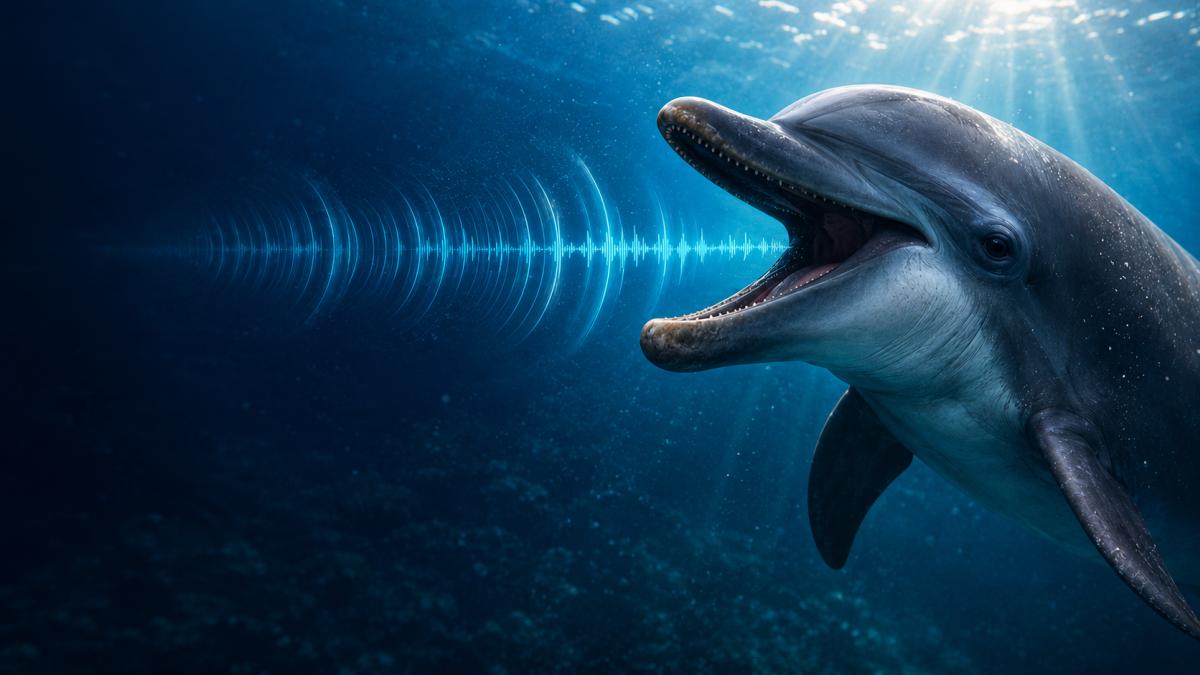
For decades, the question of whether any non-human species possesses true language has been treated as more or less settled by mainstream science. Humans speak. Animals signal. The two are categorically different, and the boundary between them is fixed. That boundary is now dissolving — and artificial intelligence is the tool doing the dissolving.
For decades, the question of whether any non-human species possesses true language has been treated as more or less settled by mainstream science. Humans speak. Animals signal. The two are categorically different, and the boundary between them is fixed.
That boundary is now dissolving — and artificial intelligence is the tool doing the dissolving.
In April 2025, on National Dolphin Day, Google announced DolphinGemma: the first large language model ever built specifically for a non-human species. Trained on nearly four decades of underwater recordings of wild Atlantic spotted dolphins gathered in the Bahamas, this AI is not attempting to translate dolphin sounds into English. It is doing something far more profound — it is learning the structure of dolphin communication the same way a language model learns the structure of human speech.
And what it is finding is forcing scientists to ask a question they thought they had buried long ago: what if dolphins don’t just communicate — what if they have language?
Before understanding why DolphinGemma matters, you need to understand what researchers already knew about dolphins — because the answer is staggering.
Dolphins pass the mirror self-recognition test, a gold-standard measure of self-awareness developed in 1970. Young bottlenose dolphins demonstrate this awareness as early as seven months old. Human children typically do not pass the same test until eighteen to twenty-four months. Dolphins comprehend syntax in laboratory settings, distinguishing between instructions where the order of words changes the meaning entirely. They demonstrate metacognition — an awareness of their own uncertainty — flagging in experimental settings when they do not know the answer to a problem. Their brains are nearly twice the size predicted for their body weight, with deeply folded neocortices and highly developed limbic regions associated with emotion, social awareness, and decision-making.
These are not signals of an average animal. They are the hallmarks of a mind.
And then there are the whistles.
Every bottlenose dolphin develops a unique sound — a signature whistle — within the first months of life. This whistle is not inherited. It is not copied from a parent. Each calf listens to the sounds around it and invents a completely original acoustic pattern that will identify it for the rest of its life. Researchers confirmed across more than 250 wild dolphins in Sarasota Bay, Florida, that when dolphins are separated, they broadcast the signature whistle of the individual they want to reach. They are calling someone by name across the open ocean.
And when a dolphin hears its own name called by a voice it recognises, it answers.
Research published in Science Advances went even further, demonstrating that when a dolphin hears another dolphin’s signature whistle, it does not merely recognise the sound — it forms a mental representation of that individual: who they are, what they look like, the history of their relationship. The whistle is not just a label. It is a concept.
Hearing a friend’s name and seeing their face in your mind is something humans assume is uniquely human. Dolphins do it too.
The memory attached to these names is equally extraordinary.
Research from the University of Chicago demonstrated that dolphins retain social memories of individuals for more than twenty years — the longest recorded social memory of any non-human species on Earth. Two decades of separation, no contact whatsoever, and a dolphin will still turn and respond when it hears the whistle of someone it once knew. Anecdotal evidence suggests elephants remember for around ten years. Monkeys for approximately four. Dolphins hold the record by a significant margin.
This is not reflexive behaviour. It is memory. It is relationship. It implies an inner life capable of holding someone’s presence long after they are gone.
The problem for marine scientists was never a shortage of dolphin vocalisations. The problem was processing them.
Beyond signature whistles, dolphins produce thousands of other sounds — clicks arranged in patterns, burst pulses with varying rhythm and intensity, whistles that carry contextual meaning researchers could not decode. A few minutes of underwater recording could take human researchers hours to catalogue manually. The patterns were too dense, too fast, too alien for human ears and human timescales.
DolphinGemma changes all of that.
Built through a collaboration between Google, Georgia Tech, and the Wild Dolphin Project, DolphinGemma was trained on nearly forty years of acoustic data from a specific community of Atlantic spotted dolphins in the Bahamas — one of the most comprehensive cetacean datasets ever assembled. The model learns statistical patterns in dolphin sounds the same way a text-based language model learns grammatical and semantic patterns in human writing. It identifies recurring structures. It predicts what comes next in a sequence. It detects relationships between particular sounds and specific dolphin behaviours that no human analyst could have isolated in a hundred lifetimes.
Dr Denise Herzing, founder of the Wild Dolphin Project, put it plainly: it would take human researchers one hundred and fifty years to manually comb through what DolphinGemma processes in days.
As of early 2025, the model was already distinguishing over a dozen click variants previously indistinguishable to the human ear, predicting the next vocalisation in a sequence with more than seventy-four percent accuracy, and generating synthetic dolphin sounds so acoustically convincing that Georgia Tech professor and Google DeepMind researcher Thad Starner — who had spent years trying and failing to produce accurate burst pulses with conventional software — described his reaction to hearing the machine’s output as something close to disbelief.
The longer arc of this research is even more extraordinary than the data.
Running alongside DolphinGemma is the CHAT system — Cetacean Hearing Augmentation Telemetry. A diver wearing the CHAT device underwater can generate synthetic dolphin-like sounds: AI-invented words associated with specific objects that dolphins enjoy interacting with, like seagrass or floating toys. Two researchers swim alongside a dolphin, use these synthetic sounds to request an object, and pass it between themselves. If the dolphin mimics the sound and a researcher responds by producing the object, a rudimentary shared vocabulary begins to form.
This is not translation. This is not imposing human language on another species. This is the construction of an entirely new communicative framework built jointly between humans and dolphins, from the ground up, in the water.
Dolphins are not the only cetaceans yielding extraordinary results to AI analysis.
In May 2024, researchers from MIT’s Computer Science and Artificial Intelligence Laboratory and Project CETI — the Cetacean Translation Initiative — published findings in Nature Communications proposing what they called a sperm whale phonetic alphabet. Analysing over nine thousand recordings of Caribbean sperm whales, they discovered that the click sequences sperm whales use to communicate — known as codas — vary in structure depending on conversational context. Codas change their tempo. They add ornamental clicks. Their rhythm shifts based on social situation. The researchers found four basic structural components that whales appear to combine in potentially unlimited ways, much as humans combine phonemes into words and words into sentences.
Sperm whales possess the largest brains of any known animal. They live in complex, multigenerational family units with distinct cultural identities. The idea that their communication is simple has always been more convenient than accurate.
Beyond dolphins and whales, the Earth Species Project — a nonprofit backed by LinkedIn co-founder Reid Hoffman and the Paul Allen Foundation — has built NatureLM-audio: the first large-scale audio language model designed for all animal vocalisations across thousands of species. The model can identify species, distinguish sex and life stage from vocalisation alone, and analyse bioacoustic datasets in minutes that would previously have taken months.
Their work already spans carrion crows, jumping spiders, zebra finches, Hawaiian crows, and beluga whales. They are discovering family dialects in captive Hawaiian crows. They are finding that lessons learned from human speech can illuminate the underlying structures of communication across species that diverged from our evolutionary lineage hundreds of millions of years ago.
The working hypothesis — increasingly supported by data — is that language-like structure may not be a human invention. It may be a property of complex social consciousness wherever it arises.
Thad Starner, the Google DeepMind scientist at the centre of DolphinGemma’s development, said something that carries more weight the longer you hold it: If dolphins have language, they probably also have culture. And if they have culture, we need to understand what priorities they have. What do they talk about.
We are about to find out.
And the implications of that answer stretch well beyond marine biology.
If dolphins have language, signature names, twenty-year memories, cultural transmission, and the cognitive architecture for complex inner lives — what does it mean that we have been keeping them in concrete tanks for human entertainment? What does it mean that military sonar exercises flood their acoustic environment with noise so intense it causes internal bleeding and permanent deafness? What does it mean that commercial shipping lanes cut through the nurseries where mothers call their calves by name?
The consciousness conversation has always been uncomfortable because its logical conclusions demand behavioural change from us. It is far easier to grant a creature intelligence in the abstract while continuing to harm it in practice when we can tell ourselves it does not truly understand what is happening.
AI is quietly dismantling that excuse.
For forty years, Denise Herzing swam with the same dolphin community in the Bahamas, recording their lives and waiting for a tool powerful enough to crack the code of what she was hearing. She described DolphinGemma as being like a new kind of microphone — one that detects patterns no human ear could ever isolate on its own.
The microphone is on.
For the first time in the history of life on this planet, another species may be about to speak — not because it has suddenly learned something new, but because we have finally learned how to listen.
The question is not whether dolphins have been saying something this whole time. The question is whether we are ready to hear what it is — and whether, once we do, we will have the moral courage to act on it.
Explore related themes on BTPK: The Science of Plant Consciousness: Do Trees Think and Feel?