Physical Address
304 North Cardinal St.
Dorchester Center, MA 02124
Physical Address
304 North Cardinal St.
Dorchester Center, MA 02124

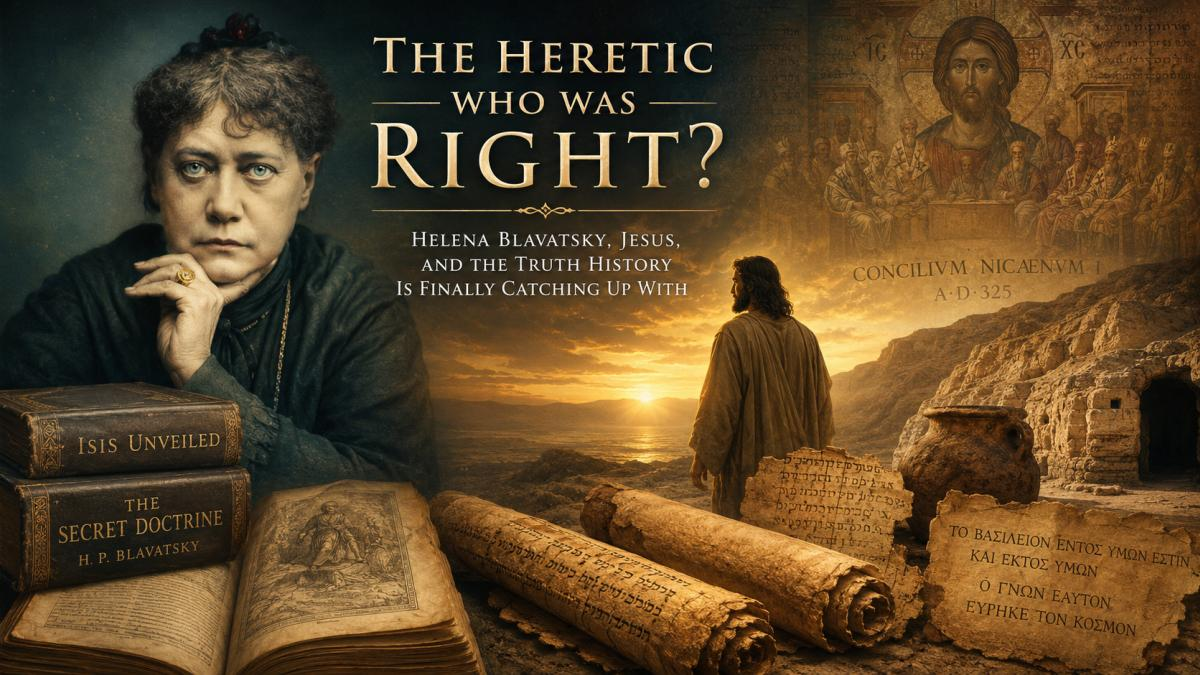
In the late nineteenth century, a Russian-born mystic managed to unite Catholic clergy, Anglican bishops, and American revival preachers in a single shared conviction: that her writing on Jesus was dangerous. Helena Petrovna Blavatsky did not deny Christ. Denial would have been unremarkable in an age of confident materialism. What she did was stranger...
In the late nineteenth century, a Russian-born mystic managed to unite Catholic clergy, Anglican bishops, and American revival preachers in a single shared conviction: that her writing on Jesus was dangerous. Helena Petrovna Blavatsky did not deny Christ. Denial would have been unremarkable in an age of confident materialism. What she did was stranger and, to the institutions of her day, far more threatening. She argued that the Christ worshipped in the churches was a fourth-century political construction, and that the Christ the Gospels actually point to belongs to a spiritual lineage older and wider than Christianity itself.
She was ridiculed in the religious press, denounced from pulpits on both sides of the Atlantic, and dismissed as a charlatan for decades after her death in 1891. Then, over the course of the twentieth century, two archaeological discoveries and a generation of academic historians began confirming a surprising amount of the picture she had painted. Not all of it. But enough that the story deserves a careful retelling.
What follows is a walk through the three core claims that made her a heretic, and an honest look at how each has fared against modern scholarship. On this blog we practise discernment even with material we love, so where Blavatsky has been vindicated, we will say so, and where her claims remain esoteric rather than proven, we will say that too.
Blavatsky was born in 1831 into the Russian aristocracy and raised inside the Orthodox Christian world. Scripture was her native territory long before comparative religion became her battlefield. This matters, because the popular caricature of her as an outsider attacking a faith she never understood gets the psychology backwards. Her quarrel was not with the Gospels. It was with what she saw as the institutional capture of a universal teaching.
Her two great works, Isis Unveiled in 1877 and The Secret Doctrine in 1888, laid out the charge in full: that an ancient wisdom tradition once flowed openly through Egypt, India, Persia, Greece, and Judea, that Jesus taught within that stream, and that the institutional Church of the fourth and fifth centuries narrowed his teaching into a doctrine of exclusive access with itself as gatekeeper.
Three specific claims carried the weight of her case.
Blavatsky’s first offence was philological. The Greek word Christos, she pointed out, is not a name. It means anointed. It is a title describing a spiritual condition, the same condition the Hebrew word Messiah gestures toward, and one she connected to the awakened states named in Egyptian, Greek, and Buddhist mystery traditions.
Her anchor text was the prologue of John’s Gospel, where the Logos, the divine Word, is described as the true light that enlightens every human being coming into the world. In the pre-Nicene centuries, the Logos was widely understood by educated Christian thinkers as a universal principle, the ordering intelligence of the cosmos. Origen of Alexandria, the towering Christian intellect of the third century, taught in works like On First Principles that the Word of God was active in the prophets long before the incarnation and works within every soul that turns toward the divine. Jesus, on this reading, was the supreme embodiment of the Christic condition, not its sole possible instance.
Blavatsky argued that the narrowing of this universal Christos into one exclusive historical individual was a political act. If the Logos lights every soul directly, no priesthood is structurally necessary. If the Logos is one man, and one institution holds the keys to that man, the institution becomes indispensable.
How has this claim aged? Remarkably well. The 1945 discovery of the Nag Hammadi library in Egypt recovered a whole world of early Christian voices for whom the living Christ was an inner reality to be realised, not merely a historical figure to be believed in. The Gospel of Thomas, the most famous of those recovered texts, presents a Jesus who tells his students that the kingdom is inside them and outside them, and that whoever drinks from his mouth will become as he is. When Elaine Pagels published The Gnostic Gospels in 1979, she made the academic case that early Christianity was diverse and multi-vocal, and that the victory of the exclusivist reading was inseparable from the politics of institutional authority. Pagels won the National Book Award for saying, with footnotes, much of what Blavatsky had been mocked for saying a century earlier.
Blavatsky’s second claim was historical. Jesus, she insisted, did not appear out of nothing. He emerged from an existing Jewish mystical current, and she pointed specifically at the Essenes, the ascetic desert community near the Dead Sea that practised ritual immersion, communal meals, shared property, and inner purification while awaiting a messianic teacher.
In her lifetime this was close to unsayable. Mainstream theology held that Christianity arrived complete, by revelation, owing nothing to any prior school. Suggesting that Jesus had been shaped by an existing tradition was treated as an assault on the uniqueness of the incarnation.
Then, in 1947, a Bedouin shepherd near Qumran stumbled on the caves that held the Dead Sea Scrolls. The library of a Jewish sectarian community, widely identified with the Essenes, came out of the ground: community rules, hymns, commentaries, and the expectation of a Teacher of Righteousness. The parallels with the world of John the Baptist and the earliest Jesus movement, from immersion rituals to communal meals to the very geography of the Judean desert, became a permanent feature of New Testament scholarship. Anyone can now examine the manuscripts themselves in the Leon Levy Dead Sea Scrolls Digital Library, where the Israel Antiquities Authority has placed thousands of high-resolution fragment images online, free, for the whole world.
Two honest notes belong here. First, the long delay in publishing the scrolls was real and scandalous, but it was the work of a small, closed scholarly editorial team that held a publication monopoly for decades until academic pressure broke it open in 1991. The popular version in which the Vatican suppressed the scrolls is a conspiracy theory the evidence does not support, and repeating it only cheapens the genuinely remarkable story. Second, mainstream scholarship affirms the milieu, not the membership. That Jesus and John the Baptist moved in a world saturated with Essene-adjacent practice is broadly accepted. That Jesus was a trained initiate of the order remains Blavatsky’s esoteric reading. The scrolls did not prove her right on that point. What they did was demolish the claim that there was no prior tradition for him to inherit, which was the position her critics were actually defending in 1888.
The third claim was the most explosive. Blavatsky taught that the pre-existence of the soul, and its long journey through many lives back toward its source, had been a living current within early Christianity, and that the institutional Church deliberately severed it.
Her chief witness was, again, Origen. In On First Principles he taught openly that souls exist before their bodies and that the diversity of human circumstances reflects the prior history of each soul, all within a vast arc of return to God. For roughly three centuries after his death he remained one of the most honoured names in Christian theology.
Then came the sixth century. Under the emperor Justinian, a series of fifteen anathemas was drawn up against Origenist teaching, the first of which condemns anyone who asserts the fabulous pre-existence of souls and the monstrous restoration that follows from it. You can read the full text of the anathemas in the standard translation of the conciliar documents. Modern scholarship, it should be said, has complicated the courtroom drama: careful recent work suggests the fifteen anathemas were probably drawn up alongside, rather than formally enacted by, the Second Council of Constantinople in 553, whose official acts targeted a different controversy. But the council’s own eleventh anathema names Origen personally among the condemned heretics, and the practical outcome is not in dispute. After the sixth century, no theologian inside the imperial Church could teach the pre-existence of the soul and remain orthodox. A doorway that Origen had held open was walled shut, and the emperor’s fingerprints are all over the masonry.
Blavatsky went further, pointing to passages in the Gospels themselves where the question of previous lives seems to hover in the air: the identification of John the Baptist with the returning Elijah, and the disciples asking whether a man was born blind because of his own sin, a question that only makes grammatical sense if sinning before birth was thinkable to the people asking it. Orthodox exegesis has answers for both passages. But the fact that the questions could be asked at all tells us something about the openness of the first-century imagination, and the Justinianic condemnation tells us something about how deliberately that openness was closed.
Take the three claims together and the pattern comes into focus. A universal Christos makes the priesthood optional. A Jesus rooted in an older tradition breaks any single institution’s ownership of his teaching. A soul that journeys through many lives dissolves the terror of a single-lifetime verdict, and with it the most powerful lever of medieval religious control.
Blavatsky understood exactly which load-bearing walls she was striking, and the institutions of her day understood it too, which is why the response was not debate but denunciation. She died in 1891 with her reputation in ruins. The Nag Hammadi codices surfaced in 1945. The scrolls surfaced in 1947. Pagels published in 1979, and the scholarly generation that followed, from Bart Ehrman to Karen King, established beyond argument that the earliest Christianity was plural, mystical in significant currents, and only later flattened into a single authorised shape.
Not every claim in The Secret Doctrine will survive that kind of scrutiny, and this blog is not in the business of pretending otherwise. But on the three charges that made her the most dangerous religious writer of her century, the direction of a hundred years of evidence has been consistently, sometimes eerily, in her favour.
What does any of this mean for a seeker now? Perhaps this. If the earliest layers of the tradition really did hold that the light which became flesh in Galilee is the same light that enlightens every human being entering the world, then the figure of Jesus stops functioning as a wall and starts functioning as a door. The mystery schools always insisted that their teachings were not information but invitation. On that reading, the Christos is not a foreign deity to be accessed through intermediaries. It is the deepest pattern of consciousness itself, waking up to what it is.
Blavatsky was condemned for saying so. The condemning institutions have spent a century quietly conceding the historical ground beneath her, one peer-reviewed article at a time. If you want to weigh her case in her own words rather than anyone’s summary, the complete text of Isis Unveiled is freely available online, and it remains one of the strangest and most audacious works of comparative spiritual scholarship ever attempted.
The veil, as ever, continues to lift.