Physical Address
304 North Cardinal St.
Dorchester Center, MA 02124
Physical Address
304 North Cardinal St.
Dorchester Center, MA 02124

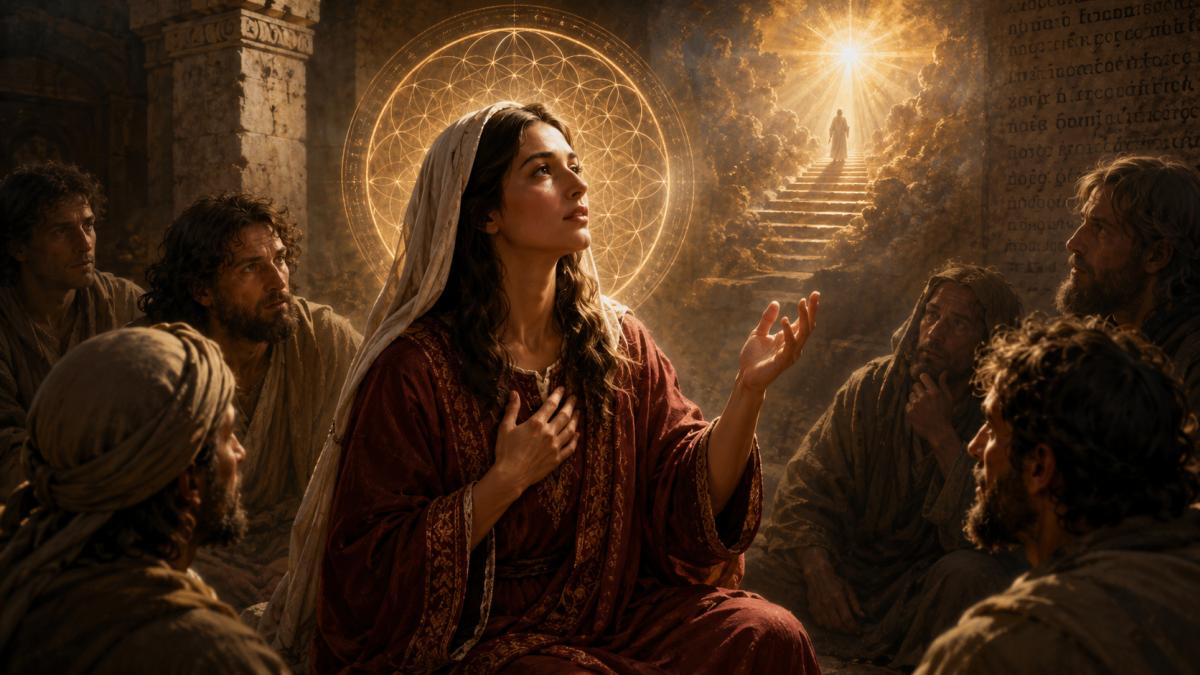
Most people carry a version of Mary Magdalene assembled for them by two thousand years of institutional curation: the forgiven sinner, the loyal mourner, the first witness at the empty tomb. It is a moving portrait. It is also a fraction of the story.
Most people carry a version of Mary Magdalene assembled for them by two thousand years of institutional curation: the forgiven sinner, the loyal mourner, the first witness at the empty tomb. It is a moving portrait. It is also a fraction of the story.
In the texts that were pushed out of the canon, condemned by the early church fathers, and in some cases buried in the Egyptian desert to survive at all, a very different Mary appears. She is the disciple who understood when the others did not. She is the one who receives teaching through interior vision rather than public instruction. And the mode of divine contact associated with her in these texts inverts almost everything most of us were raised to believe about how a human being reaches the divine.
This article walks through what those texts actually say, why the teaching was considered dangerous enough to suppress, and what the reorientation at its heart looks like in practice.
The place to begin is the Gospel of Mary, a second-century text surviving mainly in a Coptic manuscript known as the Berlin Codex. In it, Mary is not weeping in the background. When the male disciples collapse into fear after the crucifixion, terrified that what was done to their teacher will be done to them, it is Mary who stands up, steadies them, and turns their hearts back toward what the text calls the Good. She then relates a private vision in which the Saviour taught her about the soul’s ascent past the powers that hold it in bondage.
The reaction of the other disciples is the most revealing part. Andrew and Peter bristle, not because they can refute her, but because her teaching came through interior knowing rather than external authority. Levi has to step in and remind Peter that if the Saviour found her worthy, dismissing her says more about Peter than about Mary. Scholars such as Karen King have argued that the Gospel of Mary directly confronts the rejection of esoteric revelation and of women’s authority to teach, portraying Mary’s superiority as grounded in vision and private revelation. The argument inside the text mirrors the argument that was raging outside it, in the second-century communities fighting over what Christianity would become.
The Pistis Sophia, a Coptic Gnostic work that surfaced in the eighteenth century, goes even further. In its long post-resurrection dialogues, Mary is the dominant questioner by an enormous margin. A recent study in the Journal of Theological Studies counts 67 of the text’s 115 questions coming from Mary alone, with Peter a distant second at seven, and notes that the text calls her blessed among all women on earth. At one point she steps forward, asks permission to keep questioning “with precision,” and Jesus responds by inviting her to ask openly, praising the quality of her understanding. Whatever else these texts are, they are not ambiguous about who grasped the teaching most completely.
To understand why Mary’s way of knowing mattered so much, you need the concept at the very top of the Gnostic map: the Monad.
The Apocryphon of John, one of the most important texts recovered at Nag Hammadi, opens its cosmology by describing the Monad as a sovereignty with nothing above it, the Father of everything, dwelling in pure light that no eye can look into. The text then spends paragraph after paragraph explaining what the Monad is not: not a god among gods, not measurable, not lacking anything, not contained by anything, because everything is contained in it.
That last clause is the hinge. The Monad is not a being located somewhere else that you send messages to. It is the ground of being itself, the source from which every world and every consciousness emanates, including the one reading this sentence. Readers familiar with the Law of One will recognise the shape immediately: one infinite Creator, of which every apparent individual is a distortion and an expression. The vocabulary differs; the geometry is the same.
Now put those two pieces together, Mary as the exemplar of interior knowing and the Monad as the all-containing Source, and a striking picture of practice emerges.
Conventional petitionary prayer has a built-in assumption: there is a small self here and a great God there, and the practice consists of sending requests across the gap. The difficulty is that every repetition of the request quietly re-affirms the gap. You cannot ask something to come closer without implying that it is far away.
The Gnostic material points at a different move entirely. Instead of reaching across a distance, the practitioner turns attention back toward its own source and recognises that the thing being sought was never absent. The most vivid expression of this comes from the Trimorphic Protennoia, a Nag Hammadi text in which the divine First Thought speaks in her own voice: she dwells in the All, she moves in every creature, she awakens those who sleep, and she declares herself the very movement within all things. The divine feminine in this text is not receiving prayers from creation. She is speaking as the awareness already alive inside creation.
Picture a wave that has spent its whole existence sending requests down to the ocean, asking to be given water. The request is not wicked; it is simply confused about what the wave is made of. The moment the wave notices its own substance, the asking becomes unnecessary. Nothing new arrives. Something obvious stops being overlooked.
If that dynamic sounds familiar, it should. It is the same pattern explored in why so many seekers feel blocked from their spirit guides: the reflex of waiting for an external rescue is often the very thing muffling the contact that is already present. The Gnostic texts simply take that insight to its deepest level. It is not only your guides you have been outsourcing. It is your own divine ground.
The obvious objection deserves a direct answer. Recognising identity with the Source sounds like the fast lane to inflation, the “I am God, therefore my behaviour needs no examination” trap that has wrecked more than a few teachers and communities.
The Gnostic framework anticipates this, because it distinguishes sharply between two selves. The constructed personality, stitched together from material identification, fear, and habit, is precisely what these texts treat as the counterfeit, the puppet of the lower powers they call archons. Recognition of the Monad is not that self promoting itself. It is the dissolving of that self’s claim to be the whole story, so that the deeper awareness underneath it can be noticed. The small self making grand claims is inflation. The small self being seen through is the opposite of inflation.
This is also why recognition without maturation goes wrong. A glimpse of the ground does not automatically produce a developed human being, which is exactly the problem examined in why waking up is not enough and the growth stages almost everyone skips. A person can touch genuine unity and still need years of honest shadow work and psychological growing up. The Gnostics would not have been surprised; they considered the deceptions of the false self subtle enough to survive almost any revelation.
None of this stayed theoretical for the early communities that taught it. Around 180 CE, Irenaeus, bishop of Lyon, wrote his massive treatise Against Heresies, a detailed demolition of the Valentinian schools and related movements. Read it carefully and the strategic problem becomes visible: a Christianity in which divine access is interior and direct has no structural need for a mediating hierarchy. A teaching like that is not merely inconvenient from an institutional point of view. It dissolves the institution’s central function.
The pressure did not let up. In 367 CE, Athanasius of Alexandria issued his famous 39th Festal Letter, the first document to list exactly the twenty-seven New Testament books used today, while condemning the apocryphal writings circulating alongside them as the invention of heretics. Sometime in that same century, someone near the Egyptian town of Nag Hammadi sealed thirteen codices of these unauthorised texts inside an earthenware jar and buried them at the base of a cliff, where they remained until a local farmer digging for fertiliser struck the jar in December 1945. Many scholars connect the burial to the climate that Athanasius’s letter created, though the debate about who buried the codices and why continues. What is not debated is that somebody considered these texts worth preserving at real risk, and that the tradition of Mary the teacher, the Monad, and interior gnosis was a substantial part of what went into that jar.
When a body of teaching is attacked for centuries not for being trivial but for being dangerous, that tells you something about its potency. It is the same lesson that surfaces when separating authentic mystery traditions from their imitations: any path whose core instruction is to connect directly with the Source, without a middleman, will always sit uneasily beside institutions whose existence depends on being the middleman.
Stripped down to its essence, the practice these texts point toward is almost embarrassingly simple, which may be why it is so easy to miss.
Sit quietly. Notice the habitual posture of spiritual effort: attention leaning outward or upward, waiting for something to answer. Then, instead of asking anything, place a different question underneath your attention: not “what am I aware of?” but “what is it that is aware?” Do not answer with a concept. Let the question turn attention back toward its own source, and rest there.
Most people notice that nothing dramatic happens, and that the quality of the stillness changes anyway. The sense of reaching subsides, and what remains is not an answer arriving from somewhere else but a ground that was underneath the reaching all along. In the framework of these texts, that ground is not your imagination and not your ego. It is the light the Apocryphon of John says no eye can look into, noticed from the only vantage point that was ever possible: the inside.
Mary, in the Gnostic telling, was not honoured because she asked the best favours of heaven. She was honoured because she understood what she was looking at, and what was looking. Two thousand years of curation could not quite bury that. The jar came out of the ground. The recognition is still available, no institution required.