Physical Address
304 North Cardinal St.
Dorchester Center, MA 02124
Physical Address
304 North Cardinal St.
Dorchester Center, MA 02124

There's a war being waged on your front lawn, and you're paying for both sides.
Right now, you probably have a plant growing in your yard that contains more protein than spinach, produces unlimited free fertilizer, and can regulate blood sugar better than diabetes medications. You're also probably spending money to kill it.
If that sounds insane, that's because it is. But it gets worse: in 70% of American suburbs, allowing this plant to bloom can get you fined by your homeowner's association. Welcome to the greatest con job in modern agriculture.
There’s a war being waged on your front lawn, and you’re paying for both sides.
Right now, you probably have a plant growing in your yard that contains more protein than spinach, produces unlimited free fertilizer, and can regulate blood sugar better than diabetes medications. You’re also probably spending money to kill it.
If that sounds insane, that’s because it is. But it gets worse: in 70% of American suburbs, allowing this plant to bloom can get you fined by your homeowner’s association. Welcome to the greatest con job in modern agriculture.
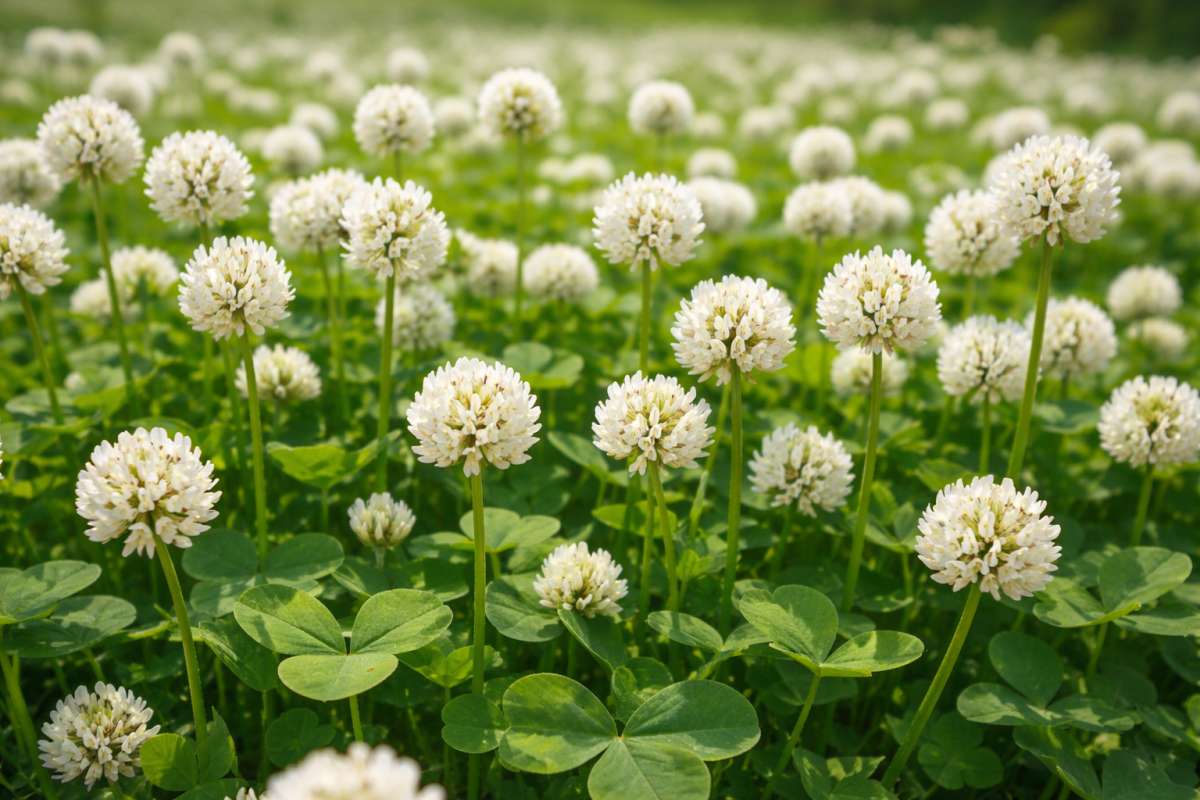
White clover (Trifolium repens) kept European populations alive through centuries of crop failures. When grain harvests collapsed and people faced starvation, they turned to clover. It grows everywhere, requires zero cultivation, and produces edible parts from early spring through late fall.
For two thousand years, white clover was free medicine that required no prescription and no permission. Native American tribes brewed it for fevers. The Iroquois used it for respiratory infections. European herbalists documented dozens of medicinal applications.
Before 1950, every single bag of lawn seed sold in America contained white clover. Gardening guides recommended it. Farmers planted it deliberately. It wasn’t a weed. It was essential infrastructure for a healthy lawn and a functioning ecosystem.
Then the chemical companies needed a new market.
Here’s what they don’t tell you in the fertilizer aisle: the herbicide you’re spraying on your lawn was originally designed as a weapon of mass starvation.
During World War II, chemical manufacturers developed 2,4-D as part of a secret biological weapons program. The plan was simple and horrific: spray it over enemy territory to destroy potato and rice fields, starving entire populations into submission.
When the war ended in 1945, these companies had warehouses full of chemical weapons and no one to use them on. Six months later, the American Chemical Paint Company launched “Weedone,” marketing it as the world’s first consumer herbicide.
The product needed a target. White clover became that target, not because it was harmful, but because 2,4-D kills broadleaf plants while leaving grass unharmed. The chemistry decided the victim.
The OM Scott and Sons Company faced an interesting problem in the 1950s. They had been selling seed mixes with clover since 1868, recommending it as essential for healthy lawns. Now they were also selling herbicides designed to kill it.
The solution was propaganda masquerading as marketing.
Advertisements began depicting pure grass monocultures as the new standard of beauty. Clover, which had kept lawns green and nitrogen-rich for generations, was suddenly rebranded as “ugly” and a sign of poor maintenance. The same plant they had sold as beneficial for 80 years became, overnight, a social embarrassment.
It worked because it exploited postwar suburban psychology. A manicured, chemically-dependent, clover-free lawn became a status symbol. It signaled that you could afford to waste land on non-productive aesthetics, that you were willing to spend money to conform.
You weren’t buying lawn care. You were buying class identity.
While marketing departments were busy demonizing clover, researchers were discovering something inconvenient: the ancient wisdom was right.
A 2018 study found that white clover extract controls blood sugar spikes better than the pharmaceutical drug acarbose. Not slightly better. Twice as effective. Its IC50 value of 25 micrograms per milliliter compared to acarbose’s 50 micrograms means this “weed” outperforms the medical standard.
A 2015 study showed white clover extracts stopped human leukemia cells from growing in laboratory tests. These aren’t folk remedies. These are peer-reviewed findings published in scientific journals that you’ll never see mentioned in a Scotts commercial.
Nutritionally, white clover is a complete protein source packed with vitamins A, B, C, and E, plus magnesium, potassium, and calcium. The leaves work in salads. The dried flowers and seed pods can be ground into high-protein, gluten-free flour.
You’re poisoning a superfood to grow decorative grass.
White clover is a nitrogen-fixing legume. It pulls nitrogen from the atmosphere and deposits up to 150 pounds per acre annually into the soil. That’s roughly $90 per acre in free fertilizer that regenerates itself every year.
When you kill the clover, you have to buy synthetic nitrogen instead. This creates a $120 billion annual lawn care market built on eliminating the plant that would make that market unnecessary.
The ecological cost is even more staggering. White clover is a critical nectar source for bees. Since the 1950s herbicide campaign began, managed honeybee colonies in the United States have collapsed from 5 million to 2.5 million. That’s a 46% die-off directly correlated with the war on clover.
A lawn with just 20% clover coverage requires zero nitrogen fertilizer and uses 30% less water. Clover stays green through droughts because its roots go deeper than grass. You’re paying to kill the exact plant that would save you money and water while supporting pollinators.
White clover isn’t federally illegal, but 70% of new suburban developments have homeowner association covenants that explicitly ban it. These aren’t suggestions. They’re legally binding contracts with fine structures attached.
Your neighbors are often encouraged to report violations. The same people who’ll smile and wave at you will photograph your lawn and submit evidence to the HOA if they spot clover blooms. This isn’t community. This is enforced conformity to corporate preferences.
You signed away your right to grow free food and medicine so your neighborhood could maintain “property values” based on a marketing campaign from the 1950s.
Companies like Scotts are now selling clover seed again, marketing it as a “sustainable alternative” and “eco-friendly choice.” They’re charging you for the same plant they convinced your grandparents to poison, the same plant they removed from seed mixes 70 years ago to create dependence on their chemicals.
The programming runs so deep that most lawn care services still automatically spray to eliminate clover, and most homeowners still believe it’s a weed that degrades their property.
When you see white clover in your lawn, you’re not looking at neglect or invasion. You’re looking at a survival crop that kept populations alive through famines. You’re looking at a complete protein source that outperforms pharmaceutical drugs. You’re looking at a natural fertilizer factory and pollinator support system.
You’re looking at something that was systematically criminalized to protect chemical company profit margins.
The transition of white clover from cherished resource to fined nuisance is like burning a library because someone convinced you the books made the shelves look cluttered, then selling you expensive substitutes for the knowledge you destroyed.
The books contained instructions for your own survival. You paid to burn them. And now you’re paying again to buy back inferior replacements.
The question is: are you going to keep paying?