Physical Address
304 North Cardinal St.
Dorchester Center, MA 02124
Physical Address
304 North Cardinal St.
Dorchester Center, MA 02124

Most of us have experienced moments where a small comment from a colleague ruins our entire day, or where an old memory surfaces and pulls us into a spiral of anger or grief that feels completely out of proportion. Eckhart Tolle would say that in those moments, something ancient and hungry has woken up inside you. He calls it the pain body.
Most of us have experienced moments where a small comment from a colleague ruins our entire day, or where an old memory surfaces and pulls us into a spiral of anger or grief that feels completely out of proportion. Eckhart Tolle would say that in those moments, something ancient and hungry has woken up inside you. He calls it the pain body.
The pain body is not a metaphor. Tolle describes it as an accumulation of old emotional pain that lives in the body as a semi-autonomous energy field. It is made up of every hurt, trauma, disappointment, and suppressed feeling that was never fully processed. And here is the unsettling part: it wants to survive. Like any living entity, it feeds. It perpetuates itself by pulling more pain into your experience, hijacking your thoughts, and using your life situations as its food source.
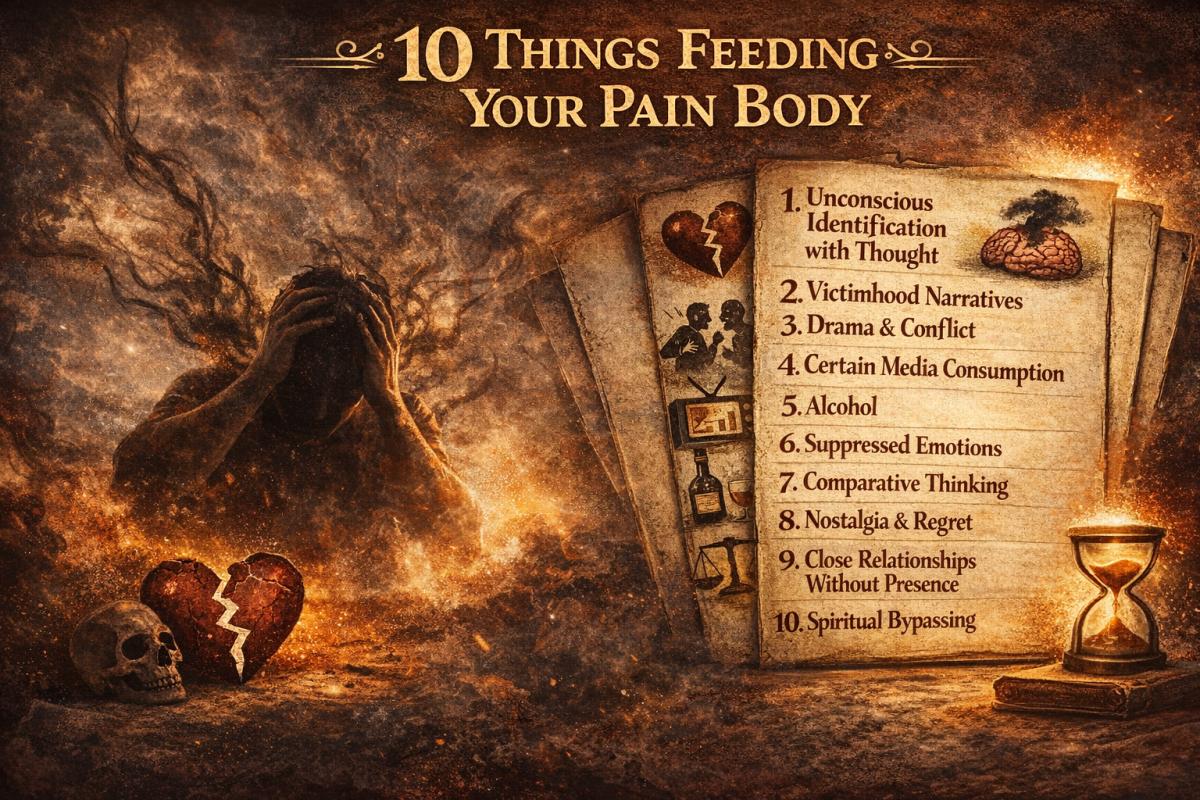
Understanding what feeds the pain body is the first step toward withdrawing your energy from it. Below are ten of the most common ways the pain body gets its power, and why becoming aware of them is such a radical act of self-liberation.
The pain body’s single most reliable food source is the unexamined mind. When you believe every thought that arises, especially the dark, repetitive, self-critical or other-condemning ones, you hand the pain body a direct pipeline to your energy.
Tolle teaches that most people are not aware that they are thinking. They are simply lost inside the thought stream, mistaking it for reality. The pain body exploits this completely. It generates thoughts that justify its existence: “I am unloved,” “nothing ever works out for me,” “they are always doing this.” These thoughts feel true because the pain body is feeling them from the inside. But they are the pain body’s story, not the truth of the present moment.
The practice here is not to fight thoughts but to notice them. The witness that can observe a thought is already free of it.
There is a particular kind of mental content the pain body finds irresistible: the story of being wronged. Replaying past injustices, rehearsing arguments in your head, cataloguing everything someone did or failed to do, these are not efforts to understand or heal. They are the pain body feeding.
This does not mean your grievances are not real or that harm done to you did not happen. It means that the chronic, looping rehearsal of those events long after they have passed serves only one function: to keep the wound open and the pain body fed.
Genuine healing moves through acknowledgement and then release. The pain body prefers to orbit the wound indefinitely.
The pain body does not just feed passively. It actively creates situations designed to generate more emotional pain. It will provoke arguments, misread intentions, escalate minor friction, and interpret neutral events as personal attacks, because conflict is rich feeding ground.
You may notice a pattern in yourself or others where certain people seem to attract chaos wherever they go. Relationships repeatedly implode. Every workplace becomes a battlefield. This is not bad luck. It is often the pain body engineering situations that match its emotional diet.
When you catch yourself being pulled toward unnecessary conflict, drama, or the urge to make someone else feel wrong, it is worth pausing to ask: who is hungry right now?
The modern information environment is extraordinarily well-suited to feeding pain bodies at scale. Outrage-optimised news cycles, social media engineered for emotional provocation, true crime content, conflict-driven reality television, and doomscrolling are all, from a pain body perspective, banquets.
This does not mean you should disengage from the world or ignore injustice. But there is a difference between staying informed and marinating in stimulated fear, anger, and helplessness. The pain body cannot distinguish between a real threat and a curated digital one. It simply feeds.
Auditing your media diet is not a luxury. For anyone on a serious path of awakening, it is essential.
Tolle is fairly direct on this point. Alcohol, in particular, lowers the threshold of presence and allows the pain body to surface and take control with far less resistance than usual. The temporary numbing that alcohol provides does not dissolve emotional pain. It simply removes the conscious observer that was keeping the pain body in check.
This is why some people become dramatically different under the influence: angry, weepy, aggressive, or maudlin in ways that seem disproportionate. The pain body has taken the wheel.
This is not a moral argument against alcohol. It is simply an observation about mechanism. If you are carrying a heavy pain body, substances that erode presence will consistently amplify it.
The pain body is built from emotions that were never fully felt. Grief that was shut down too quickly. Anger that was deemed unacceptable and buried. Fear that was pushed away before it could move through the body.
What you resist does not disappear. It densifies. Suppressed emotion compresses into the pain body and adds to its mass and charge. The irony is that the very attempt to avoid painful feelings is what gives the pain body its power.
The path through is not performance of emotion but genuine willingness to feel what is present, to let it move through the body without acting it out or narrating it into a story. This is subtle and often requires practice or support, but it is the only real way to metabolise what the pain body is made of.
[Also See: Eckhart Tolle on Why You Should Not Worry About Archons and Evil in This World]
The mind’s habit of measuring and ranking, whether you come out ahead or behind, is a constant source of pain body nourishment. Envy and contempt are two expressions of the same comparative movement. Both keep the self-concept active, effortful, and anxious.
Envy says: they have what I should have. Contempt says: I am better than that. Both are the ego struggling to establish and defend itself. And wherever the ego is straining, the pain body is feeding.
This does not mean you should not aspire or discern. It means noticing when comparison is not orienting you toward growth but is simply generating suffering, and recognising that as pain body activity.
The pain body has a special relationship with the past. Not the past as a source of genuine memory and learning, but the past as a place to live. Chronic nostalgia, persistent regret, and the inability to stop replaying what went wrong are all forms of pain body nourishment.
Tolle’s core teaching is that life only ever happens now. The pain body, by contrast, is almost entirely located in the past. It keeps pulling awareness back there because that is where its content is stored. Every time you mentally re-enter a painful chapter and re-experience it emotionally, you are, in effect, feeding the archive.
The practice is not to deny history but to notice when the movement into the past is involuntary and emotionally charged, and to return, gently and repeatedly, to the present moment.
Intimate relationships offer the deepest opportunities for awakening and, simultaneously, some of the most reliable pain body feeding loops available. Partners can trigger each other’s pain bodies into a kind of mutual escalation, where each person’s emotional reactivity amplifies the other’s until neither is operating from their actual self.
Tolle describes this as pain body resonance. One person’s pain body activates, the other’s responds, and suddenly an argument about dishes has tapped into decades of accumulated hurt on both sides.
The shift here is not to avoid intimacy or to find a partner with no pain body (they do not exist). It is to bring presence into relationship, to recognise when you have been triggered and to pause before the pain body gets to speak on your behalf.
Perhaps the most subtle item on this list, because it wears the costume of the solution. The pain body and ego are entirely capable of colonising spiritual seeking. They can use concepts like awakening, consciousness, and non-duality as new material for identity, superiority, and separation.
“I am more evolved than people who are still unconscious.” This thought feels spiritual. It is not. It is the pain body using spiritual language to generate the same old sense of self that feels elevated by comparison to others.
Real awakening is not a concept you hold. It is a shift in the locus of identity from thought and story to presence itself. Any spiritual framework that is used primarily to feel better about yourself without genuine transformation in the quality of your presence is still feeding the pain body, just with more sophisticated content.
Across all ten of these, the pattern is the same: anything that pulls you out of the present moment, into unconscious identification, into story, into resistance, or into reactivity, feeds the pain body.
The antidote is not more effort or self-improvement in the conventional sense. It is presence. The simple, alert, spacious awareness that watches thoughts without becoming them, feels emotions without being consumed by them, and meets each moment as it is rather than as the pain body would have it be.
That awareness is already in you. It has never been absent. It is what you are beneath the noise.
Recognising what feeds the pain body is not an invitation to self-judgment when you catch yourself doing these things. It is an invitation to notice, to become the watcher, and in that noticing, to find the gap where freedom lives.