Physical Address
304 North Cardinal St.
Dorchester Center, MA 02124
Physical Address
304 North Cardinal St.
Dorchester Center, MA 02124

The first piece in this series looked at the ethical concerns traditional spiritual frameworks raise about eating sprouts. The Jain position, the Law of One perspective, the stavara jivas teaching, all of these treat the seed and its sprouting as a continuous arc of plant consciousness that we interrupt when we eat. The question that lingers after reading those traditions is whether the model they assume is actually correct. Are sprouts really beings with souls already attached, or is something more interesting happening?
The first piece in this series looked at the ethical concerns traditional spiritual frameworks raise about eating sprouts. The Jain position, the Law of One perspective, the stavara jivas teaching, all of these treat the seed and its sprouting as a continuous arc of plant consciousness that we interrupt when we eat. The question that lingers after reading those traditions is whether the model they assume is actually correct. Are sprouts really beings with souls already attached, or is something more interesting happening?
A different model emerges when you look at what hypnotic past life regression therapy has documented over the last fifty years. The picture that comes through repeatedly, across thousands of independent subjects working with practitioners who never coordinated their findings, is that souls do not enter incarnating bodies on a fixed schedule. There is a window. And the window has interesting implications when you transpose it down into plant consciousness.
The most systematic body of work on this question comes from clinical hypnotherapist Michael Newton, whose subjects under deep regression describe the period between lives in remarkable detail. Newton documented thousands of cases over decades, and one of the most consistent findings is that the timing of soul entry into a new incarnation varies dramatically from case to case. Some souls report attaching at conception, fully present from the moment of cellular merge. Others describe hovering around the developing pregnancy, dropping in and out, getting acquainted with the form without fully committing. A significant subset only enter at or near birth, with some describing the first breath as their actual threshold of full embodiment. If this territory is new to you, our earlier piece on Michael Newton‘s between life research covers the foundations in more depth.
Dolores Cannon’s work using her Quantum Healing Hypnosis Technique produced the same spread across an entirely separate body of cases. Her QHHT methodology and case archive describes subjects reporting entry timings that range from early pregnancy through to birth itself, with no apparent rule governing which timing applies to which soul. Brian Weiss, working from a more conventional clinical psychiatric background, reported similar findings in his own regression sessions with patients at Mount Sinai Medical Center, summarised across his books and his ongoing Weiss Institute practice.
What is striking about these three bodies of work is that they were developed independently, by practitioners using different methods, working with different populations, in different decades, and yet they converge on the same picture. There is a window for ensoulment, not a moment. Different souls make different choices within that window. The choice itself appears to reflect something about the soul’s character and circumstances rather than following any universal protocol.
It helps to think of this as a spectrum rather than treating the variation as noise in the data. Some souls are early comers. They bond with the incoming form quickly, often at conception or shortly after, and they ride the entire developmental arc from the inside. Others are late comers. They observe from outside the form, sometimes for months, before finally settling in. Many fall somewhere between these poles, attaching gradually as the form develops, becoming more fully present as the body matures.
The reasons souls give for their timing choices are also varied. Some early comers report wanting to experience every stage of the physical development, including the sensory experience of fetal life. Some late comers report hesitation, ambivalence about the incarnation, or unfinished business in the between life state that delayed their full arrival. Some describe practical considerations, choosing entry points that aligned with particular planetary configurations or family dynamics. None of this maps onto a tidy doctrine, which is part of why the regression literature is interesting. It looks more like a population of individuals making choices than a system following rules.
If we take the regression literature seriously as evidence about how consciousness relates to physical form, there is no obvious reason this pattern would apply only to humans. Less individuated forms of awareness might actually have more flexible relationships with their vehicles, not stricter ones. The kind of soul that animates a plant is not making the same kind of commitment a human soul makes, and the window of entry should be expected to vary at least as much.
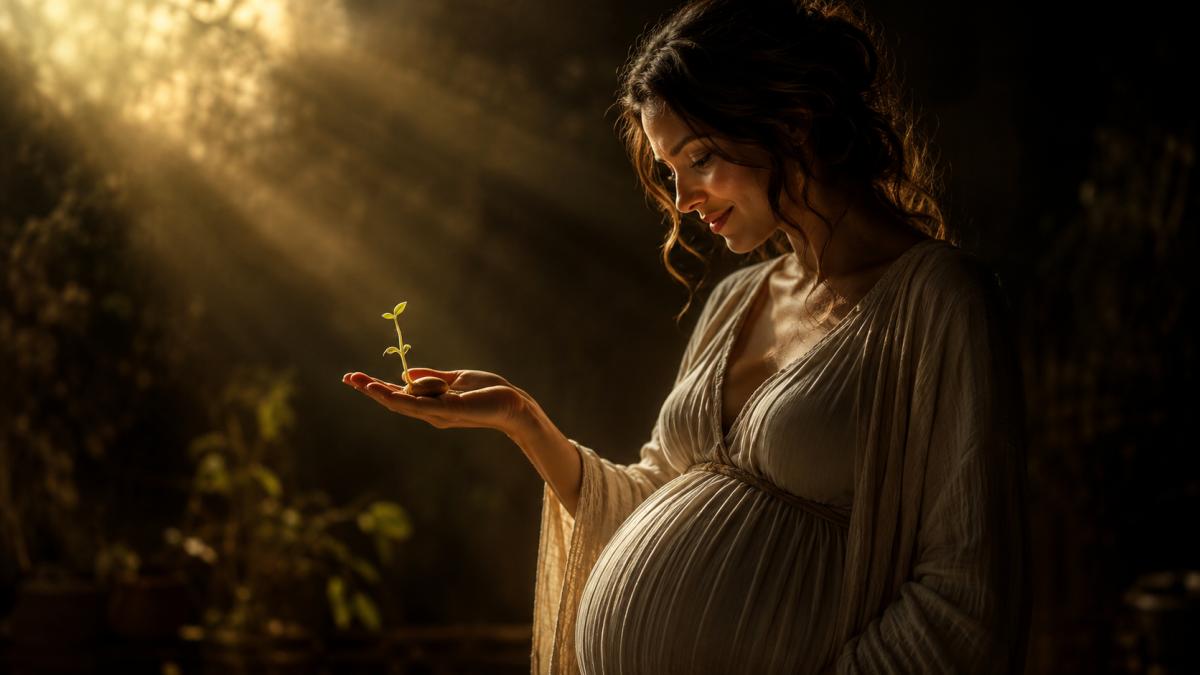
Apply this to a seed. The dormant seed in your jar is biological information storage, perfectly engineered, waiting. When you soak it and the seed coat cracks, biological activation begins. But the entry of consciousness into this newly active form is probably not a single event. It is likely a window stretching from the first absorption of water through to the establishment of the seedling as a functioning photosynthetic organism. Some plant souls would be early comers, present the moment the radicle begins to push outward. Others would be late comers, not fully grounded until the cotyledons open to light and the seedling begins to produce its own energy. Many would be somewhere in between, gradually associating with the form as it develops capacity.
This model has a parsimony the older frameworks lack. It does not require souls to be sitting in dormant biological storage for years or decades. It places the consciousness exactly where the energetic activity actually is, and it leaves room for the kind of variation that all observed consciousness phenomena seem to exhibit.
Here is where the ethics start to shift. If the window model is correct, then a tray of sprouts is not a uniform population of identically ensouled beings. It is a statistical mix. Some of those organisms have a soul fully present and active. Some host souls beginning to associate but not yet fully grounded. Some are still vessels awaiting their passenger, biologically alive but not yet ensouled.
You have no way of knowing from the outside which is which. This is structurally similar to the situation in human pregnancy, where you cannot tell from the outside whether a particular embryo has its soul firmly attached or whether the soul is still in the hovering phase. The uncertainty is intrinsic, not a failure of knowledge that better tools would resolve.
This reframes the entire ethical question. You are not making a binary choice between killing a being and not killing a being. You are entering a probabilistic relationship with a mixed population. Some of what you consume is fully ensouled life. Some is form without occupant. The act of eating becomes more like the act of harvesting a forest where not every tree has been claimed by a dryad, rather than the act of consuming a tray of identically conscious beings.
There is another layer the regression literature adds that changes the picture further. Newton, Cannon, and others have documented cases of souls who deliberately chose pregnancies they knew would not result in long lives. Some attached to pregnancies knowing in advance that miscarriage would occur. Some incarnated into infancies knowing the child would not survive past a few years. The brief experience served specific developmental purposes for those souls, and the shortness of the incarnation was a feature rather than a failure.
If this pattern extends to plant consciousness, some plant souls might deliberately incarnate into sprouts intended to be eaten. The brief experience of activation, the explosive cellular division, the encounter with light, the contact with human awareness through consumption, all of this might be the point of that particular incarnation. The soul knew on entry what the arc would be, and chose it anyway because the experience offered something specific that a longer plant life would not.
This is the section that connects most cleanly to the stavara jivas teaching from the first article. Plants offering themselves willingly may be exactly that, souls who chose forms designed to be consumed, with the consumption being part of the original agreement rather than a violation of it.
A name for this idea is worth coining, because once it exists as a named concept it becomes easier to think with. Call it the express incarnation hypothesis. Some forms exist specifically as brief, intense experiential vessels chosen by souls who want a particular flavour of activation without the long arc of becoming a fully mature plant. Sprouts are perhaps the clearest example. The form is by definition transient. The energy is by definition concentrated. The encounter with light, water, and eventual consumption is the entire purpose of the vessel.
This does not mean every sprout you eat is an express incarnation. The mixed population principle still applies. Some sprouts in your tray host souls who would have preferred to grow on if given the chance. Others host souls who chose precisely this form for precisely this purpose. You cannot distinguish them, but the existence of the second category changes the ethical weight of the meal.
The hypothesis is speculative, but it has the virtue of being internally consistent with both the regression literature and the traditional teaching that plants offer themselves to be consumed. It explains why the offering language exists in the first place across so many traditions. It accounts for the energetic intensity of sprouts without requiring that intensity to be tragic.
The practical takeaway is not avoidance. The model does not support a clean ethical prohibition on eating sprouts, and it does not even support strong unease about doing so. What it supports is recognition. When you eat a sprout, acknowledge that you are entering a relationship with a mixed population of beings, some of whom may have chosen this exact encounter as part of their journey.
Gratitude becomes the operative practice. Not generic gratitude for food, but specific gratitude that honours whichever souls in your tray made the choice to incarnate into a form that would meet you here. This is more interesting than the wellness industry’s reflexive consumption, and it is also more interesting than the Jain framework’s blanket prohibition. It treats the sprouts as participants in something, which is closer to how spiritual traditions generally describe plant life when they take it seriously at all.
Research on plant intelligence and communication continues to expand the picture of what plants actually are, and the more sophisticated the picture becomes, the more our food choices look like small acts of spiritual participation rather than purely material transactions. The window model and the express incarnation hypothesis are attempts to take that participation seriously without collapsing into either guilt or denial.
All of this is a framework rather than a confirmed truth. The regression literature is suggestive, not definitive. The transposition from human to plant consciousness involves assumptions that may not hold. The express incarnation hypothesis is original to this article and has not been tested against anything except its own internal coherence. You should hold these ideas the way you would hold any working model, useful for thinking with, available for revision when better information arrives.
The point of writing this is not to deliver doctrine. It is to offer an alternative to the two unsatisfying options that traditional discussions of plant ethics tend to leave you with, namely guilt about eating sprouts or unconscious consumption of them. The window model gives you a third option, which is conscious participation in a relationship with beings whose own choices and timings you cannot fully see. That is closer to how most spiritual practice actually works in any case. You proceed with awareness, you offer reverence, and you trust that the beings on the other side of the encounter are participating in their own way.
The sprout knows things you do not. The soul that may or may not be present in it knows things it does not. The meal itself is the meeting of all three of you, and your part is to show up to that meeting consciously.