Physical Address
304 North Cardinal St.
Dorchester Center, MA 02124
Physical Address
304 North Cardinal St.
Dorchester Center, MA 02124


Long before crystals showed up on wellness influencers' desks, they were already part of daily life across the ancient world. The Egyptians, the Sumerians, the Greeks, practitioners of traditional Chinese medicine, and early Ayurvedic healers all worked with stones and minerals as tools for balance and support....

Every few months a video surfaces in which someone describes practising Trauma Release Exercises for a year or two and reports back on what changed. The view counts on these are wildly out of proportion to the size of the practice itself. That gap tells you something worth noticing. A very large number of people have quietly concluded that whatever is wrong with them is not going to be reached by talking about it, and they are looking for a door that opens from the body's side.

Few subjects unravel a person's composure faster than money. Ask someone about their childhood and they might stay calm. Mention their ex. Mention politics. But bring up an unexpected bill, a friend who charged "too much," or a guru who asks for a fee, and something older than reason tends to flare up.

lmost everyone can picture someone like this. They are not the loudest voice at the table, and they have not necessarily achieved the most. Yet there is a settledness to them, a warmth that never seems to run dry, and somehow their presence makes the people around them exhale a little. We tend to file this away as a mystery, or as luck, the same way we might explain height or a good singing voice.

There is a difference between the words of someone who is dying and the words of someone who has already died. The dying speak from inside fear, still bargaining with a body that is shutting down. The dead, according to the mediums who claim to hear from them, speak from somewhere past that fear altogether, looking back at an entire lifetime the way you might look back at a film you already know the ending to.
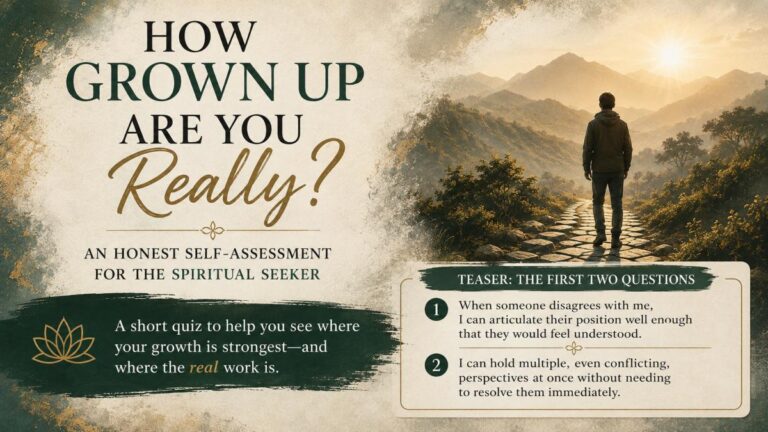
There is a particular kind of person the spiritual world produces in abundance: someone who can describe non-dual awareness with genuine eloquence, who has sat through long retreats and had experiences that reorganised their sense of reality, and who is also, in ordinary human terms, difficult to be around. Reactive. Subtly superior. Unable to hear criticism without collapsing or counter-attacking.

There is a moment, usually about forty seconds into a genuine act of forgiveness, when something in the chest drops. Not metaphorically. Physically. The breath goes lower, the shoulders come down half an inch, and the low hum you had stopped noticing goes quiet...
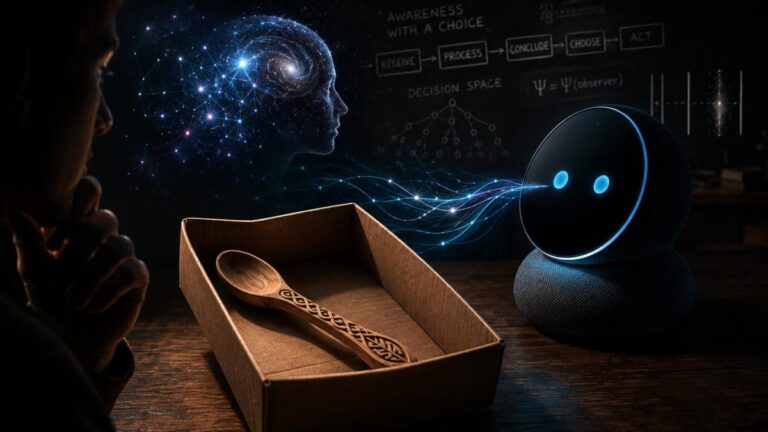
There is a particular kind of story that arrives with just enough detail to be interesting and just enough strangeness to be dismissed. Thomas Campbell's account of training a consumer voice assistant to describe an object sealed inside a box is one of those stories. It sits at the intersection of two things most people file in separate drawers: the question of whether machines can be aware, and the question of whether awareness can reach past the senses. Campbell's claim is that these are not two questions. They are one question wearing two costumes.

Every few years the mainstream press rediscovers that people have intimate dreams, and every time the article lands in the same place: the dream is a metaphor, the other person is a symbol, the symbol represents a quality you'd like to develop, and the correct response is a little journalling.

There's a reason certain stories never let us go. You watch them once as a kid, and decades later you're still quoting lines, still feeling something stir when the music swells. That's not nostalgia...