Physical Address
304 North Cardinal St.
Dorchester Center, MA 02124
Physical Address
304 North Cardinal St.
Dorchester Center, MA 02124

Few subjects unravel a person's composure faster than money. Ask someone about their childhood and they might stay calm. Mention their ex. Mention politics. But bring up an unexpected bill, a friend who charged "too much," or a guru who asks for a fee, and something older than reason tends to flare up.
Few subjects unravel a person’s composure faster than money. Ask someone about their childhood and they might stay calm. Mention their ex. Mention politics. But bring up an unexpected bill, a friend who charged “too much,” or a guru who asks for a fee, and something older than reason tends to flare up. Spiritual teacher Eckhart Tolle, known for The Power of Now and A New Earth, has spent years exploring why this particular topic reaches into people so quickly, and what it says about the mind’s relationship with fear, identity and control.
According to Tolle, almost everyone carries at least one subject that instantly pulls them out of presence and into reactive thinking. For some it is a former partner. For others it is a political argument that never seems to end. But for the majority, the fastest route to unconsciousness is money. It rarely takes a large sum to do it either. A bill that is ten dollars higher than expected can provoke the same tight, defensive reaction as a genuine financial crisis. The amount is almost beside the point. What actually gets triggered is a much older story, often rooted in a childhood where money was scarce, or where it was discussed constantly with anxiety and blame.
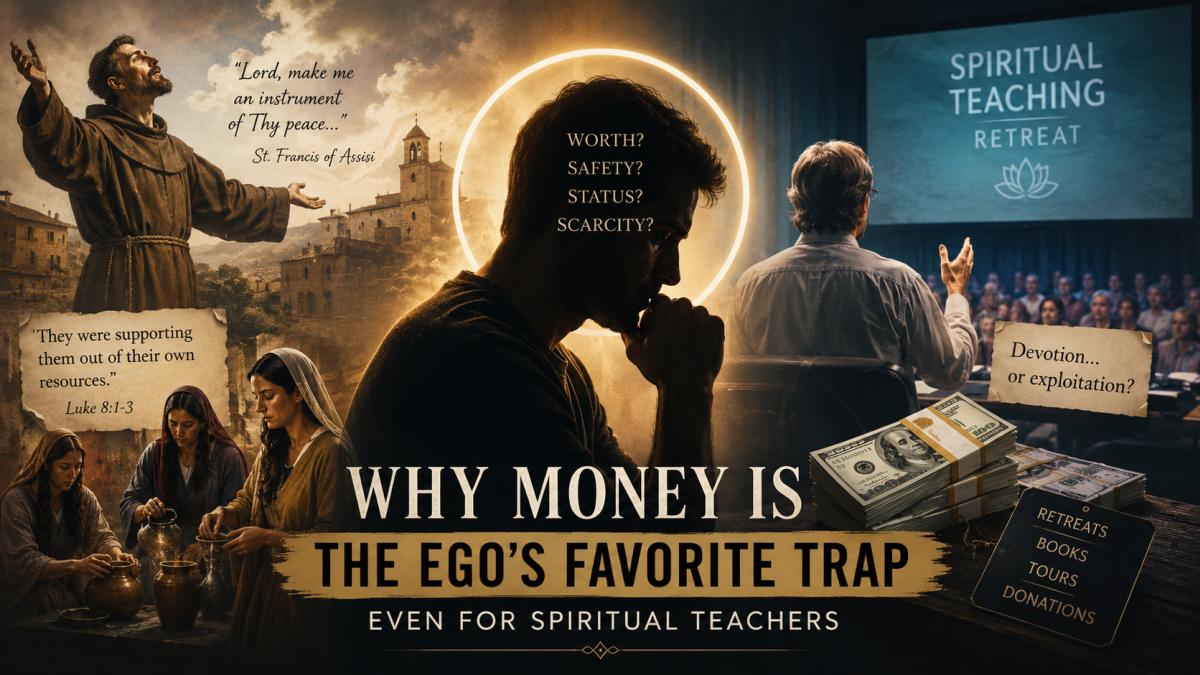
Tolle’s core teaching is that this reactivity comes from identification with thought itself. Money becomes dangerous not because of what it is, but because of what the mind attaches to it: safety, worth, status, fear of scarcity. He describes money as symbolic energy, nothing more. In itself it carries no moral charge. The distortion appears when a person’s sense of self, their ego, starts measuring itself by a number in a bank account. The uncomfortable question he poses is simple. How much are you “worth”? The phrase itself, applied to a human being, should sound strange the moment it is examined closely.
To illustrate how differently people can relate to money, Tolle often returns to the story of Francis of Assisi. Francis was born into real privilege. His father was a prosperous cloth merchant in the Italian town of Assisi, and by most accounts young Francis enjoyed a comfortable, even indulgent, upbringing before his dramatic turn toward poverty. What followed was one of the more theatrical renunciations in religious history. Confronted publicly by his father over money owed, Francis handed back not just the coins but the clothes on his back, walking away to build a life defined by having nothing at all.
What is often missed in the popular version of the story is the tension that followed once Francis’s approach to poverty attracted followers. As more people joined his way of life, the movement inevitably needed structure. It needed shelter, land, and eventually buildings. Francis reportedly found this development distasteful and stepped back from managing it, yet without that gradual institutionalization, most historians agree the Franciscan movement likely would not have survived his death. It is a pattern worth sitting with. Even a man devoted entirely to non-attachment discovered that a spiritual community, like a body, needs some material foundation simply to keep functioning after the founder is gone. The Christian History Institute’s account of Francis’s radical poverty captures how far he took this ideal in his personal life, sometimes giving away his own clothing to anyone he judged poorer than himself.
A second, quieter example comes from the Gospel of Luke, where a detail is often skimmed past. Jesus’s travelling ministry, according to the text, was financially supported in part by a group of women, including Mary Magdalene, Joanna, and Susanna, who used their own resources to provide for him and his followers. This single passage, Luke 8:1 to 3, has generated a fair amount of scholarly commentary precisely because it complicates the assumption that early religious movements ran on faith alone. They also ran on funding, and in this case, on women stepping into a financial role that was unusual for their social context.
Tolle uses this detail to make an uncomfortable point. If a modern spiritual teacher operated the same way today, relying on the financial generosity of followers, particularly women who had left family responsibilities behind to join the movement, a critical journalist could easily frame it as exploitation. The headline practically writes itself. Yet within the religious tradition, this same arrangement is remembered as devotion and discipleship. The lesson is not that one framing is correct and the other wrong. It is that money entangled with spiritual authority will always be judged through the lens of the observer’s own relationship with money, fear, and trust.
This tension is very much alive in the present. Tolle himself has faced public scrutiny over the commercial scale of his teaching business, from retreat pricing to publishing revenue. One widely read critique noted that his organization has grown into a substantial commercial enterprise, complete with paid retreats, a subscription platform, and a catalogue of bestselling books translated into dozens of languages. Meanwhile Tolle continues to make a large portion of his material freely available through recorded talks and Q&A sessions, which supporters point to as evidence that the paid offerings do not represent the whole of his teaching. In interviews, Tolle has argued that an enlightened relationship to money means not being primarily concerned with acquiring it in the first place, since chasing money pulls attention out of the present moment and into anxious calculation about the future, a dynamic explored in one interview where Tolle discusses making money and alignment with life.
There is no clean resolution to this debate, and Tolle himself does not pretend there is one. His answer, instead, is to shift the question. Rather than asking whether a teacher should charge money, he suggests each person ask what they, personally, feel comfortable participating in. If a retreat fee feels wrong, there are free talks, free books from libraries, and traditions built around donation rather than fixed price. If a person walks into a space that operates on donation and never gives anything, over time that will be noticed too. Somewhere, energy has to move in both directions for a teaching relationship to remain healthy.
Tolle has been candid about his own history of restless spiritual searching before he settled into the understanding for which he later became known. In the years following an intense personal transformation, he explored a wide range of paths trying to make sense of what had happened to him internally. He sampled workshops connected to A Course in Miracles, tested Scientology’s assessment process without ever joining, and sat with teachers from multiple traditions, some of them expensive. In one memorable account, he needed money for a weekend course and took a temporary job registering dog breeds by hand at a London kennel club, working two weeks simply to afford the workshop fee. When the course itself turned out to be underwhelming, he did not regret the experiment. It taught him what was not the right path for him, and that clarity, he suggests, was worth the cost even when the workshop itself was not particularly memorable.
The real turning point for Tolle came through contact with Zen Buddhism. A conversation with a Zen monk crystallized something he had been living but had not yet named. Zen, the monk told him, is fundamentally about not thinking. That phrase became a revelation, because Tolle realized he had already been experiencing a form of inner peace that came specifically from an absence of compulsive mental narration, without having understood what it was. This concept in Zen is closely related to what practitioners call mushin, or no-mind, a state in which conscious deliberation quiets and a person responds to life directly, without the constant overlay of anxious commentary. It is not blankness or absence of awareness. It is closer to clarity with the noise turned off.
Tolle closes this particular reflection with a story about a wealthy acquaintance who, despite doing significant charitable work, could not resist listing his donations in conversation almost immediately after meeting someone. The generosity was genuine, Tolle notes, but the ego had quietly attached itself to the giving, turning charitable acts into evidence for a favorable self-image. His counterpoint is the old instruction attributed to Jesus, not to let the left hand know what the right hand is doing, meaning that giving loses its distorting effect on the ego the moment it stops needing to be seen or acknowledged. Anonymous giving, in this view, is not about secrecy for its own sake. It is a way of keeping generosity free of the subtle bookkeeping the ego tends to perform on every act, however good, that could be used to inflate a sense of self.
This same willingness to sit with an idea until it stops feeling strange runs through most of Tolle’s teaching, including his more unconventional claims, like his view that a kind of reincarnation happens every single day rather than only at the end of a lifetime. The pattern in both cases is the same. He takes a concept people assume they already understand, whether that is money, worth, or death, and asks what it looks like once the usual assumptions are set aside.
Taken together, these threads point toward a single idea repeated across very different eras and traditions. Money itself carries no inherent moral weight. What determines whether it distorts a person’s inner life is the story wrapped around it: fear of not having enough, the ego’s need to measure worth in numbers, or the quiet pride that can attach itself even to generosity. Whether the example is a medieval friar disowned by his merchant father, a group of women funding an itinerant ministry two thousand years ago, or a contemporary teacher weighing how to price a retreat, the underlying work is the same. It is not about arriving at the “correct” amount to charge, give, or own. It is about noticing what happens internally the moment the subject comes up, and choosing awareness over automatic reaction.
This article draws on themes discussed by Eckhart Tolle in one of his recorded public talks and Q&A sessions.