Physical Address
304 North Cardinal St.
Dorchester Center, MA 02124
Physical Address
304 North Cardinal St.
Dorchester Center, MA 02124

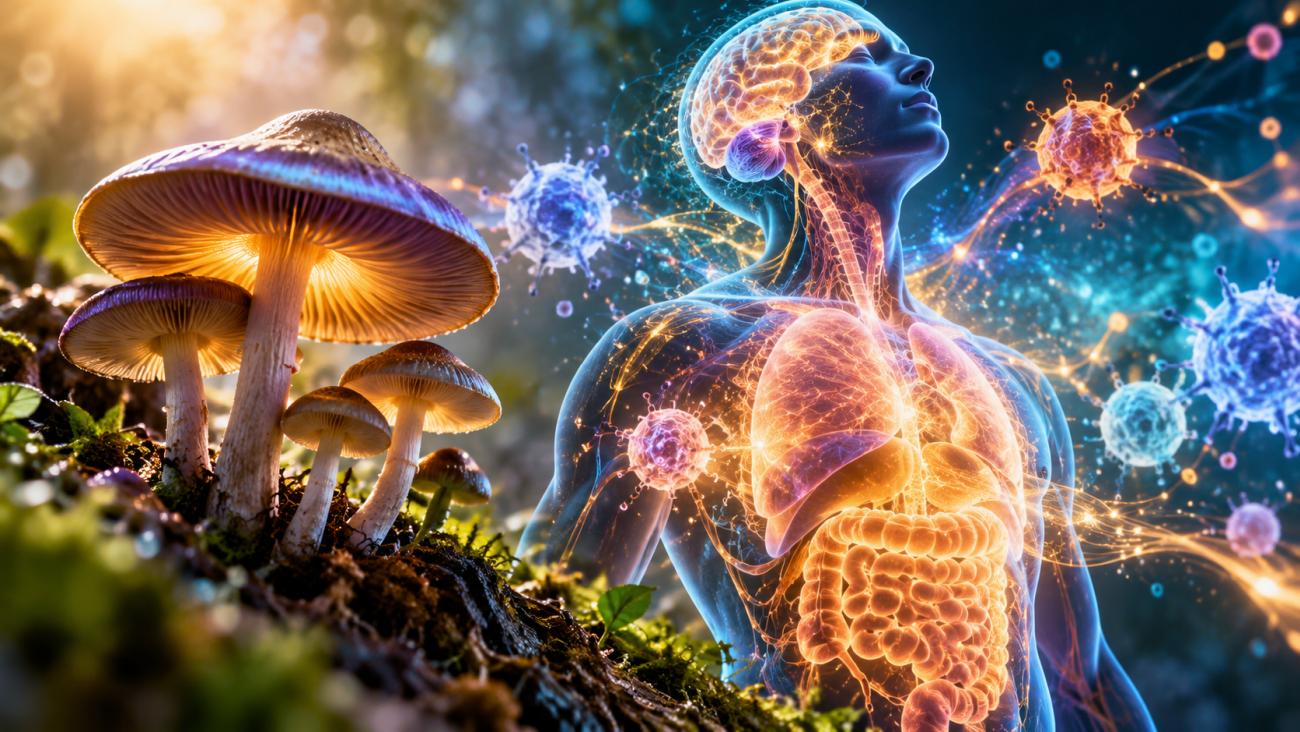
For most of the modern conversation, psychedelics have been treated as instruments of the mind. We talk about ego dissolution, mystical union, the default mode network falling quiet, the one long night that rearranges a life. The body, when it appears at all, is cast as the vessel that has to be kept safe while consciousness goes travelling.
The older traditions never drew the line quite so neatly. In the Mazatec velada, mushrooms were taken to discover what was wrong with a sick person and to help them recover. The Amazonian curandero preparing ayahuasca was understood as a healer of bodies as much as souls. Illness of the spirit and illness of the flesh were not filed in separate drawers.
A body of laboratory work stretching back almost two decades suggests this older instinct may have caught hold of something real. Underneath the visions, and possibly at doses far too low to produce any vision at all, certain psychedelics appear to speak directly to the immune system. And this month, for the first time, that conversation has been glimpsed in the blood of people living with a neurodegenerative disease.
On 21 October 2026, a team at the University of California, San Francisco published a short research letter in JAMA Psychiatry that went back to stored plasma from an earlier pilot study. That pilot had given psilocybin to twelve people with mild to moderate Parkinson’s disease who were also struggling with depression or anxiety. Each received two sessions roughly a fortnight apart, a lower dose followed by a higher one, held within a course of psychotherapy. The researchers reported gains not only in mood but in cognition and motor symptoms, which was more than anyone expected from what was designed as a safety study.
The new analysis asked a different question. Parkinson’s is known as a movement disorder, but chronic low-grade inflammation and strained mitochondria are increasingly seen as part of its machinery. Could psilocybin be touching either?
Blood from nine participants was tested at four moments: before treatment, the day after each dose, and a month after the second. The team folded five inflammatory signals (IL-6, IL-8, TNF-alpha, interferon gamma and C-reactive protein) into a single composite score. That composite dropped after the first session, stayed down after the second, and was still significantly below its starting point thirty days later. A marker of mitochondrial strain called GDF-15 also fell the day after each dose, though by the one-month mark it had drifted back toward where it began.
Hold that result loosely for now. We will return to its weaknesses. First it is worth understanding why anyone thought to look.
The trail leads to a pharmacology lab at Louisiana State University’s health sciences campus in New Orleans, run by Charles Nichols. Psychedelic chemistry runs in the family. His father, David E. Nichols, spent decades at Purdue University working out how these molecules interact with serotonin receptors, and in 1993 founded the Heffter Research Institute, which went on to fund some of the first modern clinical studies of psilocybin.
The younger Nichols took a less visible route. Rather than studying altered states, he studied what happens inside cells when the serotonin 2A receptor, usually written 5-HT2A, is switched on. This is the receptor most responsible for the psychedelic experience, but it is not confined to the brain. It turns up in blood vessels, the gut, the lungs, and in cells that take part in immune responses.
In 2008 his group exposed rat aortic smooth muscle cells to TNF-alpha, one of the body’s master alarm signals for inflammation, and then added a research psychedelic called (R)-DOI. The cascade TNF-alpha normally sets off was sharply blunted: adhesion molecules, the cytokine IL-6, nitric oxide activity and the switching on of inflammatory genes. What startled the team was how little drug it took. The working concentrations were so tiny that the researchers struggled to name any conventional medicine with comparable potency for any effect, with the exception of a few natural toxins.
Cells in a dish are one thing; whole organisms are another. In 2013 the lab gave (R)-DOI to mice before injecting TNF-alpha and found that the expected inflammation was largely prevented in the aorta and small intestine, and that the usual rise in circulating IL-6 was blocked as well. Using drugs that selectively shut particular receptors, they confirmed the effect ran through 5-HT2A.
Two years later they turned to asthma. In a standard mouse model where an allergen sensitises the airways, inhaled (R)-DOI stopped the hallmark features from developing: the twitchy, over-reactive airways, the excess mucus, the influx of inflammatory cells into the lung. The doses involved were reported to be roughly fifty to a hundred times lower than those that change an animal’s behaviour.
That last detail is the hinge of the entire field. If the anti-inflammatory action sits that far beneath the psychoactive threshold, then the body-level effect and the mind-level effect may be two separate events that happen to share a doorway.
Here is where things get subtle. If LSD, psilocybin and DOI all activate the same receptor, you might expect them to calm inflammation equally well. They do not. Across the Nichols lab’s comparisons, some compounds proved strongly anti-inflammatory while others, LSD among them, looked comparatively modest in certain models despite being extraordinarily potent in the mind. Later structure-activity work from the same lab found that a molecule’s anti-inflammatory strength did not track how strongly it altered behaviour.
The explanation the lab favours is called functional selectivity, sometimes biased agonism. A receptor is less like a light switch and more like an instrument. Different molecules settle into it in slightly different ways, bend its shape in slightly different directions, and so draw out different chains of signals inside the cell. Serotonin itself, the body’s own messenger, tends to push inflammation upward through these receptors. Certain psychedelics appear to play the very same instrument and coax out the opposite tune.
Their 2018 review in the International Review of Psychiatry sketched where this could lead: compounds built to favour the anti-inflammatory pathway while leaving the perception-altering one untouched. Medicines inspired by psychedelics, in other words, that are not psychedelic at all. For conditions such as asthma, inflammatory bowel disease or atherosclerosis, that could mean a genuinely new class of treatment rather than another variation on steroids.
For years this remained a niche corner of the literature. That shifted with a systematic review and meta-analysis published this year in Brain, Behavior, and Immunity under the blunt question Are psychedelics anti-inflammatory?
The authors screened more than nine thousand records and kept 61 studies: 24 on cells, 30 on animals, and seven human studies covering ten separate trials. The preclinical picture was strikingly consistent. Nineteen of the cell studies and twenty-five of the animal studies reported anti-inflammatory effects.
The more interesting finding was conditional. When the team pooled mouse data, reductions in inflammatory cytokines showed up in animals that already had inflammation induced. In healthy animals, no consistent effect appeared. Raised inflammation at the outset was the single clear factor linked to the drugs lowering any specific inflammatory molecule. An earlier review of the preclinical evidence had spotted something similar and even more pointed: psychedelics tended to ease inflammation that was already present, yet could nudge it upward when given to animals in a normal state.
That pattern deserves a pause, because it changes what kind of thing we are looking at.
A conventional anti-inflammatory works like a dimmer switch. Steroids turn the immune response down whether or not it needed turning down, which is why long-term use carries risks of infection and other trouble. What the animal data hints at is closer to a thermostat: a correction back toward a set point, felt strongly when the system has drifted far out of range and barely at all when it has not.
Readers of this site may recognise the shape. In our look at the LSU study on why psilocybin’s effects outlast the drug, work from this same Nichols lab suggested that the brain does not so much build new architecture as settle into new settings. The immune findings rhyme with that. In both cases the substance seems less to add something foreign than to help a system find its way back to a balance it already knew how to hold.
Nearly every healing tradition carries some version of this idea, whether it is called prana, qi, or simply the wisdom of the body. The medicine does not do the healing; it clears what is in the way so that the organism can. It would be far too much to claim that a meta-analysis of mouse cytokines proves anything of the sort. But it is a striking echo.
Here the story has to slow down. Of the ten human trials in the review, only three reported anti-inflammatory effects. That sounds like a failure until you look at who was enrolled. Most of these studies were built to test mood or psychological outcomes, with inflammatory markers measured on the side, and most recruited people whose inflammation was normal to begin with. Only two human studies included participants with raised baseline inflammation. If the thermostat idea holds, healthy volunteers are exactly the group in whom you would expect to see little.
The exceptions are suggestive. In a placebo-controlled Brazilian trial of ayahuasca for treatment-resistant depression, patients started with higher C-reactive protein than healthy controls, and CRP fell within 48 hours of ayahuasca but not after placebo. Among the patients, larger drops went hand in hand with fewer depressive symptoms. Ayahuasca is a brew of several active compounds, though, so it cannot tell us which molecule did the work.
Which brings us back to the Parkinson’s paper and its fine print. It had no control group and no placebo. Nine people is a very small sample. The authors themselves list placebo effects, regression to the mean, and shifts in stress and sleep as possible explanations, and concede that some findings could be false positives. The individual markers only moved significantly after the first, smaller dose; the lasting effect lives in the composite score. And in a small irony for a story that began with TNF-alpha in a New Orleans lab, TNF-alpha itself barely shifted in these patients at any point. The work was funded by a pharmaceutical company alongside an anonymous donor.
None of that makes the result worthless. It makes it a first look, which is exactly how the investigators frame it. NPR’s coverage of the findings framed it as among the first human data of its kind, and a larger randomised trial of around one hundred participants is already running across UCSF and Yale.
It is worth being plain about the limits, because the internet is quick to turn early science into a supplement shelf. Nothing here suggests that microdosing mushrooms will settle arthritis, asthma or Parkinson’s. The compound with the most impressive anti-inflammatory record, (R)-DOI, is a research chemical with a very long-lasting psychoactive profile at higher doses and no safety record as a human medicine. The human data are small, mostly uncontrolled, and measure blood markers rather than disease outcomes. The animal literature also contains studies where psychedelics raised inflammation instead of lowering it. And several of the scientists leading this field, Charles Nichols included, hold roles with companies developing psychedelic-derived medicines, which readers deserve to know.
What it does mean is that a serious question is finally being asked of the right people. If psychedelic pharmacology is going to help inflammatory disease, the proof will come from trials that enrol people who are genuinely inflamed, using compounds and schedules chosen for the immune system rather than borrowed wholesale from depression research.
There is something quietly fitting about the shape of this story. A father keeps psychedelic chemistry alive through the decades when it was professionally dangerous, so that researchers might one day study what these molecules do to consciousness. His son, working with the same family of compounds, finds that some of their most remarkable effects may have little to do with consciousness at all, unfolding in blood vessels and airways while the mind stays perfectly ordinary.
For anyone who thinks of healing as a whole-person matter, that is no contradiction. The vision and the body were never really separate. The old healers who used plant medicines to treat physical sickness may simply have been working from a wider map than the one modern psychiatry inherited. Science is now, slowly and with proper caution, filling in the half of that map it forgot to look at.
This article discusses early preclinical and clinical research and is not medical advice. Psychedelics carry real risks, remain illegal in many jurisdictions, and should not be used to self-treat any inflammatory or neurological condition. Please speak to a qualified healthcare professional about any health concern.