Physical Address
304 North Cardinal St.
Dorchester Center, MA 02124
Physical Address
304 North Cardinal St.
Dorchester Center, MA 02124

If you have spent any time sitting in stillness, watching thoughts rise and pass without grabbing onto them, you already know something that most Reiki students take years to arrive at. The witness behind the mind and the energy that moves through the body are not separate projects.
If you have spent any time sitting in stillness, watching thoughts rise and pass without grabbing onto them, you already know something that most Reiki students take years to arrive at. The witness behind the mind and the energy that moves through the body are not separate projects. They are the same inquiry approached from two directions. One works from the inside out through awareness. The other works from the outside in through the hands, the breath, and an attunement passed from teacher to student. Reiki healing is not a detour from your meditation practice. It is what happens when that same witnessing presence learns to move.
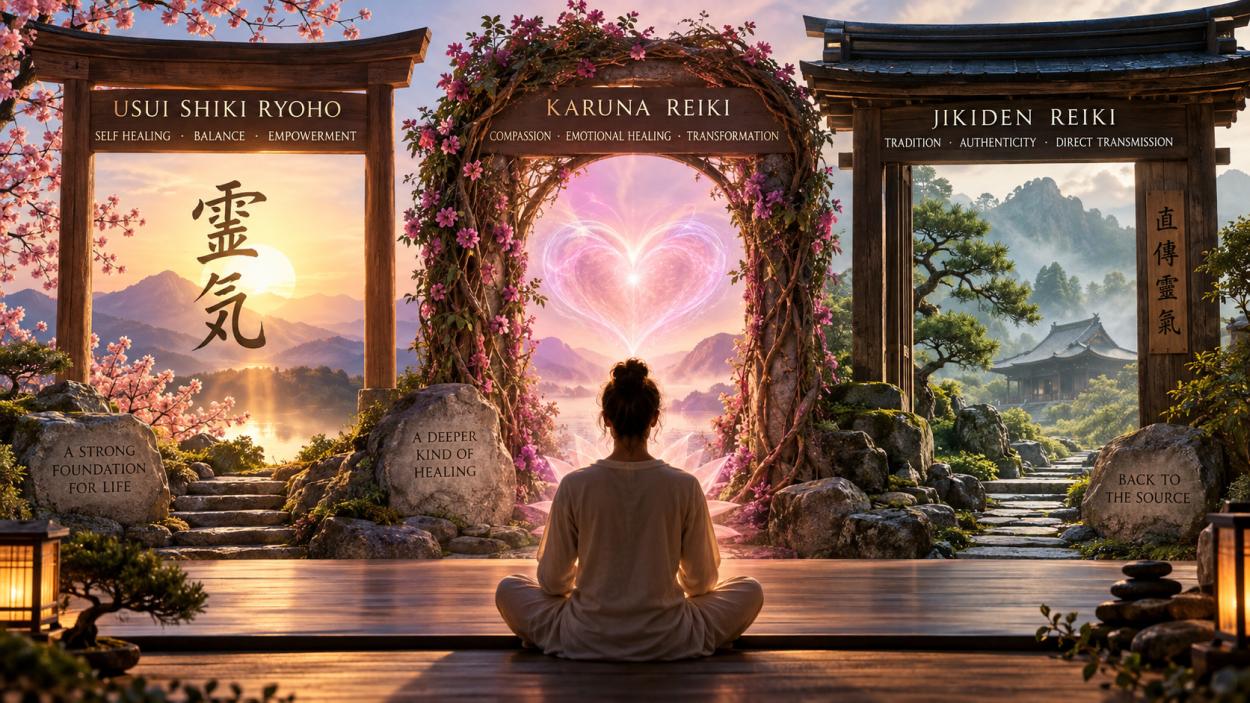
What almost nobody explains before you sign up for a class is that Reiki is not one system with one flavor. It is a tree with several major branches, each descending from a different point in its hundred year history, each carrying a different emphasis, and each shaped by the teacher who developed it. Choosing a lineage is not a small administrative detail. It shapes what you will be taught, how the attunement itself will feel, and which aspect of your own spiritual development gets emphasized first. Here are the three that matter most if you are serious about energy healing as a long term practice, not a weekend curiosity.
In Reiki, a lineage is the direct chain of teacher to student that traces back to the tradition’s founder, Mikao Usui, who is said to have received his initial experience of universal life force energy during a period of fasting and meditation on Mount Kurama in Japan. That chain matters because Reiki is not learned from a book the way you might learn a stretching routine. It is transmitted through an attunement, a ritual in which a teacher opens a student’s ability to channel energy directly. You can see how a single lineage chart is built and passed down generation by generation, teacher to student, almost like a family tree.
Different branches of that tree grew in different directions after Usui’s death in 1926. Some stayed close to the original Japanese teachings. Others were expanded by Western practitioners who added new symbols, new frequencies, and new areas of focus. None of this makes one lineage more “real” than another, but it does mean the experience of a Level One class in one lineage can look almost nothing like a Level One class in another. That is the piece most beginner guides skip.
Usui Shiki Ryoho is the lineage most Westerners think of when they hear the word Reiki. It descends from Mikao Usui through his student Chujiro Hayashi and then through Hawayo Takata, the Japanese Hawaiian woman who is credited with bringing Reiki to the West in the late 1930s. Takata trained twenty two Reiki Masters before her death, and nearly every Western Reiki lineage you encounter today traces back through one of them.
This branch is built around three levels of training, standardized hand positions, and a strong emphasis on personal empowerment and self healing practices as the foundation before any healing of others begins. It also carries techniques like Reiji-ho, an intuitive form of scanning the body’s energy, alongside Byosen scanning and the traditional Reiki precepts for daily living, which are meant to be lived with rather than simply studied.
Usui Shiki Ryoho tends to suit people who want structure before they improvise. If your temperament leans toward wanting a clear map before you wander off it, and your spiritual stage is still building the basic vocabulary of chakra alignment and energetic sensation, this is usually the right place to begin.
Karuna Reiki is not a separate root but a graft onto the Usui tree, developed in the 1990s by Reiki Master William Lee Rand at the International Center for Reiki Training. The word Karuna is Sanskrit for compassionate action, and the system was built specifically to address emotional, mental, and spiritual wounds that traditional Usui training does not always reach directly. Rand worked with a group of other Reiki Masters who had independently channeled a set of new symbols, and he later organized those symbols into a formal attunement process, which he described in detail in his own account of how the system came together.
Because Karuna is typically only taught to those who have already reached the Master level in Usui Reiki, it functions less like a beginner’s path and more like a second chapter. Its symbols, including ones like Harth for matters of the heart and Rama for grounding, are said to carry a different vibrational quality aimed at deep emotional and cellular healing rather than the broader, gentler current of Usui practice.
Karuna tends to call to people who are already comfortable with energy work but who keep bumping into the same emotional blockage or old trauma pattern in their sessions, whether their own or a client’s. If your spiritual stage involves shadow work, unresolved grief, or a felt sense that your heart center needs more direct attention than your crown or root, this is the lineage that was built for exactly that.
Jikiden Reiki is the newest of the three in terms of public availability, but it claims the oldest and most unaltered teaching. For decades, the Western world assumed that Reiki had all but vanished from Japan after Usui’s death. That assumption turned out to be wrong. Chiyoko Yamaguchi had quietly learned Reiki in 1938 directly from Chujiro Hayashi and continued practicing it, largely unchanged, for the rest of her life. When Western students discovered her in the late 1990s, she and her son Tadao Yamaguchi formalized what she had learned into a teachable curriculum, which they named Jikiden, meaning directly taught, to signal that this was Reiki passed down without the modifications introduced once it crossed the Pacific.
The founding of the school itself involved more of the old Japanese Reiki community than people usually realize. Hyakuten Inamoto, who would go on to found his own related system, was the seventh student initiated into the newly formed Jikiden lineage in 1999, alongside Hiroshi Doi, another respected figure in Japanese Reiki history. The word Jikiden itself carries the sense of something handed down in person, teacher to student, with nothing lost in translation, and the documented chain back through Usui and Hayashi to Yamaguchi is treated as central to the system’s identity rather than incidental to it.
Jikiden places heavy emphasis on physical healing technique, hands on treatment protocols for specific ailments, and a more austere, less symbol heavy approach than either Usui Shiki Ryoho or Karuna. If your temperament is drawn to authenticity over accessibility, and your spiritual stage has you questioning which parts of your current practice are original teaching and which are later additions, Jikiden is worth serious consideration.
None of these three is objectively superior. The mistake most new practitioners make is choosing based on which class happens to be running nearby rather than asking what their nervous system and spiritual stage actually need right now.
If you are new to energy healing modalities altogether and want a stable framework for basic chakra alignment and self healing practices, start with Usui Shiki Ryoho. If you already have a foundation and keep encountering the same emotional knot no matter how many times you clear it, Karuna’s compassion focused symbols may finally address what Usui alone has not touched. If you are the kind of practitioner who wants to strip away every accumulated layer and get as close as possible to what Usui originally transmitted, Jikiden offers that in a way no other widely available lineage does.
What all three share, and what connects this whole conversation back to witness consciousness, is the requirement of presence. An attunement does not do the work for you. It opens a channel. What flows through that channel, and how clearly, depends on the same quality of attention you have already been cultivating on the cushion. Reiki is not a shortcut around inner awareness. It is one more doorway into it, and now you know which door actually fits the room you are standing in.