Physical Address
304 North Cardinal St.
Dorchester Center, MA 02124
Physical Address
304 North Cardinal St.
Dorchester Center, MA 02124

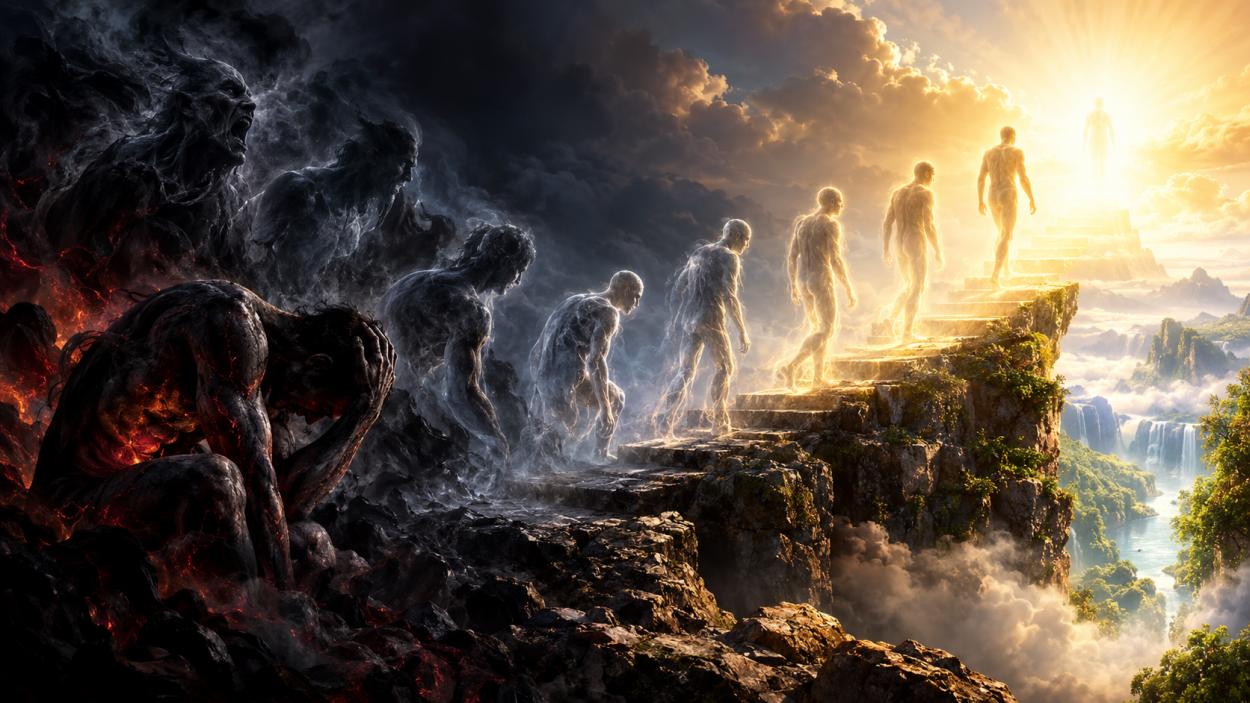
Most religious traditions treat demons as a lost cause. They are painted as a separate species of monster, locked into an eternal war against God, doomed to endless torment with no way out. It is a tidy, frightening picture, and it has shaped Western imagination for centuries.
Most religious traditions treat demons as a lost cause. They are painted as a separate species of monster, locked into an eternal war against God, doomed to endless torment with no way out. It is a tidy, frightening picture, and it has shaped Western imagination for centuries.
Allan Kardec, the nineteenth century French educator who codified the philosophy known as Spiritism, offered a very different account. Working through years of communications received via mediums and compiled into The Spirits’ Book in 1857, Kardec described something closer to a long, difficult school than a permanent prison. In this view, there is no separate race of eternally evil beings and no rival dark power standing against God. What we call demons are simply spirits early in their development, and every one of them, however far gone, is on a path that eventually leads home.
The starting point of Kardec’s doctrine is that every spirit begins life in the same condition: simple and without prior knowledge, not good or evil by nature. There is no factory setting for wickedness. Spirits are given free will and a long task ahead of them, which is to gain understanding and moral maturity through direct experience.
Because spirits progress at wildly different speeds, a kind of ladder forms. Kardec grouped this ladder into three broad bands, from spirits who have reached full purification down to those who are still ruled by their lower impulses. It is this bottom tier, sometimes called the third order, that supplies the raw material for every folk tale about demons and imps. According to the spirit teachings on this order, these beings are marked by pride, selfishness, ignorance, and a tendency to let matter dominate over spirit, though not all of them are malicious. Some are simply mischievous or shallow rather than cruel, while others genuinely enjoy causing harm.
Kardec even traces the word “demon” back to the Greek daimon, a neutral term for a disembodied intelligence, good or bad, that only later narrowed into something purely sinister. So the demon of folklore, in this framework, is not a unique creature at all. It is an ordinary spirit that has not yet done the work.
If evil spirits are just underdeveloped humans in another form, where does that leave Satan? Spiritism’s answer is blunt: there is no sovereign evil being running a rival kingdom against God. Allowing for an independent, eternal force of evil would mean allowing for something close to a second god, which contradicts the idea of one supreme, unified intelligence behind everything.
When the question was put directly to the communicating spirits, the answer recorded in the text was equally direct. Asked whether demons exist in the usual sense, the reply noted that if such condemned beings existed, they would still be God’s own creation, and it would be hard to reconcile that with a just Creator. The passage goes on to suggest that if demons exist anywhere, it is here, among us, in the form of people who act out cruelty and deceit. Satan, in other words, becomes a personification, a stand-in for base instinct and material temptation, much the way older cultures pictured time itself as an old man carrying a scythe. It is a symbol built from human imagination, not a literal ruler of the underworld.
This is where Spiritism breaks most sharply from traditional doctrine. Kardec devoted an entire later work, Heaven and Hell, or Divine Justice According to Spiritism, to dismantling the idea of eternal punishment. His argument rests on a simple test: either the soul is capable of progress, or it is not. If a person can still change and grow right up until the moment of death, it makes little sense that death itself would suddenly slam that door shut forever, freezing someone in whatever state they happened to be in at the time they died.
That does not mean Spiritism throws out the idea of consequences altogether. It explicitly does not deny future punishment for wrongdoing, and it treats the world we currently live in as a kind of purgatory, a place of trial and correction rather than reward. What it rejects is the idea of an unpardonable sin or a punishment with no end point. According to the doctrine, the suffering that follows a difficult life is not fire and brimstone but a mental and moral anguish, often simply the natural weight of one’s own past actions seen clearly for the first time. It is corrective rather than vengeful, and it lifts the moment the spirit chooses to change course.
If a single lifetime is not enough to sort out a soul’s moral development, something has to fill the gap, and in Spiritist doctrine that something is reincarnation. A spirit returns to physical life again and again, each time facing a fresh set of circumstances designed to test specific weaknesses and offer the chance to repay old debts.
The system is built to move in one direction only. Once a spirit reaches a certain level of understanding, it does not slide back down the ladder. It can stall, resist, and delay through stubbornness, but the doctrine holds that its overall trajectory only ever points forward. There is also a firm line drawn against older theories of transmigration between species. Human spirits do not reincarnate as animals; the whole arc plays out within the human condition.
None of this happens on a fixed schedule. How fast a spirit climbs is entirely a matter of choice. A spirit that accepts its trials with some humility and genuinely tries to do better moves through the process relatively quickly. One that clings to pride, resentment, or hatred draws the same process out, sometimes across what feels, from the inside, like forever.
That feeling of endlessness is worth pausing on. When spirit communications describe suffering as eternal, the doctrine treats this as a subjective distortion rather than a literal fact. A being still trapped in moral darkness has no way of seeing the road ahead, so the suffering feels infinite even though it is not. Eventually, the pull toward genuine happiness proves stronger than stubbornness, and the spirit asks for new trials and starts moving again.
The chapter on free will in The Spirits’ Book is explicit that this freedom is never taken away, not even during incarnation. No temptation is described as truly irresistible. A spirit can always call for help, resist, and choose differently, which is also what gives moral responsibility any weight in the first place.
Spiritism does not pretend that imperfect spirits leave us alone in the meantime. At this stage of the earth’s development, they are described as mixing constantly with the physical world, nudging people toward pride, selfishness, and division, and taking a certain satisfaction in watching others give in to the same temptations that once tripped them up.
But the doctrine is careful to deny them any real power over a person who does not want it. The teaching on how these spirits influence human thought is direct on this point: they can only attach themselves to someone whose own thoughts and desires already lean in their direction. A person who consistently rejects the suggestion loses their interest, at least for the moment, since they keep watching for a better opening rather than giving up entirely. Prayer, discipline, and simple resistance are enough to break the connection, and resisting is framed less as a burden and more as the actual training ground where character gets built.
Strip away the horns and the fire, and what Spiritism leaves behind is a strikingly hopeful picture. Evil is not a fixed identity handed down from birth or imposed by some rival deity. It is an early stage, a kind of spiritual childhood marked by ignorance and unchecked impulse, and it is temporary by definition.
Read this way, The Spirits’ Book is less a manual about monsters and more an argument about how far mercy is allowed to reach. If Kardec’s spirits are right, there is no version of a person, living or dead, who has moved permanently beyond the possibility of turning around. The lower orders are simply the beginning of the story, not its ending, and the point of the whole system is that every single one of them eventually finishes the climb.