Physical Address
304 North Cardinal St.
Dorchester Center, MA 02124
Physical Address
304 North Cardinal St.
Dorchester Center, MA 02124

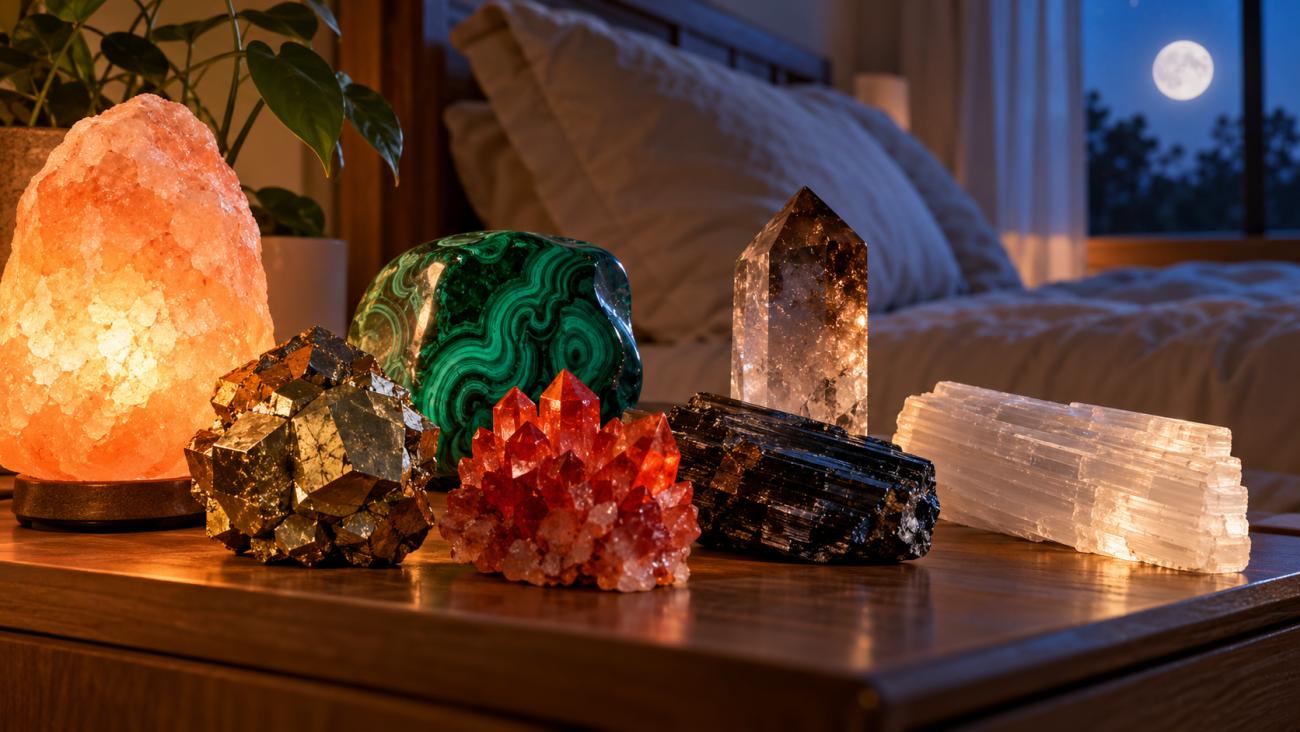
Sleep is the one part of the day when you stop managing anything. For six to eight hours the guard comes down, the body gets on with its repairs and the mind slides into the hypnagogic borderlands that dreamworkers, mystics and astral travellers have mapped for centuries. Whatever shares the room with you during those hours shares it on your least defended terms.
That is why the nightstand deserves more thought than it usually gets. Crystal collections grow by accumulation: a gift from a friend, an impulse buy at a weekend market, a piece someone swore would help you sleep. Slowly the bedside table turns into a small museum. Some of those stones are perfectly at home there. Others are not, and the reasons fall into three groups.
Some stones change the air you breathe or the safety of the room. Some are changed by the room itself, because a bedroom with the door shut is warm, still and humid with your own breath. And some, according to the people who work with them every day, keep the mind switched on at exactly the hour it needs to switch off.
For each of the seven below you will find which kind of reason applies, where the stone does belong, and one honest check you can run before you spend money on another piece. None of them needs to leave the house. They just need a different address.
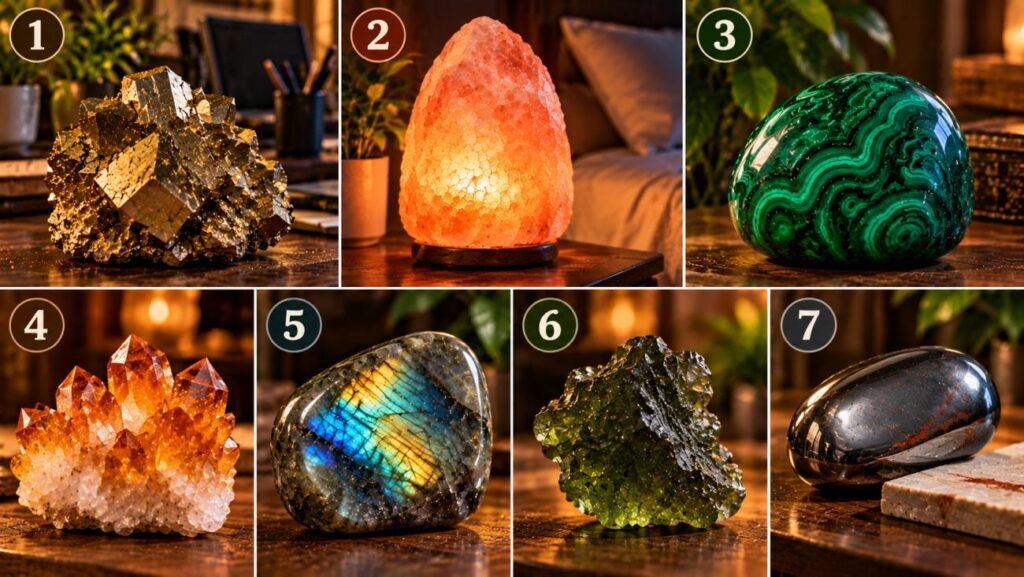
Pyrite is the brassy, cube-shaped mineral everyone knows as fool’s gold. Chemically it is iron disulphide, and museums know a side of it that crystal shops rarely mention. When pyrite meets oxygen in damp air it can oxidise, breaking down into iron sulphates and sulphuric acid. Conservators at London’s Natural History Museum, who launched a dedicated project to rescue affected specimens, note that this pyrite decay can begin once relative humidity rises above roughly 60 percent, and that the warning signs are cracking, a white or yellowish powdery bloom and a whiff of sulphur. In Oslo, the curator of the national mineral collection has watched specimens leak acid strong enough to char their own paper labels.
[Also Read: Grounded 4 Step Crystal Cleaning Process]
A closed bedroom is one of the dampest rooms in a house, because a sleeping body releases moisture with every breath. Put those two facts together and a pyrite cluster beside your pillow becomes a slow chemistry experiment that you are sleeping next to.
The reason: physical first, with a traditional echo. Practitioners tie pyrite to willpower, ambition and the solar plexus. It is a stone for doing, not for resting.
Where it goes instead: a desk or home office in the driest room you have, well away from bathrooms and kettles.
The check: drag it across the unglazed back of a bathroom tile. Pyrite leaves a greenish-black line, while real gold leaves a yellow one. If you ever spot white powder or smell rotten eggs, move the piece into a sealed box with a sachet of silica gel.
A salt lamp is a hollowed lump of halite, mostly from the salt range of Pakistan’s Punjab, with a bulb inside. It is a crystal in the strict mineral sense, and it belongs on this list for three practical reasons.
The first is electrical. In January 2017 the US Consumer Product Safety Commission announced a recall of around 80,000 Lumière salt lamps because the dimmer switch and plug could overheat and ignite, and a few months later a further batch of roughly 3,900 was pulled for the same fault. A cheap dimmer running all night on a wooden nightstand, inches from bedding, is not a combination anyone should choose.
The second is water. Halite draws moisture out of the air, and in a humid room the lamp weeps brine that pools around the base, the cord and the bulb holder.
The third is pets. Cats and dogs are drawn to salt, and salt poisoning in animals can progress from vomiting and wobbliness to tremors and seizures. Bedside height is exactly where a cat ends up at 3am.
As for the claim that these lamps fill a room with healthy negative ions, the output of a warm lump of salt is far too small to matter. Enjoy the glow for what it is: a lovely, low amber light.
The reason: physical.
Where it goes instead: a dry living area, standing on a ceramic or stone coaster, out of reach of animals and switched off whenever you leave the room.
The check: look for a recognised safety mark on the cord and switch, and after an hour of use feel the dimmer. If it is warmer than the lamp itself, replace the fitting.
Malachite is a copper carbonate, and copper makes up more than half its weight. It is also soft, sitting around 3.5 to 4 on the Mohs scale, which means it chips and scratches easily. A polished, finished piece is perfectly safe to own and handle. The concern is dust. Lapidary guidance is blunt that copper-rich dust from malachite and its cousin chrysocolla should never be breathed in or left on the skin, which is why professional cutters work wet and wear respirators.
A raw, crumbly specimen on a nightstand gets knocked, chipped and dusted, and then you spend the night breathing beside it. Never put malachite in drinking water or so-called crystal elixirs either.
History offers a quiet hint about where this stone belongs. When the Winter Palace in St Petersburg was rebuilt after its 1837 fire, the architect Alexander Briullov dressed an entire state room in Ural malachite for Empress Alexandra Feodorovna. Notice the room’s purpose: it was for receiving guests, not for sleeping.
The reason: physical, plus tradition. People who work with malachite describe it as a stone that drags buried emotion to the surface. That is valuable work, but it is daytime work.
Where it goes instead: a study, a journalling desk or a high shelf in the lounge, polished rather than raw.
The check: real malachite is dense and cold. Hold it for a minute. Resin copies feel surprisingly light for their size and warm up quickly in your palm.
Citrine is the golden form of quartz, and across almost every crystal tradition it is the stone of the sun. Shopkeepers have long called it the merchant’s stone. It is linked with abundance, confidence, motivation and the busy, planning part of the mind. That is a wonderful companion for a Monday morning and a poor one for 2am, when the last thing you need is a mental to-do list lighting itself up.
There is also an irony buried in most citrine on the market. The Gemological Institute of America explains that natural yellow quartz is rare and that most stones sold as citrine are amethyst that has been heated until the purple turns gold. Amethyst, of course, is the classic sleep stone. Baking it changes the colour and, if you follow the tradition, the job.
The reason: tradition.
Where it goes instead: a desk, a cash drawer, a wallet or a sunny east-facing windowsill where the day begins.
The check: look at the base of any cluster or geode. Heat-treated amethyst usually shows deep orange tips fading to white near the base, while natural citrine tends to be pale, even in colour and almost never grows in geodes. Heated material is not a fraud in itself. Just make sure you are paying heated prices.
Labradorite is a feldspar that looks like an unremarkable grey stone until you turn it in the light and a sheet of electric blue, gold or green flashes across it. Geologists call this labradorescence, a play of colour produced by light reflecting between extremely thin layers inside the crystal. The most vivid material, mined in Finland, is sold as spectrolite.
Among practitioners labradorite has a consistent reputation as a stone of magic, intuition and thinning veils. Dreamworkers keep reporting the same pattern when it sleeps beside them: long, crowded, vivid dreams and mornings that feel as if the night was spent working rather than resting.
If you are deliberately practising lucid dreaming or projection, a few nights of intentional work with labradorite under the pillow is a conscious choice. Leaving it there permanently is something else. Consciousness does not need a door propped open every single night to explore. It needs rest so that the explorations, when you choose them, have something to stand on.
The reason: tradition.
Where it goes instead: a meditation corner, an altar or the desk where you do creative problem-solving.
The check: tilt the stone slowly under one light. Genuine labradorescence appears and vanishes as the angle changes, and you will often see dark needle-like inclusions and fine cleavage lines. Colour that stays put whichever way you turn it points to coated or printed glass.
Moldavite is not really a crystal at all. About 14.7 million years ago a large meteorite struck what is now Bavaria, carving out the Nördlinger Ries crater. Molten rock was flung high into the air, cooled into green glass while still in flight, and rained down across Bohemia and its neighbours. The stone takes its name from the Moldau, the German name for the Vltava river, and people were already collecting and working it in the Upper Palaeolithic, tens of thousands of years ago.
Its modern reputation is almost unique in the crystal world, because the warnings come from the people selling it. Shops speak of the moldavite flush: a rush of heat to the face, a light-headed swirl and, in the weeks that follow, a stretch of life where things come loose. Whether you read that as energetic acceleration or as the power of expectation, it is plainly not a stone for unconscious hours.
The reason: tradition.
Where it goes instead: a wooden box or a cloth pouch that you open deliberately, or a pendant worn by day and taken off at night.
The check: buy from dealers who name the find locality, such as Chlum or Besednice in the Czech Republic. Under a loupe, natural moldavite shows a sculpted, etched surface, stretched and flattened bubbles and swirling flow lines. Factory glass is smooth, carries round bubbles or none at all, and batches look suspiciously alike.
Hematite is iron oxide, around 70 percent iron by weight, which is why a small polished piece feels so heavy in the hand. Its name comes from the Greek word for blood, because the silver-black stone leaves a rust-red powder when scratched.
Of all the stones ever placed beside a sleeping head, hematite has the longest written record, and that record belongs to the dead. Ancient Egyptians slept on curved headrests, and miniature amulets of those headrests were placed at the neck of the mummy to protect the head in the afterlife, a promise spelled out in Chapter 166 of the Book of the Dead. The British Museum notes that these amulets were once reserved for royal burials but later became common, made almost exclusively from hematite or a dark substitute. The oldest tradition of hematite at the pillow, in other words, was for a sleep nobody expected to wake from.
Modern practitioners describe hematite as the ultimate anchor: grounding, heavy, pulling energy downward. That is ideal on a day when you need to hold your ground and less helpful at night, when sleep asks you to let go.
The reason: tradition.
Where it goes instead: by the front door, or in a pocket on a day you are dreading.
The check: rub it on an unglazed tile. Real hematite always leaves a reddish-brown streak, however silver the stone looks. Then bring a fridge magnet near it. Genuine hematite barely responds, while the cheap material sold as magnetic hematite or hematine is a man-made ceramic that snaps straight onto the magnet.
Pyrite goes to a dry desk. The salt lamp goes to the living room, on a coaster and out of a cat’s reach. Malachite moves to the study, polished and up high. Citrine goes wherever your mornings begin. Labradorite moves to the meditation corner, moldavite into a box you open on purpose, and hematite stands guard at the front door. Nothing is thrown away, and the bedroom gets quieter.
If you want a stone beside the bed, choose something stable and gentle. Smoky quartz and rose quartz are both good candidates. Both are quartz, hard enough at 7 on the Mohs scale to resist chipping, chemically inert, and they neither shed dust, sweat brine nor decay in humid air. In tradition, smoky quartz is used to release tension without weighing you down, and rose quartz to soften the heart at the end of a hard day.
Keep it to one stone, not a shelf. And remember that an empty nightstand is also a valid choice.
Every night you cross the same threshold that meditators spend years learning to approach awake. The body goes still, the busy mind loosens its grip, and awareness drifts somewhere less defined. What you place within arm’s reach of that crossing matters. Not because a stone can override your free will, but because the room you sleep in is a statement of intention, made every night without words.
Make that statement a simple one: here, I rest.