Physical Address
304 North Cardinal St.
Dorchester Center, MA 02124
Physical Address
304 North Cardinal St.
Dorchester Center, MA 02124

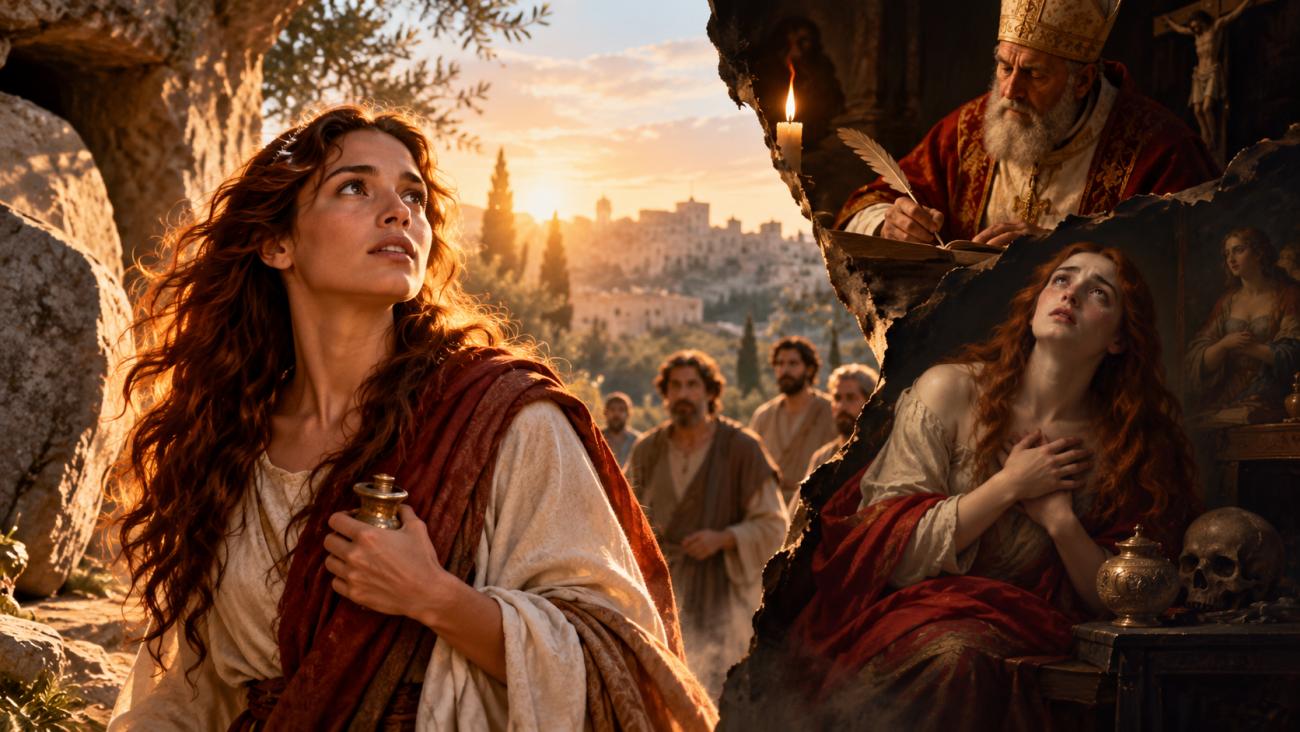
For fourteen centuries, most people in the Western world could tell you one thing about Mary Magdalene. She had been a prostitute. Painters gave her loose red hair, streaming tears, an ointment jar and sometimes a skull...
For fourteen centuries, most people in the Western world could tell you one thing about Mary Magdalene. She had been a prostitute. Painters gave her loose red hair, streaming tears, an ointment jar and sometimes a skull, her eyes lifted to heaven in endless repentance. Whole convents for “fallen women” were named after her. Films and musicals repeated the story well into living memory.
None of it came from the gospels. It came from a single sermon preached in Rome in 591, and it took the Church until 1969 to quietly set it aside, without ever quite saying it had been wrong.
Her story is one chapter in a much longer pattern, the one traced in The Long Hijacking: How Female Energy Was Taken, and What Is Taking It Back. The mechanism is familiar. Take a woman whose authority is inconvenient, and relocate the conversation from what she knew to what she supposedly did with her body. Mary Magdalene may be the oldest and most successful example of it.
Strip away the paintings and read the texts, and a very different woman appears. In Luke 8:1 to 3, she is named first among a group of women who travelled with Jesus through the towns and villages and supported the whole company out of their own resources. That detail matters. These were not hangers-on. They were funding the mission.
Luke also says seven demons had gone out of her. In the ancient world that was the language of illness, affliction or deep distress, not sexual sin. Nothing in the text links it to prostitution, and nothing anywhere in the four gospels calls her a sinner of any kind.
What the gospels do agree on is her presence at the moments that matter most. She is named in all four accounts at the empty tomb. In John’s gospel she is the first person to encounter the risen teacher and the one sent to tell the others. Few figures in the entire story are given that kind of role, and none of the men receive it before her.
So where did the harlot come from? The trail leads to Pope Gregory the Great and his thirty-third homily on the gospels, preached around 591. In it, Gregory took three separate women and folded them into one. As TheCollector’s account of the confusion sets out, he merged the unnamed “sinful woman” of Luke 7, who anoints Jesus’s feet from an alabaster jar, with Mary of Bethany, sister of Martha and Lazarus, and with Mary Magdalene. Because the woman in Luke is called a sinner, and because readers assumed a sinful woman must be a sexual one, the composite figure became a reformed prostitute.
Fairness requires a note here. The historian Roger Pearse, who went back to the homily itself, points out that it was an ordinary sermon rather than a formal decree, and that Gregory’s real target was the Pharisee’s contempt for the woman, not the woman herself. That is worth knowing. But a pope’s preaching carried enormous weight in the medieval world, and his interpretation was repeated, copied and illustrated for a thousand years. Intent aside, the effect was total. As Aleteia notes, from that point the prostitute reading moved into art, preaching and the liturgy itself.
Ask what the rewrite actually accomplished and the pattern becomes clear.
A woman who funds a movement, travels with its teacher and is the first entrusted with its central message is a figure of authority. A reformed prostitute is a figure of gratitude. Her role is no longer to teach but to weep, kneel and be forgiven. The witness becomes the penitent, and the penitent has no standing to instruct anyone.
This is the same move made against Marie Antoinette, and against thousands of women accused of witchcraft. The charge that sticks is always the one about the body. It works because it changes the subject. Nobody asks what Mary Magdalene knew once everyone is busy discussing what she used to be.
What she knew is not entirely lost. In 1896 a fifth-century Coptic book was bought in Cairo and taken to Berlin. Its first text turned out to be a gospel named after her, the only early gospel attributed to a woman. As TheCollector’s overview of the Gospel of Mary explains, scholars date its composition to the second century, and the Berlin Codex is missing its first six pages, so we only have part of it.
What survives is remarkable. After the teacher departs, the male disciples are frightened and grieving. It is Mary who steadies them, and when Peter asks her to share what she was told privately, she describes a vision of the soul rising past a series of powers that try to hold it back, powers named things like desire, ignorance and wrath. The emphasis is inward. The kingdom is not a place you are admitted to by an institution. It is something recognised within.
Then comes the argument. Andrew doubts that the teacher would have said such things. Peter goes further and asks whether he would really have spoken privately with a woman and preferred her over them. Levi rebukes Peter for treating her as an adversary and reminds him that the teacher knew her fully and loved her.
It is hard to read that exchange without seeing the next fifteen centuries in miniature. The tradition that eventually built its authority on Peter was never going to make much room for her.
The Gospel of Mary says nothing about the crucifixion. Its focus is entirely on the soul and its liberation, not on a death that pays a debt. That silence matters to many readers of Gnostic and channeled material, who have never been able to accept the idea that an infinitely loving Creator required a blood sacrifice before forgiving anyone. That idea turns the Source of all things into a creditor who must be paid in suffering, and it sits closer to the logic of ancient temple ritual than to a teaching about the kingdom within.
It should be said plainly that most academic historians treat the crucifixion as one of the best-attested events of Jesus’s life. The dissent is real, though, and it is very old.
The Second Treatise of the Great Seth, a text found at Nag Hammadi and dated to around 200 AD, has Jesus himself describe the crucifixion as a mistake made by the powers of this world. In it, another man bears the cross while Jesus watches from above, laughing at the ignorance of those who believe they have killed him. The early teacher Basilides, as reported by his opponent Irenaeus, taught something similar, with Simon of Cyrene taking his place.
Six centuries later the Quran made the same claim independently. Surah 4:157 to 158 states that he was neither killed nor crucified, that it was only made to appear so, and that he was raised up instead.
Whatever one concludes, notice who stands at the centre of each version. The woman who knew the true story. Whether she was guarding a teaching the new orthodoxy could not absorb, or simply knew more than the official account allowed, she stood on the wrong side of the story that won.
In 1969, as part of a revision of the liturgical calendar, the Catholic Church dropped the “penitent” label from her feast and replaced the reading about the sinful woman with the passage from John in which she meets the risen teacher in the garden. There was no announcement that an error had been made. The composite woman was simply retired, and most of the world kept believing in her for decades afterwards.
The fuller acknowledgement came in 2016. At the request of Pope Francis, the Vatican raised her memorial to the rank of a feast, the same rank given to the apostles. As Catholic News Agency reported, Archbishop Arthur Roche explained the decision by pointing to her honour as the first witness, and the new liturgy gave her the ancient title Apostle of the Apostles.
There is an irony buried in the decree. It cites Gregory the Great with approval, for a kinder phrase he once used about her. The man whose sermon cost her fourteen centuries of her reputation is quoted in the document that finally restores it.
It would be easy to turn Mary Magdalene into a symbol of grievance. Her treatment was unjust, and it shaped how countless women were taught to see themselves. But the lesson of the long hijacking is that the victim identity is the ego’s last and most comfortable hiding place. She is more useful as something else.
Read as an archetype, Mary Magdalene is the part of us that knows directly, without needing permission from an institution. She is the witness who saw first and was told to be quiet. She is inner authority that was relabelled as shame, because shame is easier to control.
That relabelling did not stop with her. Most people carry a version of it: a name someone else wrote over what they actually are, repeated so often it became the first thing anyone knows about them. The quiet correction of 1969 is worth remembering for exactly that reason. The label was false the entire time. Removing it did not require becoming someone new. It only required remembering who had been there all along, standing in the garden, the first one to see.