Physical Address
304 North Cardinal St.
Dorchester Center, MA 02124
Physical Address
304 North Cardinal St.
Dorchester Center, MA 02124

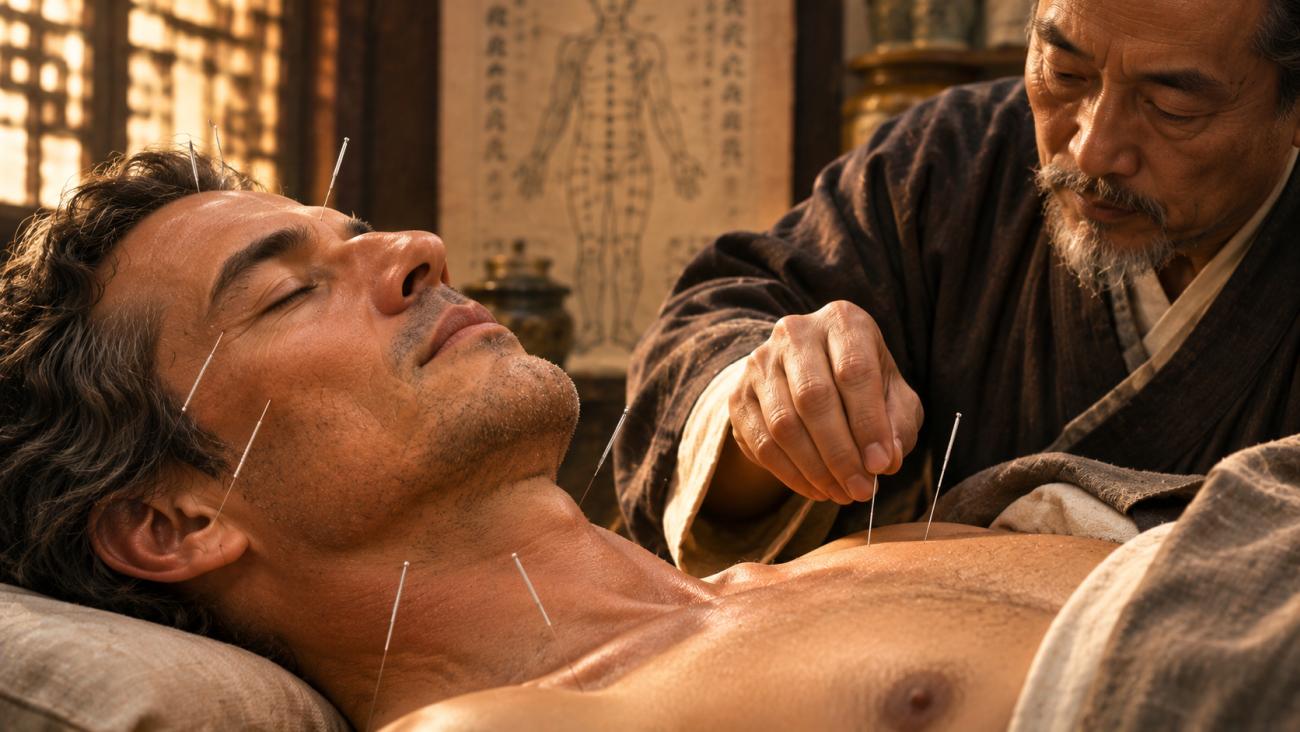
A declassified file in the CIA reading room describes people seeing their own nerve cells under acupuncture. Here's what page 43 of Human Paranormal Capabilities really says, who wrote it, and how to try a needle-free version of inner seeing.
Somewhere in the middle of a 99 page declassified file sits one of the strangest claims ever to pass through an American intelligence archive. A small group of people, needles in place at their acupuncture points, closed their eyes and described the inside of their own bodies. Not vaguely, either. They talked about nerve endings swollen to the size of soybeans, hair follicles with sensors they could count, and nerve cells that looked like red beans with noodle-thin tails.
The file is called Human Paranormal Capabilities, and you can read it yourself in the CIA’s online reading room. The section that has people talking starts on page 43, under the title “An Experiment into the Psychic Magnification Effect.” Clips about it have been circulating with a simple message: the CIA admitted that acupuncture switches on psychic powers.
The real story is more interesting than that headline, and a little different. So let’s open the file and look at what it says, who wrote it, and why it ended up in a US government archive at all.
The first thing to know is that this isn’t a CIA lab report. The 99 page document is an English translation of a Chinese quarterly journal, Research in Human Paranormal Capabilities, volume two, issue two, published on 15 June 1984. The translation even keeps the original subscription details on its opening page: half a yuan an issue, two yuan for the year.
The journal printed reports on Chinese experiments into what researchers there called exceptional functions of the human body, along with essays on qigong theory and summaries of research abroad. American intelligence analysts had it translated in 1985 because they wanted to know what Chinese scientists were doing in the field. The material was cleared for release in stages from 2000 onwards, and it now sits online alongside the rest of the declassified psychic research files.
So when the page 43 article says “we aroused latent capabilities,” the “we” is not the CIA. It is a Chinese researcher named Nai Chi-Jing, of the Wuhu Municipal College of Chinese Medicine. The CIA’s role was to read it, translate it and file it. That doesn’t make the experiment any less fascinating. It just puts it in the right hands.
Nai opens by saying he had already reported that certain psychics, once triggered by acupuncture, could enlarge the cells at an acupuncture point in their mind’s eye until they seemed as big as cherries. They could sense the cell membrane and watch material passing in and out. The page 43 article is his attempt to test that more carefully. A standalone copy of the article is also in the reading room if you only want these four pages.
He set up two groups. The experimental group was five men aged 32 to 58, all living with chronic illnesses, all classed as “sensitives” under criteria agreed at a national Chinese conference on the subject. Every one of them had already been through two or three courses of acupuncture, each lasting ten days. The control group was also made up of five sensitives (three men and two women, aged 21 to 43), but none of them had ever had acupuncture.
The procedure was simple. Each person sat, rested in a quiet place until relaxed, and was then needled with fine needles inserted quickly and shallowly at chosen points. The needle was twisted by hand, left in place, and turned again whenever the sensation started to fade. The instruction to the subject was to pour all of their attention into the part of the body being tested.
According to Nai, the acupuncture group began describing the tissue of their own bodies as though looking through a microscope. Touch receptors just under the skin appeared as big as soybeans. Smaller sensory endings looked like mung beans. Around a single hair they could see the touch receptors and count them, anywhere from five or six to more than ten. A nerve cell looked the size of a red bean, its axon stretching out like a strand of bean noodle. Some described the arrangement of nerve clusters in the cerebellum.
The control group, the sensitives who had never been needled, reported nothing like it.
Nai also noticed a pattern in timing. The magnified view only showed up after the needling sensation had travelled along the channel and reached the area the person was focusing on. It lasted while the needle stayed in, faded as the needle sensation faded, and came back when the needle was turned again. The moment a subject’s attention wandered, the image vanished.
From this he concluded that the effect was not chance, that it could be repeated, and that acupuncture on these sensitives had awakened a dormant human ability he called “microscopic vision.” Intense, single-pointed concentration was the other half of the recipe.
Part of what makes the article so compelling is that Nai doesn’t present any of this as new. He reaches back into classical Chinese texts that describe exactly this kind of inward seeing.
He cites the Huangtingjing, the Yellow Court Classic, a Daoist meditation text which teaches that if you close your eyes calmly and quietly, you will see inside. He also turns to the Ming dynasty physician Li Shizhen, whose study of the eight extraordinary vessels says the inner tunnels of the body can only be perceived by someone using “reverse vision.” Nai reads reverse vision as deep concentration turned back on the self.
In Daoist practice this inward observation has a name, neiguan, often translated as inner viewing. It is the idea that awareness itself can be pointed inward like a lamp. Whether you read Nai’s subjects as seeing tissue directly or as entering a very vivid, focused inner state, they were walking a path that Chinese contemplatives had mapped centuries earlier. If you’ve worked with practices for opening inner vision, the shape of it will feel familiar.
In the late 1970s and 1980s, China went through what historians now call qigong fever. It started in 1979 with reports of a Sichuan boy said to read with his ears, and it grew into a national movement with tens of millions of practitioners, along with journals, conferences and some very senior scientific backers. Research in Human Paranormal Capabilities was one product of that boom.
The United States was watching. Its own psychic research program, the one later known as Stargate, ran from the 1970s until 1995, driven largely by fear that the Soviet Union was ahead in the field. Any foreign claim of trainable psychic ability was worth translating.
The reading room even holds a 1981 UPI wire story that someone in the program clipped and kept. It describes Chinese experiments linking extrasensory perception with acupuncture points and qigong. Physicists in Beijing reported that acupuncture points showed lower skin resistance during psychic tasks, and that a point on the back of the neck warmed up during telepathy trials. The American parapsychologist Stanley Krippner, who led a visiting team, found the work provocative. He also noted that the gifted children his group met could not show unusual ability during their short stay.
Respecting an experiment means reading it closely, and there are real limits here that are worth naming.
The study had five people in the active group. Nobody outside the room checked their descriptions against anything independent, and there’s no sign the researcher was blind to which group a subject belonged to. The two groups also differed in more than acupuncture, since the controls were younger and included women. Nai notes that two of his five subjects already had a general knowledge of anatomy and physiology, and the structures they described are the ones found in standard anatomy textbooks. He also mentions that the subjects’ periods of concentration were trained with “repeated explanations,” which could easily shape what a focused mind expects to see.
Nai insists that he didn’t prompt his subjects and that their descriptions matched one another. Both claims may be sincere. But consistent descriptions from people who share a vocabulary are not the same as independent confirmation.
The US government’s own verdict on its psychic research is part of the record too. When the American Institutes for Research reviewed the Stargate program in 1995, it found the work had never given anyone intelligence they could act on, and the program was shut down. Holding a file in a CIA archive is evidence of interest, not endorsement.
None of this means nothing happened in that room in Wuhu. It means the strongest honest reading is this: concentrated attention, combined with a strong physical anchor like a needle, seemed to produce unusually vivid and stable inner experiences in some people. That alone is worth exploring.
You don’t need needles to explore the core of what Nai describes, which really came down to two ingredients: a clear physical sensation and undivided attention placed on it.
Sit somewhere quiet and let yourself settle for a few minutes, the way his subjects did before each session. Choose one small area, such as the fleshy web between your thumb and index finger. Press it firmly with the other thumb until you feel a dull, spreading ache, then ease off slightly and hold.
Now gather all of your attention into that single spot. Each time your mind drifts, bring it back. Don’t try to make anything appear. Simply notice texture, pulse, warmth, and whether the sensation seems to have depth or shape. If images come, let them, and write them down afterwards without judging them.
Practised over a few weeks, this kind of attention training builds the same fine sensitivity explored in how subtle sensitivity is built one small experiment at a time. It sits comfortably alongside the playful approach in learning to bend a spoon with energy, another exercise in loosening what we believe the body and mind can do.
If the file has you curious, there’s no harm in finding out how your own body responds to acupuncture. The US National Center for Complementary and Integrative Health summarises the evidence: acupuncture has reasonable support for some kinds of chronic pain, mixed results elsewhere, and is generally safe in the hands of a trained practitioner using sterile, single-use needles. Choose someone qualified, mention what you’re hoping to explore, and treat any inner experiences as a bonus rather than a guarantee.
The deeper lesson from page 43 might not be about needles at all. Nai’s subjects only saw anything when their attention was completely gathered in one place. That’s the skill every contemplative tradition keeps pointing to, and you can start practising it today. And if you’re still deciding whether you’d even want abilities like these, the question Dean Radin asks first is a good place to begin.
The file is out there, released and searchable. Read page 43 for yourself, then close your eyes and look inward.