Physical Address
304 North Cardinal St.
Dorchester Center, MA 02124
Physical Address
304 North Cardinal St.
Dorchester Center, MA 02124

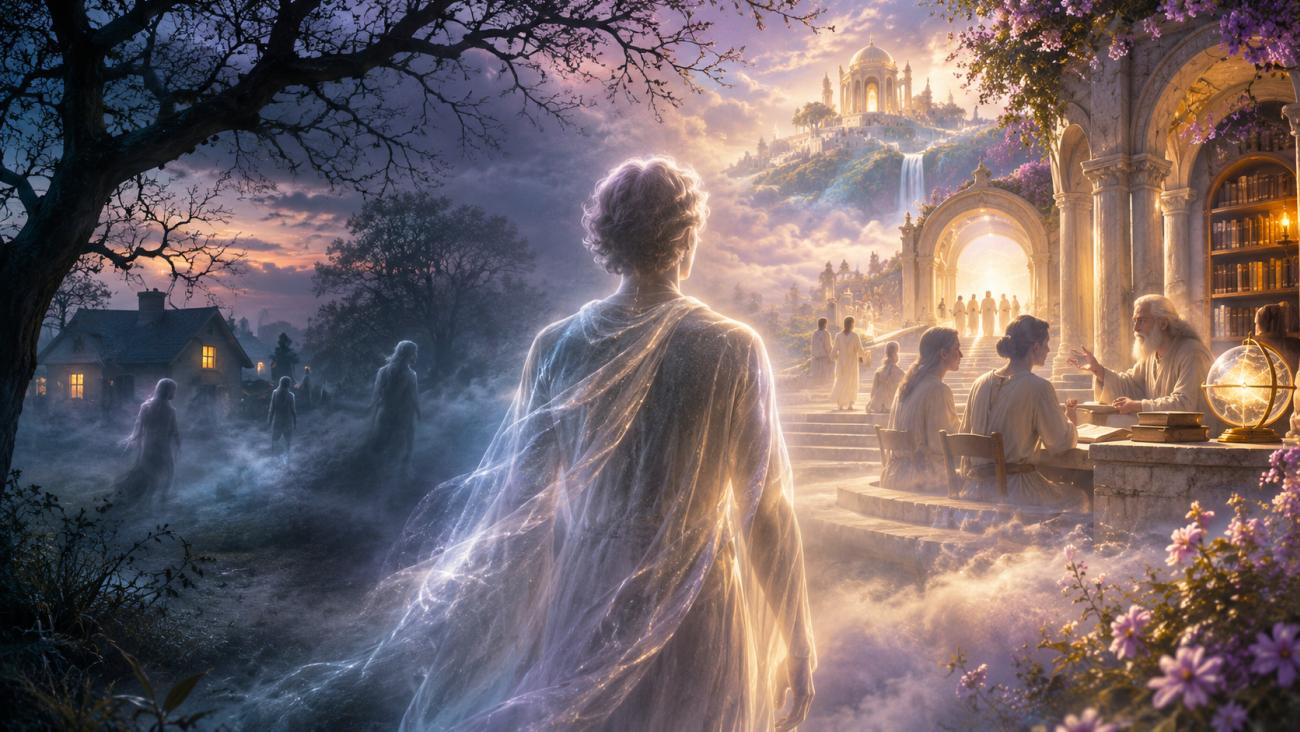
Kardec's spirits describe souls who linger near the living, some still holding grudges. Newton's clients remember soul groups, guides and a council of elders. Here is where the two afterlife maps really differ, and how they fit together.
Two of the most widely read maps of the afterlife seem, at first glance, to describe two completely different places. One comes from a nineteenth-century French educator who spent years questioning spirits through mediums. The other comes from a twentieth-century American hypnotherapist who guided his clients back through their memories of the time between lives. Read them side by side and you are left with an uncomfortable question. When we die, do we drift around the living, nursing old grudges and meddling in their affairs? Or do we head off to something resembling a celestial campus, with teachers, study halls and a review board?
The surprising answer is that the two accounts agree on far more than they seem to. Where they really part ways is narrower, more interesting, and says a great deal about how each picture of the spirit world was gathered in the first place.
The Spirits’ Book, first published by Allan Kardec in 1857 and expanded in 1860, is arranged as more than a thousand numbered questions put to communicating spirits, with their answers and Kardec’s own commentary. In question 531, Kardec asks whether the malice of people who harmed us on Earth ends when they die. The reply is sobering. Many of them, once free of the body, see the injustice of what they did and regret it. Others, if divine law permits, keep following their former victim with the same hostility, and that ongoing pressure becomes part of the living person’s trial. Kardec adds his own note that imperfect spirits can carry a vendetta from one lifetime into the next.
The picture that forms is of a spirit world pressed right up against our own, crowded with discarnate beings who watch us, whisper to us and, in some cases, work against us.
Now open Journey of Souls, Michael Newton’s 1994 collection of case studies. His hypnotised clients describe leaving the body, passing through a kind of gateway, being met by a guide and having the residue of their last life gently washed away. They rejoin a familiar group of fellow souls, study their past choices in something like a library, appear before a council of wise elders, and eventually help select their next body and life. Hanging around the living to settle old scores does not seem to be on the timetable at all.
So which is it?
The first thing to clear up is a word. Kardec calls spirits between incarnations “errant,” which sounds like aimless wandering. In his usage it simply means a spirit that is not currently in a body and will incarnate again. The section on errant spirits (questions 223 to 233) paints a much more structured picture than question 531 alone suggests.
According to the communicating spirits, the interval between lives can last anywhere from a few hours to, in the old Blackwell translation, “thousands of ages.” There are errant spirits of every degree, so being between lives is not in itself a sign of backwardness. And when Kardec asks what errant spirits actually do, the answer is: they study. They review their past, look for ways to rise higher, observe the places they pass through and learn from enlightened people and from more advanced spirits.
The same section explains why some do not behave so well. Strong passions cling to a spirit after death, almost like an atmosphere wrapped around it, keeping its old faults alive. Spirits still attached to their passions suffer, while the more detached ones are happier. Purified spirits regularly visit lower worlds to guide those who live there. Kardec even describes transitional worlds that serve as resting stations where spirits gather for instruction, and a later chapter covers the choice of trials, in which a spirit plans the difficulties of its next life.
Elsewhere the spirits are blunt about grudges. In the section on sympathy and antipathy between spirits, they say hatred exists only among impure spirits, and that most former enemies come to see their quarrel as petty once they cross over.
In other words, Kardec’s spirit world has a school too. The mischief of question 531 is not what all spirits do. It is what one band of the spirit hierarchy does.
Newton was a counselling psychologist and hypnotherapist who said he stumbled onto the interlife by accident while working with a client on past-life material. Journey of Souls presents 29 cases, and its 2000 sequel, Destiny of Souls, draws on around 70 more. Over his career he is credited with guiding several thousand people through what came to be called Life Between Lives sessions. The opening scenes his clients described, leaving the body and being met by a welcoming presence, will feel familiar to anyone who has read accounts of near-death experiences.
His map is orderly. Souls are graded by experience from beginner to advanced, with the colour of their energy reflecting their level. Each belongs to a primary soul group of companions who incarnate together over many lifetimes. Guides oversee their progress, and a council of elders reviews each completed life with compassion rather than judgement.
Yet Newton’s framework is not as sealed off from Earth as it first appears. His guides influence incarnate people through intuition and dreams. Souls can return to comfort grieving family members. And Newton describes what he called displaced or disturbed souls: spirits so distressed or so attached to their old lives that they resist going home and linger near the physical world as what we would call ghosts. Souls whose energy has been badly damaged by cruel lives are set apart for a period of intensive repair before rejoining others.
What Newton does reject is the idea of truly evil spirits. In his account, there are no demons, only souls that are young, wounded, confused or careless.
Once both books are read in full, the contrast shrinks. Kardec has study, guides, life review and planned reincarnation. Newton has influence on the living, earthbound souls and spirits in need of serious rehabilitation. Both models contain both behaviours.
The genuine difference is one of proportion.
Kardec describes Earth as a world of trial and atonement, populated mostly by spirits from the lowest of his three orders: imperfect spirits still tied to matter, ranging from the frivolous and mischievous to the actively malicious. For him, spirits still bound to their passions are common, and their presence around us is a normal feature of life.
Newton treats the same kind of soul as an exception. In his clients’ reports, the earthbound condition is unusual, temporary and quickly addressed by guides.
Lay one map over the other and they line up surprisingly well. Newton’s tidy cycle of gateway, group, library and council looks like the experience of spirits from roughly Kardec’s upper third order and above, those free enough of earthly attachment to move on. Kardec’s grudge-bearing spirits look like a larger version of Newton’s displaced souls. The two systems mostly disagree on how big that troubled group really is.
Why would honest researchers reach such different estimates? A large part of the answer lies in their methods.
Mediumship opens a channel to whichever spirits happen to be close by and willing to speak. Kardec warned repeatedly that frivolous and deceptive spirits crowd into séances, and he built checks into his work to filter them. But that very warning tells us something: the population he was sampling was weighted toward spirits who hang around the physical world. Those are precisely the spirits question 531 describes.
Hypnotic regression works the other way round. It can only reach souls who are incarnate again right now. By definition, every one of Newton’s clients had already completed the full cycle and come back. A spirit currently drifting near Earth, caught up in resentment, cannot lie down on a therapist’s couch. His clients were also self-selected: people drawn to a spiritual hypnotherapist, not a random cross-section of humanity. Memory may be selective as well, since the classroom is far easier to recall fondly than a long spell spent haunting a rival.
Each source is therefore reporting on a different crowd, and different reports are what we should expect.
Sceptics add another layer. Research on past life regression shows that hypnosis can make people more suggestible, and that a hypnotist’s expectations can shape the stories clients produce. Mediumship carries a parallel risk, because every message passes through a medium’s mind and then through the compiler’s editing. Neither approach is a clean window, and it is fair to hold both to the same standard.
Even if you accept both sources as genuine, they speak in the idiom of their time.
Kardec worked in Catholic France in the 1850s. His communicating spirits reframed the devils of church teaching as imperfect human spirits who could and would improve. The moral struggle against temptation stays at the centre, now relocated from hell to a hierarchy of discarnate souls, and prayer remains the main defence.
Newton worked in late twentieth-century America, steeped in counselling and personal growth. His spirit world speaks the language of therapy and education: healing showers, counsellors, study groups, evaluations, life planning. Evil disappears and is replaced by immaturity and injury.
Whatever is behind each map, both descriptions use the vocabulary their age made available.
Kardec himself supplies the key that makes the two accounts compatible. His spirits say that what a spirit perceives depends on its degree of advancement. Errant spirits generally remain in surroundings that match their level, and when they enter higher spheres they do so as strangers, catching only glimpses. Add the enormous range in how long the interval lasts, from hours to ages, and a coherent picture appears.
Newton is describing the inner experience of a moderately developed soul that lets go of the Earth fairly quickly and steps into an orderly cycle of rest, review and learning. Kardec is describing the whole range, including the heavy lower band of spirits who have not let go. For a spirit consumed by bitterness there is no library and no council, at least not yet. Its world is the Earth, its old injuries and the person it blames. That is exactly the world of question 531.
Seen this way, the two books are not contradicting each other. They are describing different floors of the same building, and arguing mainly about how many people live on the ground floor.
Whichever map feels closer to the truth for you, both point to the same practical lessons.
First, inner state decides the journey. Kardec’s spirits say passions cling after death; Newton’s clients describe souls held back by unresolved pain. The attachments and resentments we cultivate now are the baggage we carry across.
Second, forgiveness is protective in both directions. In the follow-up to question 531, Kardec’s spirits say that praying for a hostile spirit and returning good for its ill will gradually disarms it, because it gains nothing from its efforts. In his later work on the Gospels, Kardec urges readers to reconcile with their adversaries before death, so that no grudge outlives the body on either side.
Third, fear is unnecessary. Even in Kardec’s more crowded spirit world, guides and higher spirits are active, and a calm, kind and morally steady person gives troublesome spirits very little to work with. In Newton’s world, help is waiting for every soul willing to accept it.
So, do spirits wander or go to school? The most honest answer the two maps allow together is: both, depending on what each spirit is ready for. The question that remains open, and that neither source can settle on its own, is how many of us head straight for the classroom and how many linger at the gate for a while first.