Physical Address
304 North Cardinal St.
Dorchester Center, MA 02124
Physical Address
304 North Cardinal St.
Dorchester Center, MA 02124

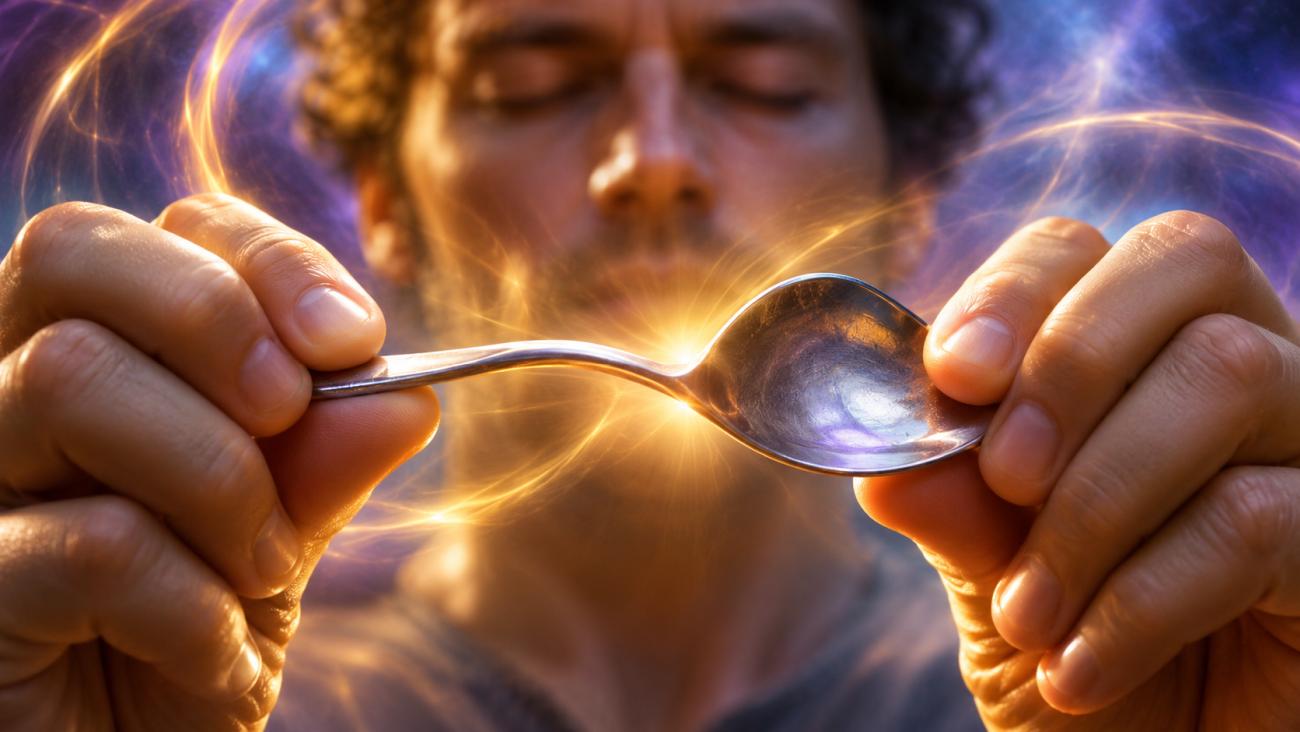
Few experiments in consciousness are as tactile, as playful, or as quietly unsettling as spoon bending. You sit at a table with an ordinary piece of cutlery, you shift your state of mind, and for a short window the metal seems to stop behaving like metal. Whether you come to it as a curious sceptic or a committed explorer of psychokinesis, the practice offers something rare: a direct, hands-on test of how much your expectations shape what you experience. This guide draws on a workshop-style teaching shared by medium Jamie Butler, known as the Everyday Medium, and places her method alongside the wider history, the energy practices that support it, and the honest debate around what is really happening.
Metal bending entered popular culture in the 1970s, when televised demonstrations turned bent keys and spoons into the universal symbol of psychic ability. The history of metal-bending research is a tangle of excited early testing, physicists who changed their minds, and magicians who showed how easily the effect can be faked.
The version most people practise today owes more to an aerospace engineer than to any stage performer. Through the 1980s and beyond, Jack Houck ran hundreds of PK parties, group gatherings where noise, laughter and shared expectation were treated as essential ingredients. Houck described a brief phase he called warm-forming, when the metal appeared to soften enough to fold with very little pressure. His format spread widely, and organisations such as the Institute of Noetic Sciences still describe PK parties as a form of citizen science for the consciousness movement.
The Monroe Institute in Virginia also became a centre for this kind of work. Psychologist Joe Gallenberger, a long-time trainer there, built a programme around psychokinesis, healing and manifestation, and metal bending became one of the most memorable exercises for participants.
Spoons won out over other objects for practical reasons. They are cheap, easy to replace, and blunt. Forks have tines that can jab a finger, and knives are an obvious bad idea for a beginner, so start with a spoon and leave everything with an edge or a point in the drawer.
Most teachers agree that the biggest obstacle is not the steel. It is the deeply held certainty that steel cannot yield. Before you touch the spoon, it helps to loosen that certainty a little.
Physics offers a useful starting point. Nearly all of an atom’s mass sits in a tiny nucleus, and the rest of its volume is defined by spread-out electron clouds, which is why physics teachers often say that atoms are mostly empty space. To be fair to the science, objects feel solid because of electromagnetic repulsion and quantum rules, not because anything is packed tight. The point of the exercise is not to argue physics. It is to soften the mental image of the spoon as an unbreakable lump and to hold it instead as a pattern of energy and relationship that is more open than it looks.
Readers familiar with Thomas Campbell’s My Big TOE framework will recognise the idea that physical reality behaves like a rule set within consciousness. From that angle, spoon bending becomes a small, safe way to ask how firmly those rules are held in your own experience, and what shifts when intent and expectation change.
Gather a handful of spare spoons, ideally mismatched ones you will not miss. Stainless steel is fine, and so is most other cutlery metal, although you may prefer not to practise on family silver. Lay them out and pass your palms slowly over each one. Many people report that one piece feels more inviting than the rest, a faint pull or warmth in the hand. Choose that one.
Next, look for the spot where the bend wants to happen. Pinch the handle lightly between thumb and index finger and slide slowly up and down its length. Usually there is one area, often near the point where the spoon balances, that warms faster than the rest. Treat that as your focal point. Keep rubbing it gently while you settle in.
People who live mostly in their heads often find that the logical, watchful part of the mind is exactly what stalls the process. Two approaches help.
The first is sound. Group sessions frequently use a simple repeated command, chanted louder and louder until self-consciousness gives way to momentum. It can feel silly for the first minute, and that is part of its value: the inner critic gets drowned out. If you prefer something gentler, a phrase such as “I am the light” works well as a steady inner mantra.
The second is distraction. A surprising number of practitioners say the metal stiffens the moment they stare at it and wait for a result. Talk to a friend, tell a story, hum a tune, or think about something unrelated while your fingers keep working. Paying light, peripheral attention, rather than intense scrutiny, seems to keep the window open.
For those who enjoy energy work, a short visualisation adds another layer. Sit upright and picture a ball of light entering through the crown of your head. Draw it down into your chest and let it gather there, imagining a warm, almost affectionate regard for the spoon in your hands.
Then work with the breath. Take a few slow, deep breaths, holding each one slightly longer than the last. On a final full exhale, imagine all that collected light pouring down your arms, through your palms and fingers, and into the warm spot on the handle. Many people say this is the moment the metal begins to feel different, with a slight springiness or give under the fingertips.
Some teachers add yogic and Taoist methods for gathering energy before releasing it. The best known is mula bandha, a gentle lift of the pelvic floor muscles. A good beginner’s guide to mula bandha describes it as a contraction at the centre of the perineum that steadies the energy system and sharpens concentration. Keep the buttocks relaxed and sit or stand tall, since slumping tends to collapse both posture and focus. If uprightness is difficult, try practising with your back against a wall.
A second technique places the tip of the tongue just behind the upper front teeth. In Taoist practice this links the front and back energy channels so that energy circulates rather than escaping. Not every teacher recommends it for beginners, and one qigong instructor argues that lifting the tongue can create unwanted tension if you have not prepared for it. Try it lightly, and drop it if your jaw or throat starts to tighten.
The general rhythm is simple: gather and hold on the in-breath, then release everything on the out-breath and direct it into the spoon.
The most important instruction is also the easiest to forget: do not force anything. When the metal reaches its soft phase, a gentle, guiding pressure is all that is needed. Think of shaping warm candle wax rather than wrestling a crowbar.
A useful check is to look at your fingers afterwards. Bending a spoon by muscle alone tends to leave red pressure lines on the skin. Practitioners say that when the energetic softening is working, the hands stay unmarked because so little effort was involved. Be aware that the metal can also snap without warning, so keep your face clear and handle any broken edges with care.
Honest exploration means taking the critics seriously. Rubbing metal does produce warmth through friction, and many sceptics argue that the bending is simply ordinary force applied while the mind is distracted. Controlled psychology research has also shown how powerful suggestion can be: in one well-known study summarised on the Wikipedia page on spoon bending, viewers who heard a performer claim a key was still bending reported seeing movement that never happened. Even researchers sympathetic to psi acknowledge that early laboratory claims were often undermined by weak controls and outright trickery.
None of this rules out a personal, meaningful experience. What it does suggest is a sensible stance: treat spoon bending as an experiment in attention, expectation and state of mind, and keep notes. Compare sessions where you force the metal with sessions where you relax into the process. Pay attention to how your body feels, what your mind was doing at the moment of softening, and whether results change with mood, group energy or time of day. Your own careful observation is worth more than any testimonial.
Once the basic practice feels familiar, many people use it as a gateway to other disciplines. Candle gazing with a repeated mantra is a good way to train single-pointed focus, and that steadiness carries straight back into metal work. Some practitioners move on to bending without touch, although even experienced teachers describe this as rare, slow and hard-won, sometimes involving days of patient connection with something as small as a paperclip.
There is a creative side too. Bent cutlery makes striking wind chimes, garden ornaments and small sculptures, which gives your practice spoons a second life.
Above all, keep the spirit light. The practice works best when approached with curiosity and play rather than pressure to prove something. Whatever happens on the day, you will have spent time observing your own mind, testing your assumptions about what is fixed, and noticing how much of your reality you were holding rigid without realising it.