Physical Address
304 North Cardinal St.
Dorchester Center, MA 02124
Physical Address
304 North Cardinal St.
Dorchester Center, MA 02124

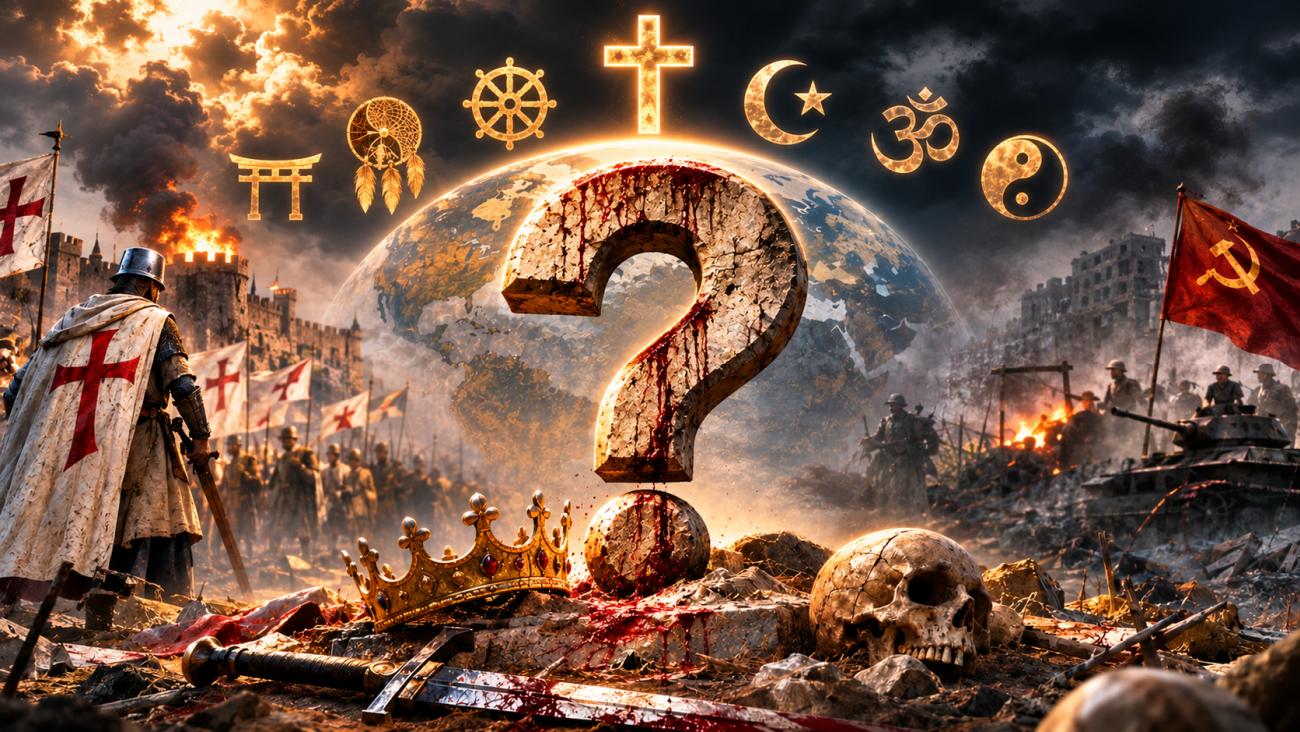
Every so often a startling statistic makes its way around social media. Over the last two thousand years, it says, the civilization responsible for the largest share of humanity’s mass killing is not the one most Westerners would name if asked. Islam, so often cast as the villain in modern headlines, sits near the bottom of the list. Christian civilization sits at the top, and the communist world, which rejected God altogether, comes in second.
The figures come from a real academic study, and they deserve to be taken seriously. They also deserve to be read carefully, because what the study actually measures is not quite what the viral version claims. Beneath the numbers sits a question that matters far more to anyone walking a spiritual path: what is it in human beings that turns conviction into permission to kill?
The research is the work of political scientist Naveed Sheikh, who was at the University of Louisville when he published Body Count: A Quantitative Review of Political Violence Across World Civilizations in 2009 through the Royal Aal al-Bayt Institute for Islamic Thought in Jordan. A revised version later became chapter seven of War and Peace in Islam: The Uses and Abuses of Jihad, an essay collection edited by Prince Ghazi bin Muhammad, Ibrahim Kalin and Mohammad Hashim Kamali, and it appeared again in an Edward Elgar volume on Islam and the law of armed conflict in 2015.
Sheikh built his framework on Samuel Huntington’s well known idea that after the Cold War the world would divide along large cultural blocs, with religion as the deepest fault line. He adapted Huntington’s map into seven groupings: Antitheist (the communist states), Buddhist, Christian, Indic, Islamic, Primal-Indigenous and Sinic (China and its cultural neighbours).
His method had three stages. First, he catalogued more than 3,000 violent episodes between the year 0 and 2008. Second, he filtered these down to the 276 deadliest, each with an estimated toll above 10,000 lives. Third, he assigned each episode to the civilization he judged responsible. He counted four kinds of violence: wars between states, civil wars, democide (governments killing their own populations), and structural violence such as the transatlantic slave trade. Because historical death tolls are so uncertain, every figure comes as a low and a high estimate.
Across the full two millennia, Sheikh estimated that political and religious violence cost somewhere between 449 million and 709 million lives, with a midpoint of roughly 579 million. Here is how that total divides, using his median figures:
Sheikh also isolated genocide. He counted 30 genocidal episodes with a combined toll of around 51 million. Fourteen of these, accounting for about two thirds of the deaths, fell in the Christian column. The Antitheist bloc had three episodes with 8.25 million deaths, the Sinic bloc two with 5 million, and the Islamic bloc nine with just under 4 million. The Indic world recorded none above his threshold.
His summary verdict was blunt: Christian civilization was, in his words, “the most bellicose on all counts.” He also pushed back against the common argument that godless regimes are the true record holders for slaughter. The Antitheist world comes second overall, but its killing was concentrated into far fewer events. Divide its toll by its 19 recorded episodes and each one averages more than six million dead, against roughly one million per Christian episode and well under half a million per Islamic one. Atheist states did not kill most often. When they killed, they killed on an industrial scale.
Here is where careful reading changes the picture. The study does not measure what any faith teaches. It measures which cultural bloc a conflict’s instigator belonged to. That is a very different thing.
Consider the Second World War, the single largest entry in the dataset. Sheikh split its tens of millions of deaths between the Christian and Buddhist columns, reflecting Nazi Germany and Imperial Japan. Neither regime went to war to spread the Gospel or the dharma. A writer for The Christian Century who otherwise accepted the broad thrust of the findings objected that filing the Nazi genocides under Christianity makes about as much sense as calling communists Christian.
The rules for assigning blame also involve judgment at every turn. The party that started hostilities is held responsible. In colonial wars the colonizer carries the toll. In uprisings and state killings, the government is held responsible by default. Each rule is defensible, yet each can shift tens of millions of deaths from one column to another.
Then there is the matter of scale and time. Christian civilization occupies the entire two thousand year window and, for much of the modern era, was the largest and most industrialized bloc on Earth. The twentieth century’s mechanized wars dominate every column they touch. Islamic civilization only enters the record in the seventh century. The study does not adjust for population size, so a larger and more technologically advanced bloc will almost inevitably post larger numbers.
Critics from other directions have found the opposite bias. An analysis in the Indian magazine Swarajya argued that the Islamic share is understated. It points out that the Partition of India was split between the Islamic and Indic columns, and that the First World War went into the Christian column even though the Ottoman Empire fought in it. The Christian Century writer, for his part, noted the study’s silence on centuries of Ottoman campaigns into Christian Europe.
Sheikh himself was candid about the softness of the data. Estimates for some historical episodes differ by a factor of ten, which is why his ranges are so wide. Readers may also want to know that the original monograph was published by an Islamic institute and later anthologized in a volume written to correct Western misconceptions about jihad. That context does not make the research wrong, but it is worth holding in mind when a study’s conclusions happen to flatter its publisher.
None of this means the study is worthless. It works well as a mirror held up to a lazy assumption: that mass violence is the specialty of somebody else’s religion. What it cannot do is prove that any tradition’s teachings produce killing.
Other researchers who have tried to answer that question directly have reached more modest conclusions than either side of the online argument would like. Historian Andrew Holt went through Matthew White’s ranking of the hundred deadliest atrocities in history and found that only about 15 percent were primarily or significantly religious in motivation. Theologian William Cavanaugh went further in The Myth of Religious Violence, arguing that the very idea of “religion” as a separate, uniquely dangerous category is a modern Western invention, and that secular ideologies are every bit as capable of absolutism.
Sheikh acknowledged the same problem at the outset of his own study. He conceded that historians cannot cleanly separate the divine from the political, economic and territorial forces that drive real wars. His working hypothesis was more subtle: wherever large scale violence breaks out, there tends to be talk of an absolute, unquestionable truth standing behind it.
This is where the Antitheist result becomes genuinely illuminating. The regimes that abolished God from public life killed on a scale second only to the largest civilization in history, and they did it in a fraction of the time. They did not need a deity to manufacture an absolute. History’s inevitable direction, the purity of the revolution and the promise of a perfect future did the same work. The structure was identical: a truth that justifies anything, a group that carries it, and an enemy that stands in its way.
From a consciousness perspective, this is the real finding hidden in the data. Physicist and consciousness researcher Thomas Campbell describes the purpose of an individual consciousness as growing from fear toward love through the choices it makes. In his My Big TOE model, fear and ego increase disorder, or entropy, while love and cooperation reduce it. Mass killing is high entropy on a collective scale: fear organized, armed and given a banner.
Look again at those seven columns with that lens. Behind each one lies the same inner mechanism: fear of the outsider, fear of scarcity, fear of losing status, fear of the heretic or the class enemy. The banner changes from cross to crescent to red star, but the psychology underneath stays remarkably constant. Religion is simply one of fear’s most persuasive costumes, because it offers the highest possible stakes. Secular ideology, as the twentieth century proved, can offer stakes just as high.
What gets abandoned first, in every case, is the heart of the very tradition being invoked. Love your enemy. Compassion for all sentient beings. Mercy as a divine attribute. No massacre has ever been carried out in obedience to those teachings. They are what the killers had to set aside.
There is also a quieter trap in how studies like this get used. When a body count circulates online, it is usually deployed as a scorecard: proof that the other side is worse. The flush of relief when one’s own group ranks lower, or the satisfaction of seeing a rival group exposed, is the same us-versus-them reflex that fuels the violence being counted. It is the shadow at work, projecting darkness outward so it never has to be faced within.
If you come across this study, or any ranking like it, a few questions can help you read it from a place of clarity rather than tribal reflex.
What is actually being measured? Ask whether the label describes the beliefs that drove the violence or simply the cultural geography of the people involved. These are rarely the same thing.
What do you feel when you see the ranking? Relief, vindication or defensiveness are all signals worth noticing. They point to where identity has fused with a group in a way that can be exploited.
Who were the people inside the numbers? Every unit in those totals was a life with a name, a family and a story. Letting that land is itself a form of practice.
Which teaching was abandoned? In almost every case, the perpetrators acted against the deepest values of the tradition they claimed. Naming that gap honours what the tradition is meant to be.
Where do you hold a truth so tightly that you would harm to protect it? This is the question that brings the study home. The scale of history’s violence is built from countless smaller moments of certainty, contempt and fear in ordinary human hearts.
Somewhere between half a billion and seven hundred million people lost their lives to organized human violence in the last two thousand years, by Sheikh’s reckoning. No tradition emerges with clean hands, and neither does the rejection of tradition. The numbers can tell us where violence clustered and how it scaled. They cannot tell us which god is guilty, because the evidence points somewhere else entirely.
The deeper lesson is that the line between peace and slaughter does not run between civilizations. It runs through every individual consciousness, in the daily choice between fear and love. The spiritual work of our time is not to win the argument over whose ancestors killed more. It is to loosen, in ourselves first, the grip of the fear that makes every banner deadly.