Physical Address
304 North Cardinal St.
Dorchester Center, MA 02124
Physical Address
304 North Cardinal St.
Dorchester Center, MA 02124

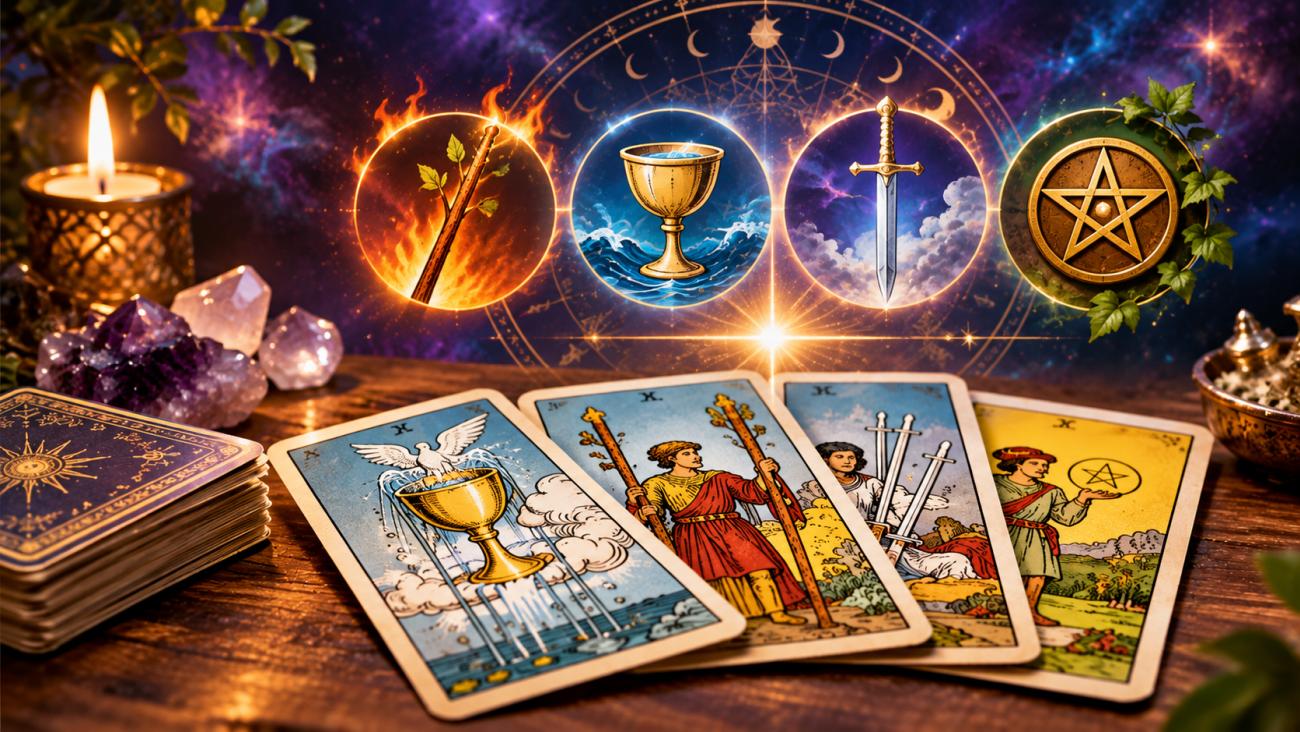
Most people come to tarot the same way. A deck arrives, the cellophane comes off, and a small booklet falls out with 78 lists of keywords. You read them, highlight a few, and promise yourself you will know them by the weekend. Then you lay out your first spread, look down at three unfamiliar faces, and nothing comes. The keywords have gone wherever keywords go when you need them most.
If that has happened to you, it is worth hearing clearly: the problem is not your memory, and it is certainly not your intuition. The problem is the approach. Tarot was never designed as 78 unrelated facts to be crammed. It is a structured system, and once you see the structure, a large part of the deck starts explaining itself.
Rote memorisation treats every card as an island. The Six of Cups has nothing to do with the Six of Swords, which has nothing to do with the Six of Pentacles. Each one becomes another entry in a list you are trying to hold in your head, and lists collapse under pressure.
There is a deeper issue too. When you read from memorised keywords, you are reading the booklet, not the cards. Your attention goes inward to a mental filing cabinet instead of outward to the image and the question in front of you. Intuition works through recognition and relationship, not recall. Give it a pattern and it will run with it. Give it 78 disconnected definitions and it freezes.
A standard deck has two parts. As the overview of tarot’s structure on Wikipedia sets out, there are 22 Major Arcana cards, the big archetypal figures like The Fool and The Tower, and 56 Minor Arcana cards divided into four suits. Each suit holds ten numbered cards, Ace through Ten, plus four court cards.
That gives you 40 numbered cards built from just two variables: which suit, and which number. Learn four suits and ten numbers, fourteen ideas in total, and you can work out the core of all 40 without memorising a single one of them individually.
It also helps to know why these cards have pictures at all. For centuries most decks showed the numbered cards as simple arrangements of cups or coins, much like playing cards. The deck most modern readers learn on, the Rider-Waite-Smith tarot first published in 1909, changed that by giving every Minor Arcana card a full scene. Those scenes were drawn by the artist Pamela Colman Smith, who, as Hyperallergic’s profile of her largely uncredited work explains, went unrecognised for decades even though her images now define how most of the world pictures tarot. Her one notable predecessor was the Sola Busca tarot, a late fifteenth century Italian deck and the earliest known to illustrate every suit card.
Smith’s scenes are not decoration. They are the suit and number speaking together in pictures, which is exactly why the pattern below works so well with her deck and the many decks based on it.
Think of each suit as a domain of life, the area where something is happening.
Wands are desire and drive. This is the suit of fire: ambition, creativity, passion, the urge to act and to make something happen. When a Wands card appears, ask what the person wants and what they are doing about it.
Cups are the heart. Water rules this suit: emotions, relationships, love, intuition and the inner life. Cups ask how someone feels and who they feel it about.
Swords are the mind. Air belongs here: thoughts, beliefs, words, decisions, and the conflicts that come from them. Swords can be sharp and clarifying, but they are also where we cut ourselves with worry and harsh self-talk.
Pentacles are the tangible world. Earth governs money, work, the body, health, home and everything you can physically hold. Pentacles ask what someone has, builds or stands to lose.
If the suit tells you where, the number tells you when. Read the numbers as stages in a single unfolding cycle.
Ace: the seed. A fresh start, raw potential, an opening.
Two: a fork in the road. A decision, a pairing, a balancing act.
Three: first growth. Something takes shape and expands, often with others involved.
Four: a foundation. Stability, consolidation, a pause to secure what has been built.
Five: disruption. Conflict, loss or difficulty that shakes the foundation.
Six: recovery. Healing, rebalancing, moving through the aftermath.
Seven: a test. Something challenges your position, your resolve or your perception.
Eight: sustained effort. Momentum, work, discipline, the long middle stretch.
Nine: almost there. Near culmination, with the intensity that comes right before an ending.
Ten: the full circle. Completion, the cycle fulfilled, sometimes to the point of excess, before it begins again.
Now put the two together. The method is simple: take the number’s stage and apply it to the suit’s domain.
A Two in Cups is a choice or a pairing in the realm of feeling, which is why the Two of Cups is so often read as a new bond between two people. An Ace of Pentacles is a seed planted in the material world: a job offer, an investment, a new opportunity you can actually hold. A Ten of Swords is the mind’s cycle completed to its painful extreme, the point where a mental struggle cannot get any worse and has to end.
You did not need to memorise any of those. You worked them out. That is the shift: from recalling meanings to reasoning your way toward them.
The pattern gives you a first draft. The image gives you the final copy. Once you have the basic idea from suit and number, look at what Smith actually drew. Who is in the scene? What are they doing? What is in the background? The picture will confirm your reasoning, sharpen it, and sometimes take it somewhere you did not expect.
This is where tarot stops being a vocabulary test and becomes what it is meant to be: a mirror for the person asking. The structure keeps you grounded, and the image opens the door for intuition to step through. Here are three cards worked through this way.

The pattern: Seven is a test. Wands are drive, ambition and action. So this card is about your will being tested, your ambitions or position coming under challenge.
The image: A man stands on higher ground, holding one staff and fending off six others thrust up at him from below. He looks determined but under pressure. Look closely at his feet and you may notice he is wearing two different shoes, a detail many readers take to mean he was caught off guard and rushed into the fight before he was ready.
The reading: Someone has worked hard to get where they are, and now others want a piece of it, or want to knock them down. The card asks them to hold their ground and defend what they have earned. As the Biddy Tarot guide to the Seven of Wands frames it, success tends to attract competition and criticism, and this card calls for confidence and persistence. The pattern got you to “drive under test.” The image added the high ground and the unexpected timing.
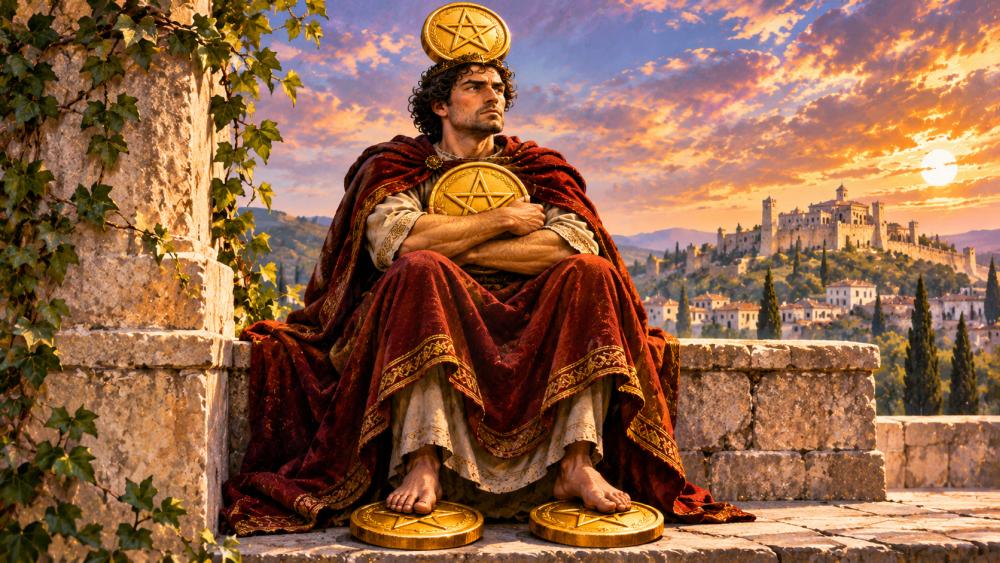
The pattern: Four is stability and foundation. Pentacles are money, possessions and material security. So this card is about financial or material stability, about holding on to what you have.
The image: A crowned figure sits outside a town, clutching one coin tightly to his chest. Another rests on his head and two are pinned under his feet. He is not going anywhere, and nothing is getting past him.
The reading: Here the image adds an important twist. Stability in the material world can tip into a white-knuckle grip. There is security in this card, but also fear of loss, a reluctance to spend, share or risk anything. The Aeclectic Tarot reading of the Four of Pentacles notes that caution can be wise but too much of it leads to stagnation. The question this card brings is a soulful one: are you protecting what matters, or has protection itself become the prison?

The pattern: Eight is sustained effort and momentum. Swords are the mind: thoughts, beliefs and words. So this card points to the mind working hard, perhaps too hard.
The image: A woman is blindfolded with her arms loosely bound, surrounded by eight swords planted in the ground. At first glance she looks trapped. Look again. The swords do not fully enclose her, there is open ground in front of her, and the bindings are not tight. If she could see, she could simply walk out.
The reading: This is where the pattern and the picture work together most beautifully. The effort of the Eight has turned inward. The mind is labouring, but its energy has gone into building a cage of fear, assumption and worst-case scenarios. The Labyrinthos guide to the Eight of Swords describes the core feeling as being trapped and powerless, while stressing that the restrictions are largely self-made and can be released through a change of perspective. A. E. Waite, who designed the deck with Smith, saw it the same way, calling it a temporary confinement rather than a permanent one.
Modern psychology has a name for this kind of mental trap. Psychology Today’s piece on breaking free of rumination describes how repeatedly turning over negative thoughts feels productive but keeps us stuck and drained. That is the Eight of Swords exactly: a great deal of mental effort, all of it spent tightening the blindfold. The way out is also effort, but redirected. Question the story, take one small concrete step, and let someone you trust help you see the open ground.
This method unlocks the 40 numbered cards, but it is not the whole deck. The 16 court cards follow their own logic, describing people or personality styles within each suit, and the 22 Major Arcana tell a larger story of spiritual initiation that deserves its own exploration. Both become far easier once the suits and numbers are second nature, because the same four elements and the same cycle of growth run through them too.
For now, try this. Pull the numbered cards out of your deck, shuffle them, and turn them over one at a time. Before you look anything up, say the suit’s domain and the number’s stage out loud and combine them. Then look at the image and let it finish the sentence. Within a few evenings you will find that the cards are no longer strangers. They are variations on a theme you already understand, and that understanding is the ground your intuition has been waiting to stand on.