Physical Address
304 North Cardinal St.
Dorchester Center, MA 02124
Physical Address
304 North Cardinal St.
Dorchester Center, MA 02124

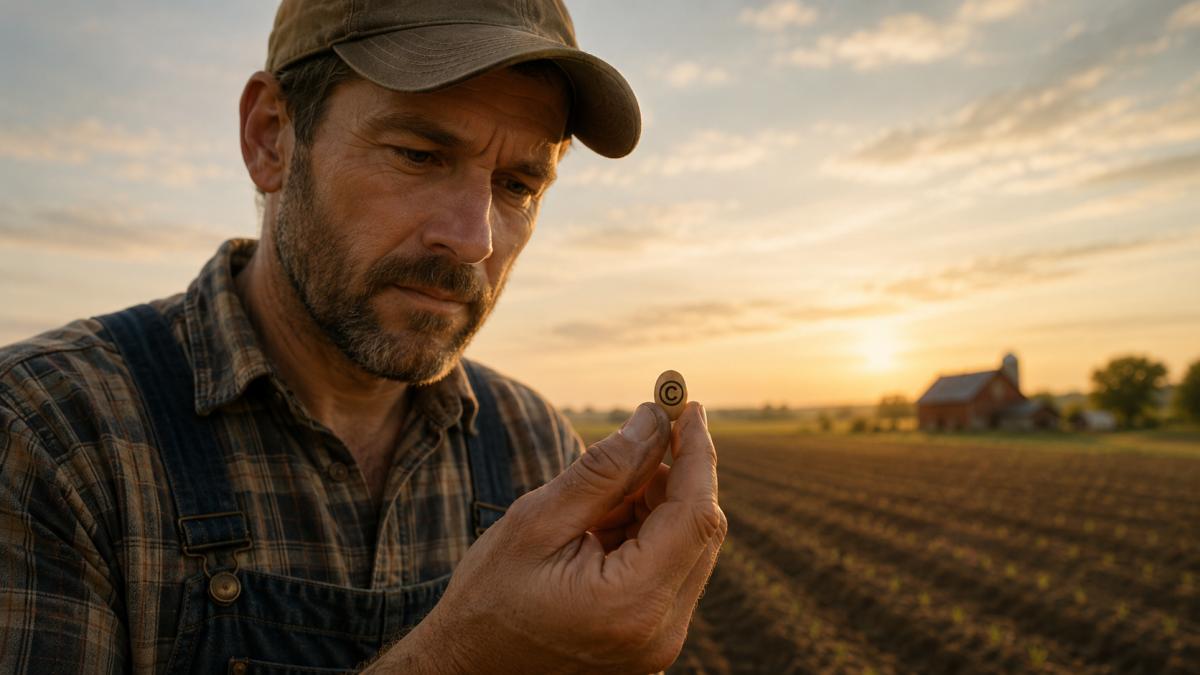
There is a quiet act that humans have performed for roughly twelve thousand years. A farmer reaches into a harvested crop, sets aside a portion of the best, most resilient seed, and tucks it away for the next planting. It is the most ancient compact between a person and the living earth. The seed gives food. The farmer returns some of it to the soil. The cycle continues, generation upon generation, free of charge, free of permission, free of any authority above the sky.
There is a quiet act that humans have performed for roughly twelve thousand years. A farmer reaches into a harvested crop, sets aside a portion of the best, most resilient seed, and tucks it away for the next planting. It is the most ancient compact between a person and the living earth. The seed gives food. The farmer returns some of it to the soil. The cycle continues, generation upon generation, free of charge, free of permission, free of any authority above the sky.
In the span of a single human lifetime, corporate America rewrote that compact. It did not ask permission. It did not pause for ethical reflection. It used patent law, lobbying, and courtrooms to turn a sacred act of stewardship into a criminal offence. If you are looking for the largest moral transgression that has ever been committed by the corporate world, look no further than the patenting of life itself and the criminalisation of farmers who do what their ancestors did since the dawn of agriculture.
Seed saving is not merely a farming technique. It is a relationship. Across cultures, from the Andean potato growers to the rice keepers of the Indian subcontinent to the corn mothers of Mesoamerica, the seed has been understood as a sacred trust. It is genetic memory made physical. It is the living archive of every drought a family survived, every disease the plants outlasted, every careful selection a grandmother made for sweetness or hardiness or colour.
When a farmer plants a seed that her line has saved for a hundred years, she is not just growing food. She is collaborating with the dead and the unborn. She is participating in a chain of consciousness that connects soil, plant, hand, and table. The corporation that walks into that field with a patent certificate and a sample bag is not just commercialising agriculture. It is severing a spiritual artery.
The legal architecture for this transgression was built quietly. In the United States, the Plant Patent Act of 1930 began the conceptual shift toward owning living things. The Plant Variety Protection Act of 1970 deepened it. Then in 1980, the Supreme Court decided in Diamond v. Chakrabarty that genetically modified organisms could be patented. Once living things could be owned, the next step was inevitable. Companies began patenting genes, then varieties, then the entire genetic lineage of staple crops.
By the time the dust settled, farmers who had been planting and saving seed for their entire lives discovered that the act of replanting a portion of their own harvest had become, in a strictly legal sense, the unauthorised manufacture of a patented product.
In 2013, the United States Supreme Court ruled unanimously in Bowman v. Monsanto Co. that an Indiana farmer named Vernon Bowman had committed patent infringement by saving and replanting soybean seeds that contained Monsanto’s Roundup Ready trait. Bowman had bought commodity soybeans from a local grain elevator, planted them as a late season crop, and saved some of the resulting harvest for the next year. According to the official Supreme Court opinion published by the Justia U.S. Supreme Court Center, the Court held that “patent exhaustion does not permit a farmer to reproduce patented seeds through planting and harvesting without permission.”
In other words, the highest court in the United States declared that the simplest, oldest, most natural act in agriculture was a violation of intellectual property when applied to seeds that had been genetically engineered. The case is dissected in clear detail by the World Intellectual Property Organization in its analysis of how the ruling cemented patent holder rights over self-replicating technology. Read it slowly. The article frames the ruling as a triumph for the biotech industry, which is precisely the point. The triumph was over the farmer.
Long before Bowman, a Canadian canola farmer named Percy Schmeiser became the face of corporate seed overreach. Monsanto sued him in 1998 after their genetically modified canola was found growing on his Saskatchewan farm. Schmeiser maintained that the seed had blown onto his fields from passing trucks and neighbouring properties. He had spent fifty years developing his own canola line. Monsanto wanted royalties.
The Supreme Court of Canada ruled five to four against him in 2004, although it accepted that he owed no damages because he had not profited from the genes. The case is documented in full by The Canadian Encyclopedia’s biographical account of Schmeiser’s life and battle, which makes clear that what was on trial was not theft but the right of a farmer to keep his own seed line uncontaminated by a corporation’s patented genes. He became, in his later years, an internationally recognised voice for farmer rights, eventually receiving the Right Livelihood Award alongside his wife Louise. The Right Livelihood organisation’s tribute to the Schmeisers is worth reading in full, particularly the section that documents Monsanto’s eventual out of court settlement and admission of cleanup responsibility.
If the legal damage was felt in North America, the human cost was felt most sharply in the Global South. When Monsanto entered the Indian seed market through Bt cotton, farmers who had saved cotton seed for generations were pulled into a cash dependency they could not sustain. Seed prices, by some accounts, rose by thousands of percent. Crops failed. Debts mounted. The wave of farmer suicides that followed has been documented for two decades.
Vandana Shiva, the Indian physicist and ecologist who founded the seed saving movement Navdanya, has written extensively on the connection between seed monopolies and the rural suicide epidemic. Her detailed response to the journal Nature on this very subject, published on the Navdanya blog under the title “Seed Monopolies, GMOs and Farmer Suicides in India”, traces the timeline directly to the entry of corporate seed into the Indian market in the mid 1990s and the introduction of Bt cotton in 2002. Whatever your view of the contested statistics, the structural picture is unambiguous. Farmers who once owed nothing to anyone for the privilege of planting were transformed, within a generation, into permanent debtors of foreign corporations.
The biodiversity cost of all this is staggering. The Rural Advancement Foundation International conducted a study in 1983 comparing the seed varieties available in commercial American catalogues in 1903 with what remained in the U.S. National Seed Storage Laboratory eighty years later. Their conclusion, summarised in RAFI’s own article “Protecting the Food Ark”, is among the most chilling statistics in food history: roughly 93 percent of the seed varieties offered to American gardeners in 1903 were extinct by 1983.
Some scholars have since contested the methodology, and the picture is more nuanced than the headline number suggests. But the direction of travel is not in dispute. The global food supply has narrowed catastrophically. Approximately seventy five percent of the world’s food now comes from just twelve crops. Where there was once a riot of locally adapted, regionally beloved, climate resilient varieties, there is now a hyper concentrated, monoculture dependent global system.
The endgame of decades of mergers and patent expansion is that four corporations now sit on top of the world’s seed and pesticide markets. According to the United States Department of Agriculture Economic Research Service chart on industry concentration, the four firms are Bayer (which absorbed Monsanto in 2018), Corteva (born of the Dow DuPont merger), Syngenta Group (owned by China’s SinoChem after the ChemChina acquisition), and BASF. Together they control the majority of global proprietary seed sales.
When four boardrooms can decide what most of humanity plants, eats, and depends on for survival, you are no longer looking at a market. You are looking at a chokepoint. And every chokepoint, in the history of human power, has been used eventually.
It is tempting to frame this as merely an economic problem or a legal problem or an environmental problem. It is all of those. But it is also, and perhaps most fundamentally, a spiritual problem.
The seed is one of the oldest symbols of generosity in the natural world. A single sunflower produces hundreds of seeds. A single tomato carries dozens. The plant gives back many times what it received. To insert a patent claim into that flow is to insert a meter into a waterfall. It is to charge the river for flowing. It violates something far older and more important than any human legal system, namely the principle that life replicates itself freely.
When corporate America made it illegal for a farmer to plant the seed she grew on her own land, it did not just commit a legal innovation. It committed a metaphysical offence. It told the human race that the gift economy of the soil was now under licence, and that the very act of returning a seed to the earth was a corporate matter, subject to royalties.
Across the world, a quiet rebellion has been underway. Community seed banks have multiplied. Heritage variety societies have grown. In 2012, a group of plant breeders, farmers, and academics founded the Open Source Seed Initiative, modelled on the free software movement, to create a protected commons of seeds that can never be locked away by patent. The pledge they ask breeders to sign is published in full on the OSSI’s official pledge a variety page, and it is brief and beautiful. It guarantees that the seed, and any variety bred from it, will remain free forever.
This is the resistance that is being built. Not in lobbying offices, but in seed swaps, kitchen gardens, indigenous seed keepers, and small breeders who refuse the patent model. Every grandmother who saves tomato seed in a paper envelope is part of it. Every neighbour who exchanges bean varieties at the gate is part of it. Every plant breeder who releases a new tomato or squash under an open pledge is part of it.
The biggest sin corporate America ever committed was to forget that the seed does not belong to anyone. It belongs to the soil, to the future, to the long human and pre human conversation between root and rain. To criminalise the saving of seed is to declare war on one of the oldest peace treaties on earth. The good news, the very good news, is that treaties of that age cannot be unmade by any court. They only need to be honoured again.