Physical Address
304 North Cardinal St.
Dorchester Center, MA 02124
Physical Address
304 North Cardinal St.
Dorchester Center, MA 02124

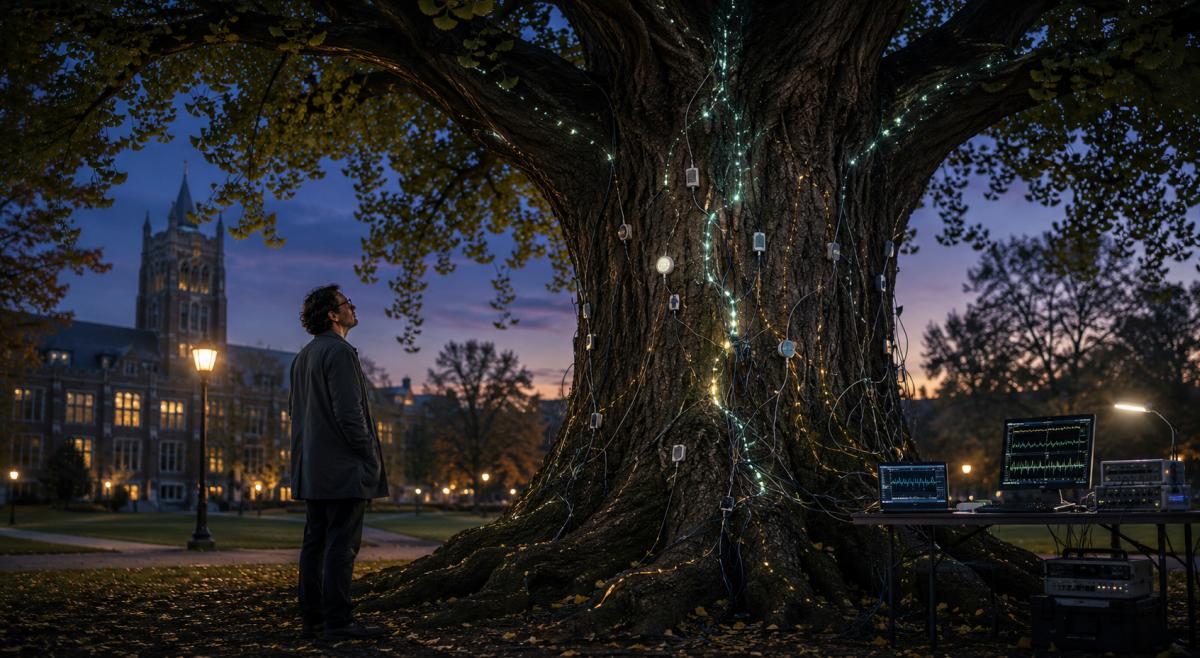
A ginkgo tree stands on a university campus. A neurologist who has spent his life mapping the electrical whispers of infant brains begins, very quietly, to wonder if that tree has whispers of its own. He sets up sensors. He runs visualizations. He does not become the tree's friend exactly, but he becomes something rarer in a Western scientist. He becomes curious without contempt.
A ginkgo tree stands on a university campus. A neurologist who has spent his life mapping the electrical whispers of infant brains begins, very quietly, to wonder if that tree has whispers of its own. He sets up sensors. He runs visualizations. He does not become the tree’s friend exactly, but he becomes something rarer in a Western scientist. He becomes curious without contempt.
This is the premise of Silent Friend, the new feature from Hungarian filmmaker Ildikó Enyedi, recently profiled in Scientific American. The film is fiction. The science it points toward is not. And the deeper truth it gestures at is something the rest of the world, the older world, the world that did not begin with Descartes, has been quietly holding for thousands of years.
The interesting thing is not that a film is asking whether plants are conscious. The interesting thing is that a peer-reviewed mainstream science publication is taking the question seriously again.
Long before there were laboratories, there were forests, and there were people who lived inside them with their senses open. Indigenous cultures across every inhabited continent treated plants as kin. Not as metaphor. As kin. The Yoruba traditions of West Africa, the Quechua relationships with coca and the high Andes flora, the San bushmen of Southern Africa with their long memory of every leaf and root, the Vedic seers who saw consciousness as a property of the cosmos itself, all of them held the same baseline assumption. Plants are aware. Plants participate. Plants have something to say if you slow down enough to listen.
This is not romantic projection. It is a different epistemology. The Western scientific method is exceptionally good at measuring things that can be isolated, repeated, and quantified. It is structurally weaker at recognising phenomena that are relational, slow, and non-verbal. A tree’s life happens at a rhythm of decades. Its conversation happens through chemistry, light, root contact, and electrical signalling. Of course a tradition obsessed with stopwatches and clean rooms would dismiss what a tradition rooted in patient observation took for granted.
The forgetting has a date. In the seventeenth century, René Descartes drew a hard line between thinking substance and extended substance. Mind on one side, matter on the other. Humans had the first. Everything else, animals included, was a kind of complicated clockwork. This was extraordinarily useful for the industrial revolution. It was catastrophic for our relationship with the rest of life.
When the New Age movement of the 1970s tried to reopen the conversation, it did so clumsily. The 1973 book The Secret Life of Plants made sweeping claims, often based on irreproducible experiments, that plants enjoyed Beethoven and could read human minds. The scientific community responded the way scientific communities respond to unfalsifiable enthusiasm. It closed the door, and for a generation the entire field of plant cognition was treated as embarrassing.
The damage was real. Serious researchers who wanted to investigate how plants sense and respond to their environments had to do so carefully, almost apologetically, for decades. Whole inquiries went underground. The conversation about plant awareness retreated to mystics, herbalists, and the indigenous wisdom keepers who had never stopped having it in the first place.
Then the data started returning.
Forest ecologist Suzanne Simard published her now famous work on what she called the wood wide web, the underground network of mycorrhizal fungi through which trees share carbon, water, and chemical messages. Mother trees feed their offspring. Dying trees dump their resources into the network for their neighbours. The Society for the Protection of Underground Networks has been mapping these systems globally, and the picture that emerges is not a collection of isolated organisms competing for sunlight. It is a single living tissue, woven through soil, communicating constantly.
Then came the work on plant electrical signalling. A 2025 study in the journal Plant Signaling and Behavior found that stressed soybean plants synchronise electrical activity across their stems and leaves in ways the authors describe as analogous to selective attention. Plants prioritise. They allocate. They notice. Drought-stressed plants activate resilience pathways before the drought arrives. Vines select hosts, and a 2021 study on parasitic dodder vines (Cuscuta racemosa) provided what its authors called the first empirical evidence of attention in plants, with the vines showing different electrical signalling patterns depending on which host species they detected. Acacias warn each other about browsing herbivores through airborne chemical signals, and downwind acacias respond by producing tannins before the giraffes ever arrive.
Anil Seth, the consciousness researcher at the University of Sussex who consulted on Silent Friend, makes the point cleanly in the Scientific American piece. The mistake is to look for human indicators of consciousness in non-human beings. Speech, mirror recognition, brain activity as we know it, these are markers for us. Different markers might be more meaningful for a creature with no central nervous system, no eyes, and a life cycle measured in centuries. Absence of evidence in a framework designed for primates is not evidence of absence in a being that is not a primate.
The science has not proven plants are conscious. It has done something more important. It has admitted the question is worth asking again.
For readers familiar with the Law of One material on the densities, none of this is news. The Ra material, channelled through L/L Research in the early 1980s, describes consciousness as a continuous spectrum that expresses itself through what are called densities. First density is the consciousness of the elements, of mineral and water. Second density is the realm of plant and animal life, where consciousness begins to organise around growth, awareness, and the seeking of light. Third density is the human realm, where self-awareness becomes recursive and choice enters the field.
In this framework, the question is not whether plants are conscious. The question is what kind of consciousness they are expressing. Trees are described as second density beings whose entire orientation is the seeking of light, both literal and energetic. They are not lesser than us. They are differently configured. A ginkgo standing for two hundred years on a Budapest campus is doing something. It is just not doing what an infant brain does.
This is the part that the new wave of consciousness research, with its careful electrical sensors and its mycorrhizal maps, is beginning to circle. Whether researchers know it or not, they are walking a path that mystics and indigenous botanists have walked for millennia. The instruments have changed. The territory has not.
If plants are conscious in their own way, then plant medicines are not pharmacology. They are communion.
This reframing is everything for anyone who has ever sat with psilocybin, ayahuasca, peyote, iboga, San Pedro, or the gentler ally we have written about before, Kanna in its various forms. Practitioners across every tradition that uses these plants describe the same phenomenon. The plant teaches. The plant has a character. The plant shows up. Reductionist pharmacology says this is the molecule acting on serotonin receptors. The older tradition says yes, and also no, and also that is not the interesting part.
When you take the new scientific data on plant communication, plant memory, and plant electrical attention, and you place it next to the testimony of every culture that has ever worked with these plants ceremonially, a coherent picture forms. The molecule is the doorway. What walks through is something else.
Ildikó Enyedi made a film, not a study, and this matters. Anil Seth himself notes that art can flesh out the nature of experience in ways that data cannot. A graph showing synchronised electrical activity in a tree is not the same as watching Tony Leung stand quietly in front of a ginkgo and slowly let his certainty soften. The first proves something narrow. The second changes the viewer.
This is why mystical traditions have always used poetry, song, ceremony, and story. Some kinds of knowing only arrive through the imagination. The hard sciences are necessary but not sufficient. We need both the spectrometer and the bard.
There is a practical edge to all of this. If even half of what the new research suggests is true, and certainly if the older traditions are pointing at something real, the implication for daily life is enormous.
It means that the houseplant on your windowsill is not décor. It means that the forest is not scenery. It means that the herbs in your garden, the trees in your street, the lawn you mow without thinking, are participants in a living conversation that includes you. It means that foraging is a relationship and not a harvest. It means that growing your own food is closer to raising children than to running a machine. It means that the slow, attentive, soil-stained practices of gardening, herbalism, and plant medicine are not hobbies. They are correspondence.
Western science is finally allowing itself to ask the question. The rest of the planet has been answering it all along. Silent Friend is a beautiful, careful, fictional bridge between those two worlds, and the fact that it is being taken seriously in the pages of Scientific American is itself a sign.
The trees noticed us a long time ago. We are only now beginning to notice them back.