Physical Address
304 North Cardinal St.
Dorchester Center, MA 02124
Physical Address
304 North Cardinal St.
Dorchester Center, MA 02124

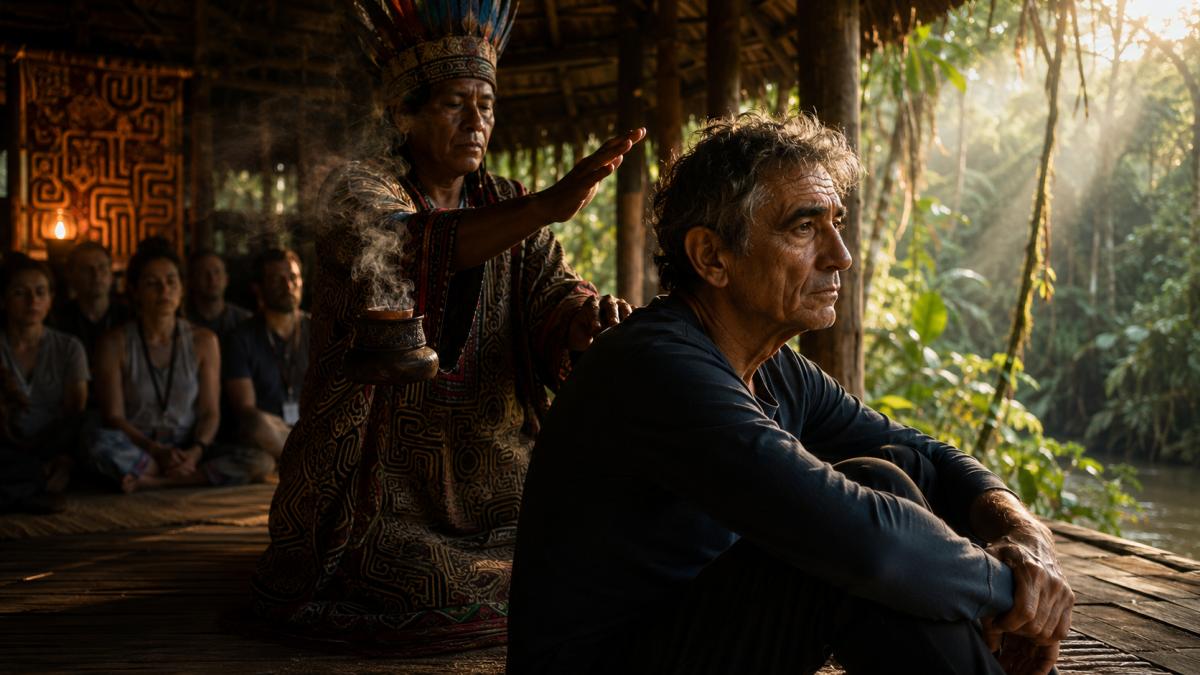
There is a particular kind of humiliation reserved for people who are good at their jobs. It arrives not as failure but as a correction from a direction you never thought to defend. For Gabor Maté, it arrived at lunch, in the Peruvian Amazon, delivered through an interpreter by a group of Shipibo healers who had known him for exactly one night.
There is a particular kind of humiliation reserved for people who are good at their jobs. It arrives not as failure but as a correction from a direction you never thought to defend. For Gabor Maté, it arrived at lunch, in the Peruvian Amazon, delivered through an interpreter by a group of Shipibo healers who had known him for exactly one night.
He was, in effect, fired from the retreat he had come to lead.
The setting matters. Getting there means a short flight from Lima to Iquitos, then a boat down the Nanay, a tributary that threads into rainforest thick enough to swallow the sound of the motor. The destination was the Temple of the Way of Light, a centre that has spent years building a working relationship between Shipibo onanyabo — the term for their visionary healers — and Western visitors who arrive carrying luggage the jungle was never designed to hold. Maté had come to run a specialised retreat: two dozen doctors, psychiatrists, psychologists and therapists drawn from four continents. The idea was to marry the Amazonian tradition of vegetalismo, a plant-based healing system with its own internal logic and centuries of refinement, to the Compassionate Inquiry method Maté had spent decades developing.
He had facilitated this kind of work for more than ten years. He was, by any professional measure, the right man for the room.
What the shamans told him was blunt. He was carrying something dense and dark that their icaros — the healing songs sung over each participant through the night — could not get through. Worse, whatever he was carrying was interfering. It was making their work with everyone else harder. He was not a neutral presence in the maloca; he was static in the signal.
Two further observations came with it. First, that decades of medical practice had left him saturated with other people’s grief, absorbed and never discharged. Second — and this is the part that should stop anyone reading casually — that something had badly frightened him very early in life, and that he had never finished being frightened by it.
They knew nothing about him. No biography, no reading list, no chart.
Maté was born in Budapest in 1944, a Jewish infant in a city under Nazi occupation. At around fourteen months old, his mother handed him to a stranger in the street — a woman she did not know, on a calculation that a stranger’s arms offered better odds than the ghetto. It worked. He survived. His grandparents did not. And the arithmetic of that survival, the wordless conclusion an infant nervous system draws when the person who is safety hands you away, became the substrate of a life: a persistent, unexamined sense that his existence was contingent, tolerated rather than welcomed.
There is now a body of research examining how this kind of catastrophe propagates. Rachel Yehuda’s group at Mount Sinai has spent years documenting the biology of intergenerational trauma transmission, including epigenetic changes at stress-regulating genes in Holocaust survivors and their adult children. None of that literature was in the room in Peru. The healers were working from something else entirely, and arriving at the same address.
Here is the detail that makes the story unusual rather than merely dramatic: for all those years of facilitation, ayahuasca had essentially not worked on Gabor Maté.
He describes participating in dozens of ceremonies and receiving, for his trouble, mild nausea and irritation. Around him, people met ancestors, dissolved, wept, encountered whatever they encountered. He lay on his mat and waited, with what he characterises as a settled pessimism, a temperamental refusal to expect anything. Going into the first ceremony of this particular retreat, his posture was not surrender but challenge — a silent dare to the shamans to get through.
The dare was answered, though not the way he expected. He was answered by being sent to his room.
The shamans put him in what amounted to psychic isolation. Ten days in his cabin, barred from contact with the participants he had flown in to serve. An American colleague took over running the retreat. Maté walked the forest paths, practised yoga, sat with himself.
Every second night he drank alone. One healer, one patient, one interpreter. Three hours or more of icaros sung directly at him in the dark, tobacco smoke blown over his chest, hands laid on. There is an ethnographic literature on exactly what these songs are doing — phenomenological work on how participants experience icaros describes them as functioning simultaneously as container, navigation aid and intervention, sung with intent that the singer holds and the listener usually cannot decode. Occasionally, in Maté’s solo ceremonies, the songs turned Catholic — Spanish hymns invoking Jesus and Santa María over the head of a Hungarian Jew who had survived the Shoah. He notes the incongruity without resolving it. Syncretism in the Amazon is not a contradiction anyone local feels obliged to explain.
Four ceremonies. Nothing. No visions, no breakthrough, no cinema.
But he reports feeling lighter. Not transformed — lighter. Which is worth sitting with, because it is the least marketable outcome imaginable and probably the most common one.
It came at the end, and it came sideways. The singing had finished. He was talking to the interpreter, ordinary conversation, and something put him face-down on the mat. Not a decision. A force.
For close to two hours he was somewhere else, with no reliable sense of duration. And at some point in it, against a field of deep blue, a single word assembled itself in letters the size of weather:
BOLDOG.
Hungarian. It means happy.
Not a message about happiness. Not a promise of future happiness. The word itself, in his mother tongue, the language he was hearing in the months before he was handed to a stranger — spelled out across the sky as a statement of what was already the case.
The lesson he took from it is the part worth carrying out of the jungle, and it does not require anyone to drink anything.
Nothing that happened to him was undone. The ghetto happened. The separation happened. His grandparents were murdered and remain murdered. The vision did not edit history. What it demonstrated was that those facts, permanent as they are, had no authority to cancel a peace that was his by default — not earned, not achieved, not a reward for sufficient processing. Simply his.
This is the distinction Maté keeps returning to across his work: healing is not the same as being cured. Curing means a condition is removed. Healing is a movement toward wholeness, and movement is the operative word — a direction rather than a destination, available to people whose conditions will never be removed at all.
And crucially, it is not an intellectual achievement. The thinking mind is a divided instrument, forever arguing with itself, running committee meetings between the part that wants and the part that forbids. Whatever it was that put him on the floor was not persuaded by argument. It arrived the moment he was, for the first time in the entire enterprise, not in charge of anything. He had been stripped of the role of leader, the role of healer, the role of the one who knows — and the stripping turned out to be the prerequisite rather than the punishment.
We have written before about why waiting for an external rescuer keeps people stuck. This is the mirror image of the same trap: the person so busy being the rescuer that no medicine can reach them.
There is a second finding from that retreat that deserves more attention than it usually gets. The shamans’ assessment of the group — twenty-odd doctors and therapists — was that they had rarely encountered people carrying so much. Not their own material. Their patients’.
Western medicine has a name for the edges of this: compassion fatigue and secondary traumatic stress, documented across healthcare with prevalence figures that vary wildly by setting and instrument but never approach zero. What the discipline is less equipped to say is where the absorbed material goes. The prevailing training holds that a clinician’s body is not really participating — that empathy is a cognitive act performed at a professional distance, and that what enters through it does not accumulate anywhere.
The Shipibo framework makes no such assumption. In their model, energy is transferred, energy accumulates, and accumulated energy has to be actively removed. You can find that unscientific. But it produces a specific, actionable instruction — this person needs to be cleaned, and until he is, he should not be working — that Western occupational health, for all its questionnaires, does not typically issue.
The participants, Maté notes, learned as much from watching him withdraw as they would have from anything he had planned to teach them. Caregivers stepping back is the lesson most of them had never seen modelled.
Maté is direct about the wider problem. The reflex of Western culture when it encounters indigenous knowledge is to read it as a rough draft of ourselves — an earlier, less developed attempt at the thing we have since done properly. Under that assumption, no genuine learning is possible, only extraction.
The critique cuts in both directions, and honest engagement means acknowledging it. Anthropologists working in the region have raised hard questions about what ayahuasca tourism does to the communities hosting it: research on healing practices at Peruvian retreat centres traces how the economics of Western clients reshape local moral worlds, while recent work centring Shipibo-Konibo healers’ own accounts argues that Western psychological framings routinely flatten a sophisticated ontology into a set of interesting subjective effects. Enthusiasm is not the same as respect. A retreat booking is not a relationship.
Maté describes psychedelics as mind-manifesting rather than mind-altering — instruments that show consciousness to itself rather than distorting it. He also stresses that they are not universally suitable, that set, setting, intention and skilled guidance are not garnish, and that the same doorway that opens onto grace opens onto genuinely bad nights. His own essay on ayahuasca is unusually clear-eyed about this for an advocate.
The clinical evidence is real but narrow. A randomised placebo-controlled trial of ayahuasca in treatment-resistant depression found significant effects a week after a single dose in a small sample, and a longitudinal study of Western participants at the very centre Maté attended tracked improvements in psychological wellbeing that persisted at twelve months. Neither is a promise. Legality varies enormously by country, screening for cardiac and psychiatric contraindications is not optional, and the evidence on what makes changes last is still being assembled — as recent psilocybin work on how the brain retunes rather than rewires suggests.
And Maté is emphatic that none of it is required. He points to people who have reached comparable ground through long solitary walking, through prolonged attention to a forest, through the slow methods that ask for years instead of hours. The plant is a shortcut to a place that has other roads.
What stays with me about this account is not the vision. Visions are the easy part of the story to tell and the hardest part to use.
What stays is the lunch. A man at the height of his authority, invited to lead, publicly informed by people with no interest in his reputation that he was the obstacle. And a part of him — he admits this — was quietly relieved. Relieved to be let off. Relieved that someone had finally noticed the weight and named it out loud.
The mind manufactures stories to protect what is still hurt underneath. His was pessimism: nothing will happen for me. A perfectly constructed defence, indistinguishable from realism, and load-bearing for decades. It did not fall to argument or insight or a better technique. It fell when the role it existed to protect was taken away from him at a lunch table in the jungle.
That is the part that transfers. Most of us are not going to Iquitos. But most of us are running something — a competence, a usefulness, a position as the one who copes — that has become the exact thing standing between us and being reached.
The word was already written in the sky. He just had to be put on the floor to see it.
Nothing in this article constitutes medical advice. Ayahuasca is a powerful substance with real contraindications and its legal status differs sharply between countries. If you are considering this path, do the unglamorous work first: medical screening, honest assessment of your own stability, and serious scrutiny of who you would be trusting with your nervous system.