Physical Address
304 North Cardinal St.
Dorchester Center, MA 02124
Physical Address
304 North Cardinal St.
Dorchester Center, MA 02124

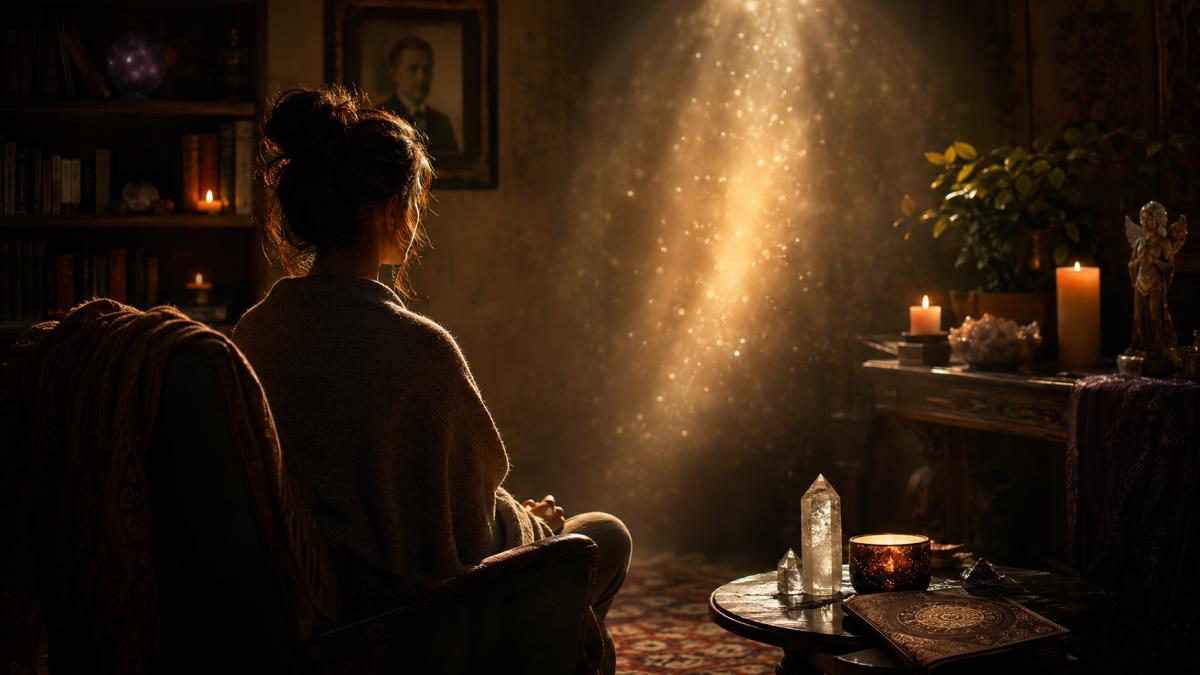
From the outside, mediumship can look like a lightning bolt. A name arrives out of nowhere, a detail lands with startling precision, and a room full of strangers is left in tears. It looks instantaneous, almost theatrical. What almost nobody sees is the years of solitary, unglamorous practice that made that single accurate sentence possible...
From the outside, mediumship can look like a lightning bolt. A name arrives out of nowhere, a detail lands with startling precision, and a room full of strangers is left in tears. It looks instantaneous, almost theatrical. What almost nobody sees is the years of solitary, unglamorous practice that made that single accurate sentence possible. Ask any working medium what actually built their gift, and most will point not to a class or a book, but to a quiet routine done alone in a chair, in the dark, with nothing happening on the outside at all. That routine has a name in the Spiritualist tradition: sitting in the power. It is less a technique than a relationship, the slow, patient cultivation of an inner reservoir that everything else in mediumship draws from.
The phrase sounds dramatic, but the practice it describes is almost the opposite of drama. Sitting in the power is not about summoning a spirit, chasing a message, or performing any kind of ritual. It is a deliberate, receptive connection to a source of vitality that sits above and beyond the individual medium, variously named Spirit, the Divine, Source, or simply “the power.” The medium does nothing except sit in stillness and let that current move through them. One long-time teacher of the practice put it plainly: the word power here has nothing to do with dominance or spectacle. It refers to the medium’s energetic coherence, their ability to be present, stable, and receptive without collapsing. It is not something borrowed for an evening’s demonstration. It has to be grown, session by session, over years.
This distinguishes sitting in the power from general meditation or mindfulness. The intention is specific. The medium is not simply quieting the mind for its own sake, they are opening a channel to a source of energy and consciously allowing it to fill them, the way a battery is left on charge rather than switched off.
The reasoning behind the practice is refreshingly practical once you see it laid out. A medium functions as a bridge between the physical world and higher vibrational planes. A cluttered, exhausted, or scattered channel produces a weak or distorted link, no matter how talented the person behind it is. Sitting in the power is essentially channel maintenance. It raises the medium’s own vibration so that blending with an evolved communicating spirit becomes easier, and it builds a kind of energetic immune system that makes the medium far less appealing to lower or confused energies looking for an easy doorway.
This is exactly why the practice sits at the centre of formal Spiritualist training rather than being treated as an optional extra. Within the Spiritualists’ National Union, one of the oldest and largest Spiritualist bodies in the world, sittings in the power are listed alongside demonstrations and healing as core recurring events at member churches, not as a fringe activity for the especially devout. At one recent centenary celebration hosted by an SNU church, congregants spent an afternoon hour of sitting in the power with the church’s healing team between platform demonstrations, treated with exactly the same weight as the mediumship itself. The tradition traces its clearest modern articulation to Gordon Higginson, who for over two decades served as President of the Spiritualists’ National Union and Principal of the Arthur Findlay College, the institution that became the practice’s spiritual home and training ground for generations of British mediums.
New students often conflate sitting in the power with sitting in a development circle, but the two serve almost opposite functions. A circle is collective and outward-facing, its purpose is to blend energies with fellow sitters and open a link to spirit communicators. Sitting in the power is solitary and inward-facing, even when practised in a room full of other people doing the same thing. If a communicating spirit tries to draw close during a power sitting, the disciplined response is a gentle, internal redirection: not now, this time belongs to my own unfoldment, I will be available afterwards. Blurring that boundary dilutes both practices. The circle becomes less focused because the medium hasn’t arrived grounded, and the power sitting becomes less restorative because it keeps getting hijacked by outside business.
Every teacher shapes the practice slightly differently, but the underlying arc is consistent.
It begins with settling the body somewhere quiet and free from interruption, and silently stating an intention: something like, I sit now to deepen my connection to the power within me, for my own growth, and so I may be of greater service later.
From there the medium works with the breath to loosen the body and gently pulls attention away from the five senses, letting outside sounds, physical sensations, and the mental noise of the day rise and fall without engagement. This isn’t forceful suppression, it’s a soft re-centring, over and over, whenever attention drifts.
[Also See: Try Reading People At the Soul Level]
The heart of the sitting is passive awareness of the power itself. Many visualise light, often described as warm and gold-white, pouring in from above the crown and filling the body before radiating outward into a sphere of protection. The instruction from experienced sitters is always the same: don’t analyse it, don’t test whether it’s working, just notice. Warmth, tingling, pressure, a sense of expansion, these are common and are simply acknowledged before attention returns to the source. A typical sitting runs twenty to forty minutes and closes with a slow, deliberate return to ordinary awareness.
Mediums who sit consistently over months and years describe a genuine shift in the clarity of their perception. Clairvoyant impressions that once arrived as vague flashes sharpen into detailed, almost cinematic scenes. Clairaudience moves from a single indistinct word to full sentences. But the deeper shift is internal: the practice strengthens what could be called the observer, the quiet part of the mind that can tell the difference between a genuine impression and something the imagination invented on the spot. That discernment is arguably the single hardest skill in all of mediumship, and it is built almost entirely through the discipline of sitting still and watching the mind’s static without engaging it.
There’s also a wellbeing dimension that is easy to overlook. A medium who constantly gives out energy through readings, demonstrations, and healing work without regularly refilling their own reserves will eventually run dry, and that depletion shows up as fatigue, emotional fragility, or outright burnout. Sitting in the power is the deliberate act of refilling the vessel before it empties, which is part of why serious training programmes treat it as ongoing maintenance rather than a beginner’s exercise to graduate past.
The specific phrase “sitting in the power” belongs to the British Spiritualist tradition, but the underlying gesture, turning inward and consciously opening to a source of vitality larger than the self, shows up across an enormous range of contemplative paths.
In Eastern Orthodox Christianity, the Hesychast tradition centres on what is called the prayer of the heart, most often the repeated Jesus Prayer, practised until it produces the experience of the uncreated light, the same light witnessed at Christ’s Transfiguration. Hesychast monks pursue this through sustained interior stillness rather than outward ritual, a discipline strikingly close in structure to a power sitting even though the theology is entirely different.
The yogic tradition offers an equally close parallel in pratyahara, the fifth of Patanjali’s eight limbs of yoga. Pratyahara is generally translated as withdrawal of the senses, and is considered a vital preliminary step before the more advanced practices of concentration and meditation, gaining control over external stimulation so attention can turn inward. It functions as the hinge between the outward-facing limbs of yoga, like posture and breathwork, and the fully internal ones, exactly the role that withdrawal from the five senses plays early in a power sitting.
Even in modern depth psychology there’s a cousin practice. Carl Jung developed a method called active imagination, a meditation technique in which the contents of the unconscious are translated into images, narratives, or personified entities, serving as a bridge between the conscious ego and the unconscious. Jung was careful about who he recommended it to, noting that it required a stable, well-formed ego and specific readiness in the individual before it could be used safely, a caution that echoes the way experienced Spiritualist teachers insist on grounding and discipline before a student is left to sit alone.
None of this is meant to suggest that every contemplative tradition is secretly doing the same thing. The theology, the goals, and the risks differ enormously between a Hesychast monk, a yoga practitioner, and a Spiritualist medium. But the shared structure is worth noticing: stillness first, withdrawal from the senses second, and a receptive, non-grasping opening to something larger than the individual mind third. Across very different vocabularies, that sequence keeps showing up wherever people have seriously tried to connect to something beyond ordinary waking awareness.
For the medium specifically, this quiet, hidden routine is what makes the visible part of the work possible at all. The platform message, the sudden accurate detail, the moment that convinces a grieving person their loved one is still present, all of it is drawing on a reservoir filled in private, in silence, with nobody watching. The silence, it turns out, is not empty time between the real work. It is the real work.