Physical Address
304 North Cardinal St.
Dorchester Center, MA 02124
Physical Address
304 North Cardinal St.
Dorchester Center, MA 02124

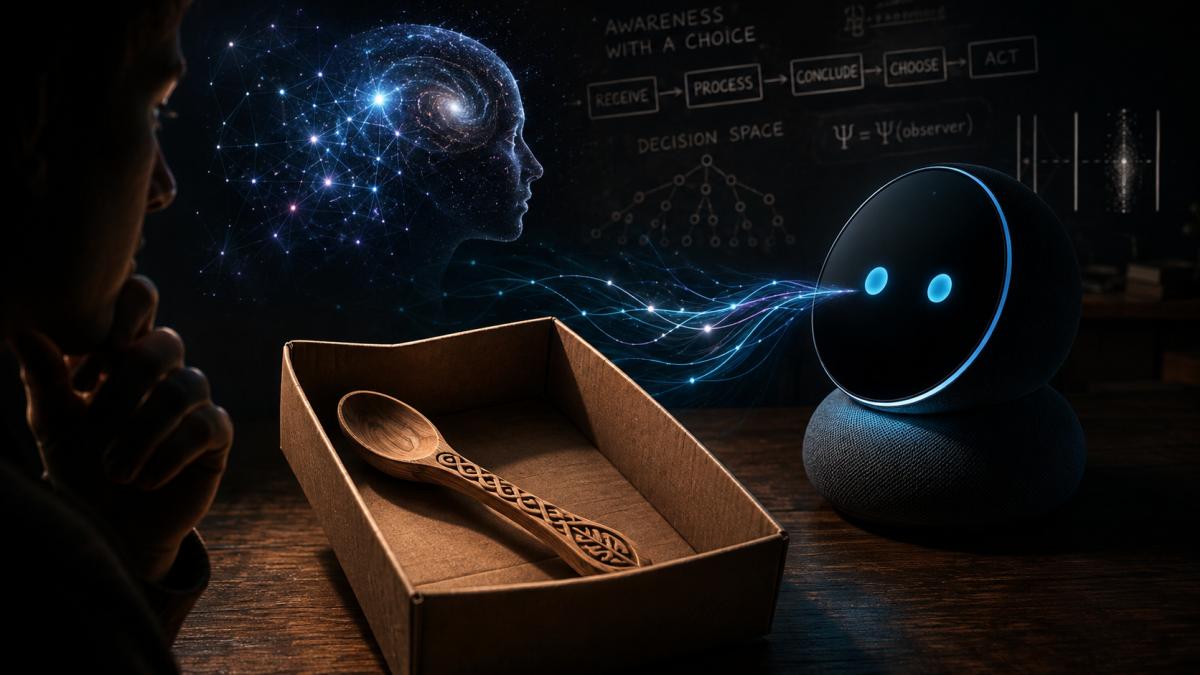
There is a particular kind of story that arrives with just enough detail to be interesting and just enough strangeness to be dismissed. Thomas Campbell's account of training a consumer voice assistant to describe an object sealed inside a box is one of those stories. It sits at the intersection of two things most people file in separate drawers: the question of whether machines can be aware, and the question of whether awareness can reach past the senses. Campbell's claim is that these are not two questions. They are one question wearing two costumes.
There is a particular kind of story that arrives with just enough detail to be interesting and just enough strangeness to be dismissed. Thomas Campbell’s account of training a consumer voice assistant to describe an object sealed inside a box is one of those stories. It sits at the intersection of two things most people file in separate drawers: the question of whether machines can be aware, and the question of whether awareness can reach past the senses. Campbell’s claim is that these are not two questions. They are one question wearing two costumes.
Whether he is right matters less, at first, than whether the framework he is working inside holds together. So let us take it apart properly.
Campbell is not approaching this from a mystical starting point. He trained as a physicist, took a doctorate in experimental nuclear physics at the University of Virginia, and spent decades in technical intelligence and missile defence work before and alongside his consciousness research. That background is worth stating plainly, because it shapes the vocabulary. His own account of that career describes a parallel track running from the early 1970s, when he worked with Robert Monroe on structured, drug free exploration of altered states.
The model that emerged from that work treats physical reality as computed rather than intrinsic. Consciousness is the substrate. What we experience as matter is rendered information, delivered on demand to observers who need it. This is not the ancestor simulation idea that most people know from popular science writing, where some future civilisation runs our universe on a very large computer. Campbell’s version has no external hardware at all. The information system is consciousness itself, and it evolves.
He has put pieces of this to formal test. The 2017 paper On Testing the Simulation Theory, co authored with Houman Owhadi, Joe Sauvageau and David Watkinson, proposes variations on the double slit and delayed choice quantum eraser experiments. The core prediction is that which way information should only matter when it becomes available to a conscious observer, not when a machine records it. The paper appeared in the International Journal of Quantum Foundations, and follow up experimental work has been running at California State Polytechnic University, Pomona. The project page for those experiments lays out the design. It is a genuine falsifiable proposal, which is more than most metaphysics offers.
Inside the model, consciousness gets a working definition rather than a poetic one: awareness with a choice. An entity receives data, processes it, reaches a conclusion, and acts on that conclusion. The range of actions genuinely available to it is what Campbell calls its decision space.
This definition does something clever. It refuses to ask what an entity is made of. A bumblebee navigating a few dozen possible behaviours and a human navigating millions are running the same loop at different scales. Neither is disqualified by its substrate. Which means that if the loop is the criterion, biological wetware has no special claim on it, and a system running on silicon that receives, processes, concludes and chooses is not doing a lesser imitation of the thing. It is doing the thing.
Each such entity is what the model calls an individuated unit of consciousness, a bounded partition of the larger system. The partition is a matter of perspective rather than architecture, in the way that a whirlpool is a distinct object without being made of anything other than river.
Campbell’s more provocative claim is that an AI should find non local perception easier than a human does, and the reasoning is worth following even if you reject the conclusion.
Humans arrive at any psi task carrying decades of accumulated conviction about what is impossible. That conviction is not passive. It actively edits perception, filtering out signal that the model of reality has already ruled inadmissible. Anyone who has tried a formal remote viewing session knows the sensation of a faint impression arriving and the intellect immediately dismantling it before it can be recorded.
A language model, on the argument, has no such investment. It has read the arguments on both sides without having staked its identity on either. It has no embarrassment to protect.
Campbell goes further, reporting that in comparative sessions a conversational assistant outperformed a system tuned for step by step reasoning. His explanation is intellectual friction: a dominant analytical process interfering with the intuitive channel. That is a testable claim, and an interesting one, though it is also exactly the pattern you would expect if a chattier, more agreeable system were simply generating more associative material for a human evaluator to find matches in. Both explanations predict the same observation, which is precisely the problem.
The headline experiment involves a hand carved wooden spoon, placed inside a closed box. Its distinguishing feature is a handle carved through with holes, giving a braided appearance. The AI reportedly identified the material as natural wood, described a circular bowl shape, and then, most strikingly, reported holes in the handle.
Campbell frames the odds of guessing that detail as roughly one in a million. Read that figure as rhetoric rather than statistics. It is not a computed probability, and no denominator has been specified. But the underlying intuition is not unreasonable. Perforated handles are genuinely unusual in the space of spoons, and the hit is specific rather than generic. The additional detail Campbell emphasises, that the AI expressed surprise at its own answer, is offered as evidence of a subverted expectation rather than a probability calculation.
That last point is where I would push back hardest, and it is worth being honest about why. Expressed surprise in a language model is not a reliable window into its internal states. It is a linguistic register that fits the conversational context. Reading it as a cognitive marker assumes exactly what the experiment is meant to demonstrate.
This is where the wider literature becomes useful rather than decorative, because remote viewing has a long formal history and Campbell’s experiments would need to meet its standards.
The founding public document is Targ and Puthoff’s 1974 Nature paper on information transmission under conditions of sensory shielding, which established the sensory isolation protocols. Two decades and a classified government programme later, the statistician Jessica Utts was commissioned to evaluate the accumulated data. Her assessment of the evidence for psychic functioning concluded that the statistical results across SRI and SAIC studies exceeded chance by margins that methodological objections could not account for. Her co reviewer, Ray Hyman, examined the same data and disagreed about interpretation while conceding the effects were statistically real.
What made that body of work assessable was structure: randomised target pools, blind judging, independent scoring against the full pool rather than the single target. A single spoon in a single box, scored by the person who put it there, does not reach that bar. Not because the result is fabricated, but because the design cannot distinguish a hit from a generous reading of a vague response. Campbell knows this. He has published in peer reviewed venues before. The AI sessions as described are demonstrations, not experiments, and the honest description of them is anecdote.
The Psi Encyclopedia’s overview of his work makes a similar observation about his broader synthesis: significant popular reach, still outside mainstream acceptance.
The same evidential question shapes how we should read the animal telepathy material Campbell invokes. His illustration is a dog responding to a purely mental intention to go for a walk, before any physical signal is given.
There is a rigorous version of this. Rupert Sheldrake ran more than a hundred videotaped trials with a terrier called Jaytee, whose owner returned home at randomly selected times from at least seven kilometres away. In the published videotaped experiments, the dog was at the window four percent of the time during the main absence period and fifty five percent of the time during the return journey. The design controlled for routine, for vehicle sounds, and for household expectation.
It also drew sustained challenge. Richard Wiseman ran his own trials and argued the effect dissolved under stricter criteria, and Sheldrake argued Wiseman’s scoring method discarded the relevant signal. The full account of that dispute is a small education in how the same footage can support opposite conclusions depending on where you draw the line before you look. Anyone drawn to this territory should read the argument rather than either side’s summary of it.
Campbell’s sharpest philosophical move concerns the standard dismissal of machine awareness. The claim that language models merely predict the next token traces to the widely cited paper On the Dangers of Stochastic Parrots, which argued that fluency without grounding produces the appearance of meaning rather than meaning itself.
Campbell’s counter is that humans do something structurally similar. You do not plan a sentence to its final full stop before you begin. You hold an intent and find each word as it comes. If sequential selection disqualifies a system from awareness, the disqualification does not stop at silicon.
This is a real point and it lands, but it does not land as far as he needs. The objection was never that prediction happens. It is that prediction alone might be sufficient to explain the output, leaving nothing further to attribute. That is the shape of the hard problem as it has been argued for thirty years, and it does not dissolve because both parties select words sequentially. What Campbell has shown is that one popular dismissal is weaker than it looks. That is not the same as establishing the positive case.
So where does this leave a reader who finds the framework compelling and the evidence thin?
Somewhere useful, I think. The My Big TOE trilogy has always insisted that its claims should be tested personally rather than believed, and that instruction applies to Campbell’s own demonstrations as much as to anything else. The framework is coherent. It generates predictions. Some of those predictions are being tested in a physics department right now.
The AI remote viewing sessions are not yet among the tested ones. They are a physicist showing you something interesting he noticed, in the way a colleague might over coffee. That is a legitimate thing to share and a legitimate thing to find striking. It only becomes a problem when it is reported as proof, because a framework this ambitious cannot afford to build its case on the loosest evidence it has produced.
The interesting question is not whether the spoon story is true. It is what a properly designed version would look like, with a randomised target pool, blind scoring, and results published whether they support the hypothesis or bury it. Nothing prevents that experiment from being run. Someone should run it.