Physical Address
304 North Cardinal St.
Dorchester Center, MA 02124
Physical Address
304 North Cardinal St.
Dorchester Center, MA 02124

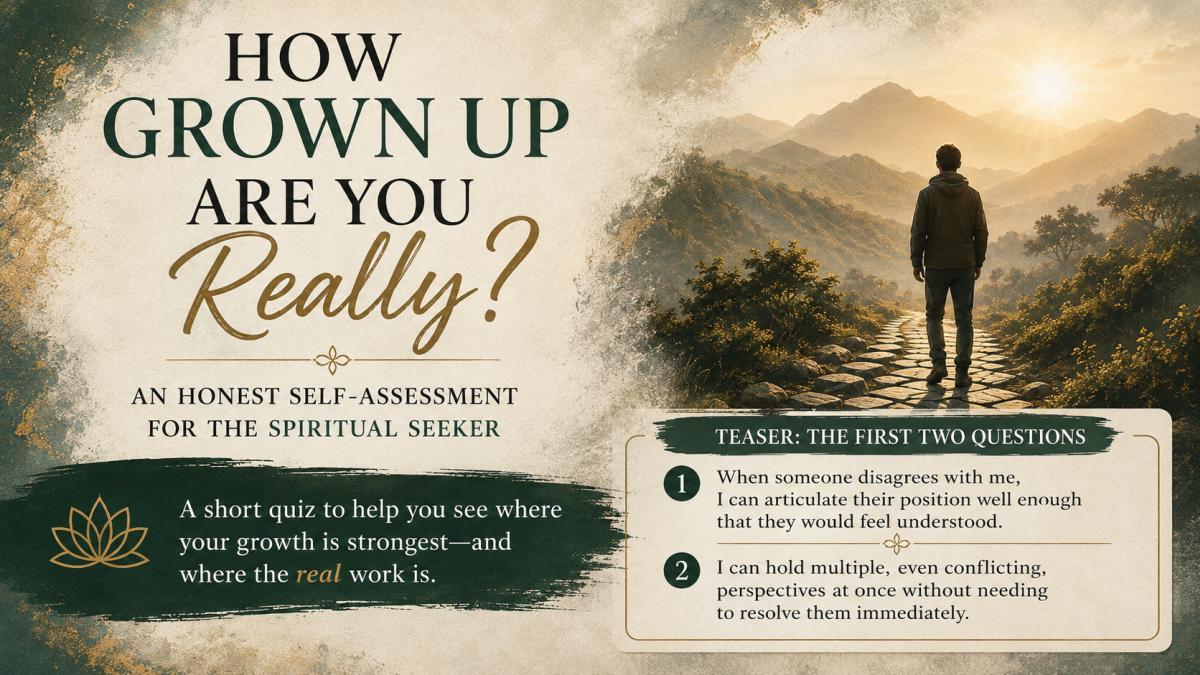
There is a particular kind of person the spiritual world produces in abundance: someone who can describe non-dual awareness with genuine eloquence, who has sat through long retreats and had experiences that reorganised their sense of reality, and who is also, in ordinary human terms, difficult to be around. Reactive. Subtly superior. Unable to hear criticism without collapsing or counter-attacking.
There is a particular kind of person the spiritual world produces in abundance: someone who can describe non-dual awareness with genuine eloquence, who has sat through long retreats and had experiences that reorganised their sense of reality, and who is also, in ordinary human terms, difficult to be around. Reactive. Subtly superior. Unable to hear criticism without collapsing or counter-attacking.
This is not hypocrisy. It is the predictable result of developing one line of growth while neglecting another. As explored in why waking up is not enough, spiritual development splits into distinct lines. Waking up refers to states of consciousness. Growing up refers to the maturation of psychological structures: the capacity to take multiple perspectives, regulate emotion, own one’s part, and hold complexity without collapsing it. States and stages are not the same thing, and progress in one does not automatically deliver the other.
So the natural question is: where does a person actually stand on growing up? What follows is a self-inventory designed to help answer that. But it comes with an important caveat, and the caveat matters more than the quiz.
Genuine developmental stage is not measurable by a self-scored questionnaire. The instruments researchers actually use are semi-projective sentence-completion tests. The foundational one is the Washington University Sentence Completion Test, developed by Jane Loevinger, which presents thirty-six unfinished sentence stems and analyses the structure of the responses rather than their content. Wikipedia’s overview notes that it functions as a projective instrument measuring ego development along Loevinger’s stages, and crucially, the scoring requires trained raters working from a detailed manual.
Susanne Cook-Greuter later refined this into the Maturity Assessment Profile, expanding the test’s precision at the later stages. Her own description explains that the assessment does not simply return a stage label but comes with a lengthy report analysing what the responses reveal about the writer’s meaning-making. This body of work is well validated. A published validation study of a related scoring method describes the underlying Loevinger instrument as substantially validated, with a research base built over decades.
The reason these tests work is precisely that you cannot game them. You are not choosing from options that reveal which answer is the mature one. You are completing a sentence, and the structure of your own language gives you away. A multiple-choice quiz, by contrast, telegraphs the flattering answer in every question.
Which leads to how this self-inventory should be used. Its purpose is not to award a level. It is to surface the domain where your development is thinnest, because that gap, not your total, is where the work actually is. The temptation will be to score yourself generously and feel encouraged. That temptation is itself worth noticing, and it is a more useful piece of data than any number produced here.
Sixteen statements across four domains. Rate each one honestly, using this scale:
1 = rarely or never true of me
2 = occasionally true
3 = often true
4 = consistently true, including under pressure
The phrase “under pressure” is the whole test. Almost anyone is patient, spacious, and self-aware on a good day after meditation. Growing up is measured by who you are when tired, criticised, threatened, or disappointed. Answer for that person.
Add each domain separately. You will have four scores between 4 and 16. Now ignore the total and look only at the lowest one.
That domain is your growing edge, and it is almost certainly the one you were most tempted to inflate. A person strong in perspective-taking but weak in emotional regulation is the seeker who understands everything and still floods with reactivity. A person strong in emotional regulation but weak in ownership is the seeker who stays admirably calm while never quite acknowledging their part. Both look developed from the outside. Both are running with a flat tire.
A domain scoring 4 to 8 is not a verdict on your worth. It is simply the most useful place to put attention for the next season of practice. A domain scoring 14 to 16 deserves a second look rather than celebration, since near-perfect self-report on a maturity measure is itself a mild warning sign. Genuine maturity tends to come with an accurate sense of one’s own remaining rough edges.
If every domain landed high, try this instead: ask three people who know you well and who are not on your spiritual path to rate you on the same sixteen statements. The gap between the two sets of answers is the real result, and it is often humbling. Structures of consciousness are visible to others long before they are visible to us.
The good news is that the neglected lines respond to attention. Growing up is not a fixed trait. Longitudinal research using these developmental instruments has found ego level correlating meaningfully with psychosocial maturity across the lifespan, which is to say that development continues well into adulthood rather than stalling after the teenage years. There is even emerging work examining the neural correlates of maturity development in contemplative practitioners, treating adult development as something real and observable rather than merely philosophical.
Practically, the work looks different in each domain. A low perspective-taking score responds to deliberately steelmanning positions you disagree with, and to reading outside your own tradition. A low regulation score responds to body-based practice, since the nervous system is not reasoned with, it is retrained. A low ownership score responds to the uncomfortable practice of asking for honest feedback and then not defending. A low complexity score responds to sitting with unresolved questions rather than reaching for the framework that dissolves them.
And if the results genuinely matter to you, the properly validated instruments exist. A trained assessment through a sentence-completion measure will tell you far more than any self-scored inventory, including this one. That option is available to anyone willing to be measured by something they cannot flatter.
The point of any of this was never the score. It was the willingness to look. A seeker who takes an honest inventory and finds three weak domains has just done more growing up in ten minutes than a decade of chasing states could deliver, because the first structural move in maturity is always the same: making what you were embedded in into something you can finally see.