Physical Address
304 North Cardinal St.
Dorchester Center, MA 02124
Physical Address
304 North Cardinal St.
Dorchester Center, MA 02124

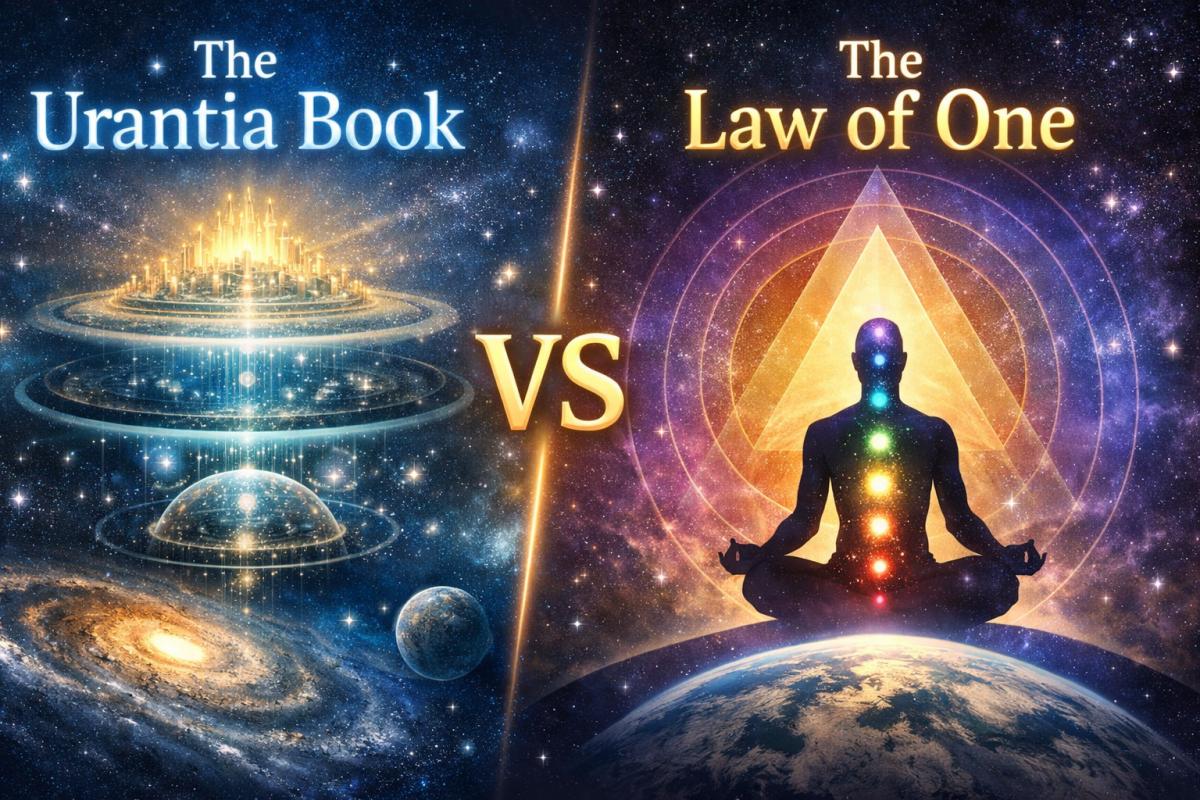
People seeking spiritual frameworks often turn to large metaphysical systems that aim to explain the nature of reality, existence, and the journey of consciousness. Two well-known sources in this category are The Urantia Book and The Law of One, also known as the Ra Material. Both offer sweeping cosmologies that go beyond typical religious or philosophical models. Yet these systems have vastly different assumptions, goals, and models of reality. In this article we will explore how each describes the structure of the universe, the nature of ultimate reality, the role of consciousness, and the spiritual evolution of beings. We will also point readers to introductory resources where they can learn more.
People seeking spiritual frameworks often turn to large metaphysical systems that aim to explain the nature of reality, existence, and the journey of consciousness. Two well-known sources in this category are The Urantia Book and The Law of One, also known as the Ra Material. Both offer sweeping cosmologies that go beyond typical religious or philosophical models. Yet these systems have vastly different assumptions, goals, and models of reality. In this article we will explore how each describes the structure of the universe, the nature of ultimate reality, the role of consciousness, and the spiritual evolution of beings. We will also point readers to introductory resources where they can learn more.
The Urantia Book is a large text that purports to offer an “epochal” revelation of cosmic truth. It was first published in 1955 and claims to be composed by celestial beings addressing scientific, philosophical, religious, and historical subjects. It aims to present an integrated view of God, creation, and humanity that unites science and spiritual meaning in a unified worldview. An overview of the Urantia cosmology emphasizes a systematically ordered creation composed of multiple universes in hierarchical relation to a divine center.
Central to the Urantia cosmology is the concept of Paradise, the fixed and eternal center of all reality where God resides. Surrounding Paradise is Havona, a perfect universe composed of a billion worlds of ideal beauty. Beyond Havona there are seven superuniverses that form the grand circle of creation. These superuniverses contain local universes, systems, and inhabited planets where beings evolve and develop.
The Urantia Book describes this structure in precise detail. For example, each superuniverse is governed by administrative orders and celestial personalities that facilitate evolutionary progress, coordinate energy, and maintain order. The universe of universes, sometimes called the master universe, is not infinite chaos but a coordinated and organized whole with definite dimensions and patterns of energy and matter.
This vast cosmology emphasizes order and hierarchy. Beings progress through stages of spiritual growth within these structured realms. Soul evolution ultimately leads beings toward Paradise, where they experience unity with the divine personality of God. Throughout this system, free will and personality maintain their importance, and God is portrayed as a personal being whose presence and influence are central to all of reality.
By contrast, The Law of One (the Ra Material) is a series of channeled transcripts from the early 1980s that present spiritual teachings purportedly communicated by an entity identifying itself as Ra through trance mediumship. In this material the fundamental principle of reality is that all is one. Everything that exists is a manifestation of a single intelligent infinity, and the apparent differences among beings and experiences are distortions of a fundamental unity.
The cosmology of The Law of One is not built around physical space, hierarchical administrative worlds, or personality in the same way as the Urantia model. Instead it posits that existence is structured through densities of consciousness, which are akin to stages in the evolution of awareness. These densities are sometimes compared to dimensions of being but are primarily defined by levels of vibration or resonance.
According to this model, there are at least eight densities of existence. The first three densities correspond roughly to physical forms of existence (such as matter and biological life), while the fourth through seventh densities correspond to increasingly subtle levels of consciousness and unity with the Creator. Fourth density is described as the density of love or understanding, fifth density as wisdom, sixth density as unity of love and wisdom, and seventh density as the gateway to transcendence. Eighth density returns all back into the unity of the next cycle.
In The Law of One system the universe is less about spatial realms and more about vibrational states of being. Beings move through these densities based on their polarization toward service to others or service to self, which is essentially a choice in how they relate to the rest of existence. Progression occurs through cycles of learning and experience rather than through adherence to a structured hierarchy of space and celestial governance.
One of the most fundamental differences between the two frameworks is how they conceive of ultimate reality.
In The Urantia Book, God is a personal being with will, intention, and a relational presence. God is described as Universal Father, along with the Eternal Son and Infinite Spirit. These persons of Deity express a divine reality that relates to finite beings in deep and meaningful ways. God’s personality is central to reality, and beings move toward increased unity with divine purposes through spiritual evolution under God’s guidance.
In The Law of One, ultimate reality is represented by the concept of the One Infinite Creator, a unified source without distinction or personality. While individual experiences and individuality are recognized as real within illusionary space/time, at the deepest level all beings and all existence are expressions of the one source. The ultimate goal is not to become like a personal God, but to realize that individuality and multiplicity are appearances within an underlying unity.
This leads to different interpretations of spiritual practice and purpose. In The Urantia Book spiritual evolution is marked by increasing cooperation with a divine personality and participation in a coherent plan. In The Law of One the journey is one of recognizing unity and choosing how to express that unity through love and service. The emphasis is on remembrance of oneness rather than alignment with a personal deity.
The Urantia Book places heavy emphasis on spatial hierarchy. The structure of the master universe is described with clear physical metaphors of worlds, universes, and superuniverses that are ultimately grounded in the presence of Paradise. These structural levels are tied to both physical and metaphysical realities. For example, Havona is described as a perfect and eternal universe encircling Paradise, and is the template that the evolutionary universes strive to emulate.
By contrast, The Law of One uses the concept of densities as its primary organizing principle. Densities do not correspond directly to physical location but to the evolution of consciousness and awareness. A being in fourth density might occupy a physical realm but is distinguished by its level of vibrational resonance and relational understanding of unity. The universe is experienced as a progression through these states rather than a journey through spatial hierarchies.
The Law of One material does not describe a centralized core like Paradise or a vast physical cosmology as Urantia does. Instead it frames existence in terms of experiential progression, where consciousness moves through intensifying levels of unity. Each density provides lessons, catalysts, and opportunities for growth that prepare a being for the next stage of evolution.
Although both systems describe a form of spiritual evolution, the mechanisms and goals are different.
In the Urantia framework, beings evolve through structured realms, progressing from mortal life through realms of morontia and spirit existence toward higher levels of realization with God. This evolution occurs within the context of cosmic governance and personal relationship with the divine. There is a sense that progress is both vertical (toward God) and orderly, with clear steps and cosmic citizenship responsibilities.
In The Law of One, evolution is defined by polarization of consciousness. Beings choose a path, either service to others or service to self. This choice determines the rate and quality of their progression through densities. Rather than moving closer to a hierarchical center, beings move toward greater realization of unity and understanding. This process is experiential and internal rather than structured by external realms.
Both systems affirm that spiritual growth is meaningful and purposeful, but they frame the nature of that purpose differently. Where Urantia centers on relational steps toward God, Law of One centers on internal realization of oneness as the mechanism of evolution.
For someone exploring metaphysical or spiritual systems it is valuable to understand what each model offers and the assumptions that underlie them. The Urantia Book provides a detailed structured cosmology complete with personalities, administrative orders, and a personal God at the center of reality. It appeals to those who seek ontological structure and narrative coherence in explanations of existence and purpose. The Law of One invites readers to explore the unity of all things and to see reality as a series of vibrational densities that reflect increasing awareness rather than spatial domains.
Both systems are rich and complex, and readers are encouraged to engage with primary sources directly to form their own interpretations. For a free version of The Urantia Book and descriptions of its cosmology you can visit the Urantia Foundation’s official text online. A searchable exploration of The Urantia Book’s universe structure is available at truthbook.com. For an introduction to the Ra Material you can find The Law of One sessions through L/L Research and related summaries such as those hosted on Medium.
The universe structures presented in The Urantia Book and The Law of One represent two powerful but distinct metaphysical visions. Urantia offers an expansive hierarchical cosmos centered on personality and administration, while Law of One presents a unified, density-based progression of consciousness designed to help seekers understand the oneness of all existence. Each offers its own unique insights, and many readers draw inspiration, challenges, and meaning from engaging with these cosmologies. Whether through hierarchy or unity, duality or oneness, the drive to understand the nature of existence remains a shared human quest.