Physical Address
304 North Cardinal St.
Dorchester Center, MA 02124
Physical Address
304 North Cardinal St.
Dorchester Center, MA 02124

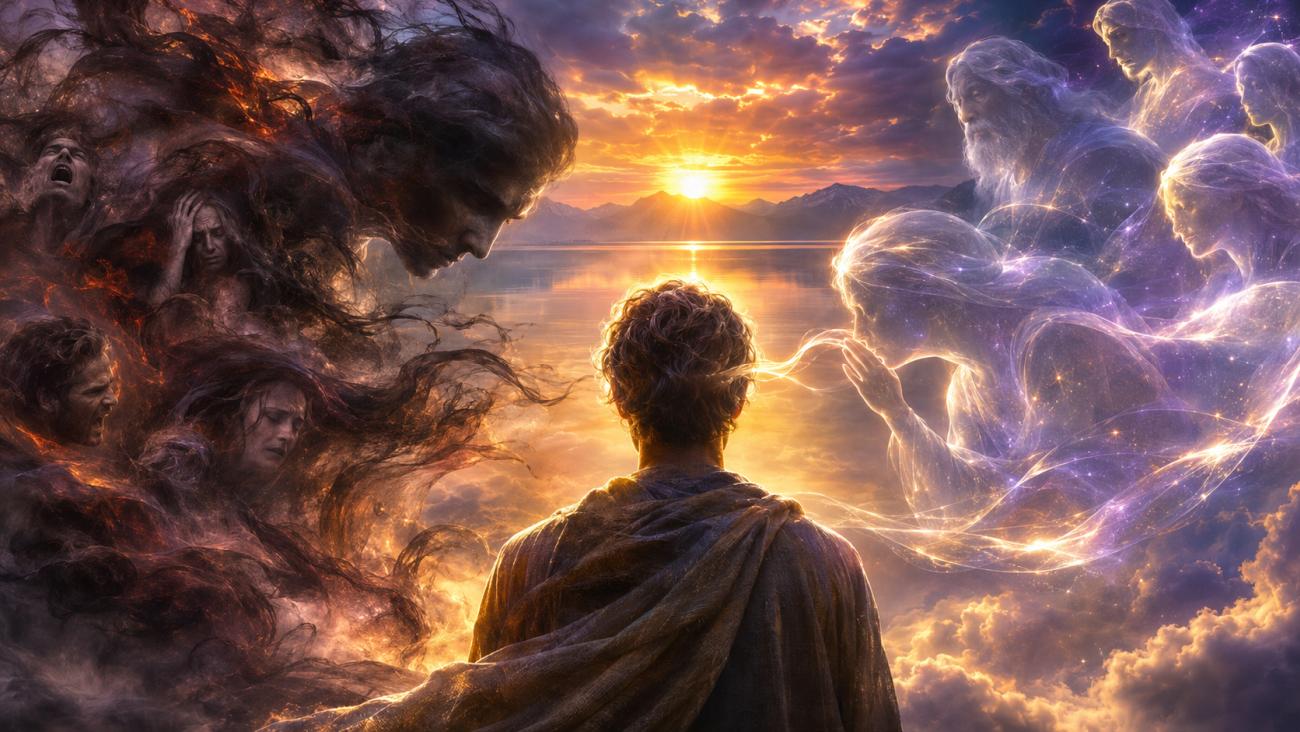
Eckhart Tolle blames our worst moments on the pain-body. Allan Kardec says spirits whisper into our thoughts. Here is where the two explanations really differ, where they agree, and a practice that works under either map.
You snap at someone you love over nothing. A memory surfaces and suddenly you are furious all over again. A voice in your head starts building a case against a friend, and you find yourself agreeing with it. Afterwards you wonder where that came from, because it didn’t feel like you.
Two very different teachers have offered an answer to that question. Eckhart Tolle, the modern spiritual teacher behind The Power of Now, says it came from your pain-body, a store of old emotional pain living inside you. Allan Kardec, the French educator who compiled The Spirits’ Book in 1857, says it may well have come from outside you, from discarnate spirits who drift close to the living and slip their thoughts in among your own.
One explanation points inward, the other outward. Look closer, though, and the two maps share a surprising amount of ground, including the most useful part: what you can actually do about it.
It helps to be clear about what each teacher is trying to explain. Both are describing the same human experience: thoughts and moods that seem to arrive uninvited, pull us into reactions we later regret, and feel stronger than our ordinary judgement.
Tolle’s answer is psychological and energetic. The trouble is something we carry, built up from our own past and from the pain humanity has accumulated over centuries.
Kardec’s answer is spiritual and relational. The trouble often involves someone else, a spirit with its own history and its own motives, who finds in us something it can work with.
These sound like rival theories. In practice they behave more like two lenses pointed at the same scene.
In The Power of Now, first published in 1997, Tolle describes the pain-body as a field of negative energy made of emotional pain that was never fully felt and released. Every hurt we resisted or buried leaves a residue, and over a lifetime that residue gathers into something with a life of its own. He developed the idea further in chapters five and six of A New Earth, where he also describes a collective pain-body carried by families, nations and humanity as a whole.
Most of the time the pain-body is dormant. Then something triggers it: a tone of voice, a disappointment, a situation that echoes an old wound. Once awake, it takes over your thinking and starts feeding. Its food is more pain, so it steers you towards anger, drama, self-pity or conflict, and it can provoke the pain-body of the person in front of you so the two feed off each other.
Tolle is careful to say that the pain-body can feel like a separate creature but is not truly an independent being. It is trapped life energy, sustained only by our unconscious identification with it. That is why his remedy is not to fight it but to watch it. When you notice the pain-body rising and observe it with calm, present awareness, without becoming it, it loses the fuel it needs and gradually dissolves.
Kardec’s picture begins somewhere else entirely. In his framework, the space around us is full of spirits between lives, and many of them take an active interest in the living. In question 459 of The Spirits’ Book, the communicating spirits say their influence on our thoughts and actions is far greater than we imagine, and that they often guide us.
The next questions explain how it feels. Our soul is itself a thinking spirit, so some of the ideas passing through our minds are our own and some are suggested. When we feel torn between two conflicting impulses at once, that inner tug of war may be our own thought meeting a suggested one. In question 461, the spirits describe a suggested thought as something like a voice addressing you, while your own thoughts tend to come first.
Not every visitor is unfriendly. Kardec’s spirits are graded by moral development, and higher spirits act as guides and protectors. The troublemakers are the imperfect spirits, still attached to envy, pride and resentment. Asked why they tempt us, the spirits give a stark answer: misery wants company, and they resent those who are happier than they are.
The difference is real, and it is worth stating plainly.
For Tolle, the source of the trouble is internal. The pain-body belongs to you, or to the collective human field you were born into, and it has no will of its own beyond the momentum of old pain. Nobody else is in the room.
For Kardec, there may be someone else in the room. An imperfect spirit is a genuine individual with its own history, often a soul who once lived on Earth just as we do. It can have personal motives, including old grudges carried over from a previous life, a theme explored in our look at how Kardec and Michael Newton describe the time between lives.
That changes the emotional tone of each teaching. Tolle invites you to see your darkest moods as unhealed energy asking for the light of attention. Kardec invites you to see them as moments when you opened a door and something unpleasant walked in.
Here is where the comparison gets interesting. On almost every practical point, the two teachers line up.
Both say that like attracts like. Kardec’s spirits say in question 467 that troublesome spirits are drawn only to people whose own thoughts and desires attract them. In question 466 they go further: lower spirits come to help with the wrong we already want to do, while other spirits pull us towards good, leaving the final choice with us. Tolle says the same of the pain-body. It only takes control when we unconsciously agree to become it.
Both describe something that waits. Tolle’s pain-body lies dormant until a trigger wakes it. Kardec’s spirits, asked in question 468 what happens when we refuse a bad influence, say the spirit gives up for the moment but keeps watching for an opening, the way a cat watches a mouse hole.
Both warn about the ego. In question 469, Kardec’s spirits advise special suspicion towards any influence that flatters our pride, because that is our weakest point. Tolle describes the ego and the pain-body as close partners, each feeding the other.
And both play down the question of origin. In question 461, the spirits say it often matters little whether a thought is yours or suggested. What matters is the choice you make about it. Tolle would say the same about any thought: you don’t need to trace it, only to stop identifying with it.
The two traditions even offer similar daily disciplines.
Tolle’s core practice is presence: becoming the watcher behind your thoughts rather than the thinker lost inside them. The moment you notice anger rising and can say “there it is,” you are no longer fully in its grip.
Kardec’s equivalent appears in the section on self-knowledge. Asked how we can best improve ourselves and resist wrongdoing, the spirits reply with the ancient maxim, know thyself. The spirit who signs as Saint Augustine explains how he did it: every evening he reviewed his day, asked whether he had failed in any duty or given anyone cause to complain, and asked for help in seeing himself clearly.
One practice works in the moment, the other at the end of the day, but they train the same muscle. Both build an observer who can see what is moving through you without being swept away by it.
Both teachers recognise that the pattern can become severe.
Tolle describes people with a heavy pain-body who spend much of their lives in its grip, and notes that this very intensity often drives them towards awakening. Kardec, in chapter 23 of The Mediums’ Book, describes what he called obsession, a persistent hold a spirit gains over a person, in three degrees: simple obsession, fascination and subjugation.
It is worth adding a note that Spiritist teaching itself stresses: ordinary psychological and medical causes should be ruled out first. If you are dealing with intrusive voices, deep depression or thoughts of harming yourself or others, a doctor or mental health professional is the right first call. Spiritual practice can sit alongside that support, not replace it.
You don’t have to decide who is right before you begin. Here is a simple approach that honours both.
When a dark mood arrives, pause and name it. Tolle would call it the pain-body waking; Kardec might call it a suggestion. Either way, naming it creates a gap between you and it.
Feel it in the body without feeding the story. Notice where the heat or heaviness sits. Let the sensation be there while declining to follow the stream of thoughts that wants to justify it.
Ask what it is drawn to. If it is pulling you towards resentment, pride or drama, that is your signal. Both teachers agree that what we feed grows, and what we refuse to feed weakens.
Turn towards something good. For Tolle, that is the stillness of presence. For Kardec, it is prayer, kind action and the company of better spirits. If the idea of needing spiritual protection makes you anxious, our piece on why you may not need protection at all offers a gentler angle.
Review the day each evening. What triggered you, what you did with it, and what you would do differently. Over weeks, this is how the patterns start to loosen, a theme that also runs through shadow work that actually transforms.
Perhaps the honest answer is both, at different times. Tolle’s map is especially useful when you recognise an old, familiar wound replaying itself. Kardec’s map can help when a thought feels oddly foreign, arrives with a strange insistence, or pushes you to act against your own values.
What matters most is that neither teacher leaves you helpless. In Tolle’s world, nothing can survive the light of your full attention. In Kardec’s, no spirit can push you anywhere you are not already willing to go. Either way, the deciding vote is yours.