Physical Address
304 North Cardinal St.
Dorchester Center, MA 02124
Physical Address
304 North Cardinal St.
Dorchester Center, MA 02124

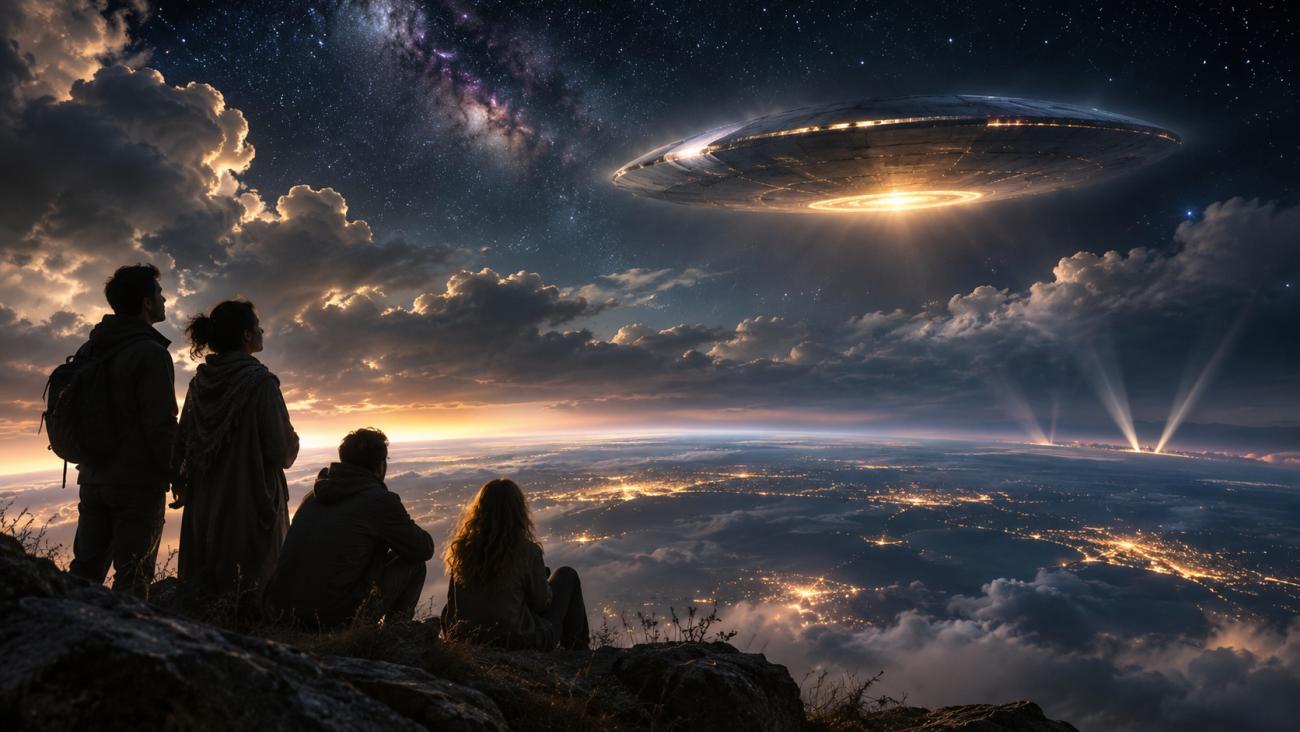
Bashar points to 2027 for open contact. How to tell genuine first contact from a staged disclosure, using a free will test and a discernment checklist.
Something unusual is happening in the conversation about extraterrestrial life. For decades it lived on the fringe, carried by experiencers, channelers, and a few stubborn researchers. Now it sits in government press releases, congressional amendments, and a summer blockbuster. At the same time, a familiar spiritual voice has been pointing at one specific year. Bashar, the entity channeled by Darryl Anka for roughly four decades, has named 2027 as the year of open contact.
When a long-awaited event finally seems to be approaching, the most important question is no longer whether it will happen. The question becomes: how will we know what is real when it does? If first contact in 2027 is announced, do we trust it? Could the whole thing be engineered? And if it is genuine, who exactly is arriving, and with what intentions?
This article looks at all three questions. It draws on the channeled material many of us have studied, on the conspiracy theories that have shadowed disclosure for thirty years, and on what governments and scientists have actually said and done. The goal is not to tell you what to believe. It is to give you a way of reading the signs that keeps you grounded, whatever the sky decides to do.
It helps to start with what the prediction actually says, because it tends to get distorted as it travels.
According to Anka, Bashar sees 2026 as a year when long-hidden truths begin to surface, including more sightings and revelations about political and global institutions. 2027 is then described as the year of the first clear, open introduction between humanity and extraterrestrial beings. As this overview of Bashar’s 2027 forecast explains, Anka frames it as gradual rather than sudden: more sightings, more official acknowledgement, and carefully managed encounters building over time. The same piece notes Bashar’s warning that humanity keeps repeating the patterns of conflict and division that other civilisations had to outgrow.
Three details in Bashar’s framework matter for this discussion.
First, the beings expected to make contact first are not mysterious strangers. Bashar describes them as hybrids, the Yahyel, said to be roughly half human and half Essassani, which would make them the most human-looking of the hybrid groups. Bashar’s own civilisation is described as a blend of human and Grey genetics. In other words, the story is one of kinship rather than invasion.
Second, Bashar has repeatedly said open contact will not look like a ship landing on a lawn in front of television cameras. It is described as something that unfolds through altered states, telepathic impressions, and personal encounters, partly because a sudden mass event could overwhelm people who are not ready for it.
Third, Bashar places responsibility on us. Asked whether visitors would clean up our oceans or fix our damage, the answer has consistently been that some help is possible but the work is ours.
It is also fair to note that Bashar’s contact window has shifted over the years, and critics point this out often. Bashar’s own answer is that predictions describe the energy present at the time they are given, not a fixed future. You can take that as a cop-out or as an honest description of how probable timelines work. Either way, it is worth holding the 2027 date loosely.
Alongside Bashar’s prediction, a very different story has been circulating. It claims that a huge object, sometimes described as planet-sized, is approaching from outside the solar system, slowing down as it comes, and due to arrive around 2027.
The clearest public account comes from the American comedian and writer Michael Ian Black. As BroBible reported, Black says he was invited into a private Signal chat by someone in the UFO community. Over about eighteen months he was told the object was enormous, decelerating, and “intelligently controlled.” He was eventually shown a grey, blurry image that he admits could have been anything.
What makes Black’s story useful is his conclusion. He did not walk away a believer. He pointed out that anything planet-sized would visibly affect the orbits of other planets, and he applied a simple Occam’s razor test. Which is more likely: that a gigantic intelligent craft is quietly braking toward Earth, or that somebody wants a growing number of people to believe that it is? He leaned toward the second option.
He was not alone. The UFO filmmaker Jeremy Corbell has publicly claimed that a false narrative about an object arriving in 2027 was being prepared, and that influencers were being approached to spread it. The documentary maker Kelly Chase and the podcaster Red Panda Koala have described similar attempts to get them to tell their audiences that a spacecraft was inbound. None of them could prove where these approaches came from. But the pattern they describe is consistent: private briefings, vague sources, a dramatic arrival date, and a request to repeat the story publicly.
To be fair, no space agency or published research has confirmed any such object, and sceptics note that claims like Corbell’s are hard to test, since any outcome can be explained away. Still, when the people being recruited to spread a story are the ones raising the alarm, that alone is worth noticing.
The idea of a ship arriving from far away sits awkwardly next to almost everything the contact literature has said for seventy years.
Experiencers, abductees, CE5 groups, and channeled sources broadly agree on one point: whatever the phenomenon is, it is not on its way. It is already here, and it has been interacting with humanity for a very long time. Kelly Chase put it simply when she called a future-arrival story a form of misdirection, because it turns something present and intimate into something distant and external.
That shift matters psychologically. A presence that is already among us invites curiosity, inner work, and personal discernment. An object approaching from deep space invites something very different: countdowns, emergency planning, and a public that looks to authorities for protection. One story puts power in your hands. The other hands it to whoever controls the announcement.
This does not prove the rumour is a deliberate operation. It does mean that if official contact is ever framed as an incoming armada with an arrival date, that framing should be the first thing you examine.
Part of what keeps the “incoming ship” story alive is that real objects keep arriving, and some scientists are willing to entertain unusual explanations for them.
In July 2025 astronomers discovered 3I/ATLAS, only the third interstellar object ever detected. Harvard astrophysicist Avi Loeb co-authored a paper asking whether it could be technology, and even raised the possibility of a hostile probe. He also created a scale for rating interstellar visitors, from zero for an ordinary comet to ten for alien technology that threatens humanity. In his March 2026 Q&A on the object, he explains that he first ranked it a four and later lowered it to a three, because it was behaving more like a comet despite some unexplained quirks.
The spacecraft that actually observed it reached a calmer verdict. The European Space Agency’s Juice mission studied 3I/ATLAS from about 60 million kilometres away in November 2025, as ESA describes in its account of the encounter. The agency’s conclusion, quoted by Scientific American, was that its behaviour matched what you would expect from a normal comet. A dedicated SETI search found no artificial radio signals either.
This month a second object has taken its place in the headlines. Loeb and colleagues have proposed that a small body called 1998 KY26 is not an asteroid at all, but Phobos 1, a Soviet Mars probe lost in 1988 after a faulty command. As BBC Sky at Night Magazine explains, the idea is controversial and most astronomers still consider it a tiny asteroid. Japan’s Hayabusa2 spacecraft is due to reach it in 2031, which should settle the question. NASA’s administrator has said publicly that nothing is about to hit Earth.
Notice what happened in both cases. A genuinely interesting scientific question was turned, online, into “alien ship heading for Earth.” And notice where the most promising “artificial” explanation for KY26 points: to our own lost hardware. The lesson is not that curiosity is foolish. It is that the leap from “unusual” to “invasion” is almost always made by the internet, not by the evidence.
The fear that first contact could be faked is not new. Two stories sit at the root of most modern versions.
The first is Project Blue Beam. In the early 1990s, the Québécois journalist Serge Monast claimed to have seen evidence of a secret plan in which NASA and the United Nations would use holographic projections and advanced technology to stage a religious or extraterrestrial event, frightening humanity into accepting a single world government. As IFLScience’s history of the theory points out, Monast originally tied the plan to 1983 and later said it had been postponed to the mid-1990s. It never happened, and Monast died not long after publishing his claims. Even so, the theory resurfaces every time something strange appears in the sky, including during the 3I/ATLAS excitement.
The second story is more personal. Carol Rosin, who worked alongside the rocket pioneer Wernher von Braun in the last years of his life, has said that von Braun warned her about a sequence of manufactured enemies used to justify weapons in space: first the Soviets, then terrorists, then rogue nations, then asteroids, and finally a fabricated extraterrestrial threat. In her telling, he called the alien threat the last card, and insisted it would be a lie. Rosin made these statements publicly in 2000 through Steven Greer’s Disclosure Project. It is important to be honest that this is her recollection, and no independent record of von Braun saying it has surfaced.
Greer himself has warned for over thirty years that covert interests would one day stage something resembling an alien attack. And the idea of an outside threat uniting humanity has deep roots in mainstream politics too. Speaking at the United Nations in 1987, Ronald Reagan reflected on how quickly our differences worldwide would vanish if we were facing an alien threat. He meant it as a hopeful thought about unity. Read through a sceptical lens, it also shows how useful a common enemy could be to anyone who wants to reorganise the world.
None of this proves a staged event is planned. What it shows is that the template for one has been discussed openly for decades, which is exactly why a fearful, threat-based “disclosure” deserves extra scrutiny.
It is easy to lose track of what is real amid the rumours, so here is the factual picture as of late 2026.
In February 2026, President Trump announced he would direct the Defense Secretary and other agencies to begin identifying and releasing government files on UFOs, UAP, and extraterrestrial life. DefenseScoop’s report on the directive captured the reaction of long-time insiders such as former defence official Christopher Mellon and retired Rear Admiral Tim Gallaudet. Both welcomed it but said they would believe it when they saw it, warning that classification barriers and bureaucratic delays would slow any real disclosure.
From May 2026 the Pentagon began releasing batches of files, describing them as unresolved cases that officials could not explain. In July, former government employees and contractors were reportedly released from earlier nondisclosure agreements so they could speak to investigators. A UAP Disclosure Act passed the House in July as part of the annual defence bill. Meanwhile, Steven Spielberg’s film Disclosure Day reached cinemas in June, adding a dramatic Hollywood version of the story to the public imagination.
What has not happened is any official confirmation that non-human intelligence exists or is visiting us. Rumours of a presidential “disclosure speech” have come and gone, and the White House has said no such address is planned. So we are in an unusual in-between moment: the stigma is falling away, but proof has not yet been put on the table. That gap is exactly where stories, true or false, flourish.
If contact is genuine, the next question is the one people feel most deeply. Will these beings be on our side?
The channeled view: it depends on who answers the call. The Law of One material describes two broad orientations among non-human intelligences. The Confederation of Planets in the Service of the Infinite Creator is said to work in service to others and to wait until it is genuinely called. The Orion group, by contrast, is described as service-to-self and oriented toward conquest. What is striking, as the Law of One’s material on the Orion group lays out, is Ra’s explanation of why even negative beings rarely land openly. A mass landing would override the planet’s free will, so they prefer to work quietly through individuals and power structures on Earth. In this view, the real danger is not a fleet in the sky. It is influence operating through human institutions.
Bashar’s view: kin, not conquerors. As described earlier, Bashar presents the first visitors as hybrids partly descended from us, arriving gradually and in ways that respect our readiness. The emphasis is on reunion and on our own responsibility to grow.
The scientific caution. Stephen Hawking famously took the darker view. In 2010 he argued that advanced visitors could treat Earth the way European explorers treated the peoples of the Americas, taking resources rather than offering friendship. NPR’s summary of his warning notes that he still believed most alien life was likely simple and microbial. His concern was less about evidence than about the lessons of our own history.
The institutional view. As far back as 1960, a report commissioned by NASA from the Brookings Institution spent two pages considering what discovering extraterrestrial life might mean for society. As Brookings itself recounts, the authors thought it could bring humanity closer together. They also recommended studying how such information might be shared with the public or withheld from it. Many researchers see that passage as the seed of the secrecy that followed.
Interestingly, research on ordinary people points in a hopeful direction. A 2018 study from Arizona State University, summarised by ScienceDaily, found that people responded to news of alien life with noticeably more positive than negative emotion. The lead researcher concluded that we would take the news rather well. The panic that Hollywood predicts may say more about the people telling the story than about the rest of us.
Put these perspectives side by side and a pattern appears, one that is more useful than any single prediction.
Both the Law of One and Bashar describe positive contact as something that respects free will. It waits to be invited, unfolds gradually, and meets people where they are. Both describe negative influence as something that bypasses consent, works through fear, and concentrates power in a few hands. The psy-op theories, interestingly, describe the same thing from the other side: a staged threat designed to frighten people into giving up their freedom.
This gives us a test that works whether you are a committed believer, a cautious sceptic, or somewhere in between. You do not need to know who is behind an event to judge what it is asking of you. Ask how it wants you to feel, and what it wants you to give up.
If you want something practical to carry into the next year or two, consider these questions whenever a major announcement, leak, or viral claim appears.
Does it arrive with a countdown? An incoming object with a fixed arrival date is designed to create urgency. Urgency shortens reflection and lengthens obedience.
Does it ask you to surrender something? Be wary of any contact story that ends with new emergency powers, new surveillance, new weapons in space, or a call to hand authority to a central body for your protection.
Who benefits from your fear? Fear is the most efficient way to move large numbers of people. Ask which institutions, budgets, or industries would gain if the public became frightened of the sky.
Does it fit what experiencers report? Decades of testimony describe something already present, often telepathic, frequently personal, and largely non-violent. A story that contradicts all of that should earn more scepticism, not less.
What happens inside you when you sit with it? Your own inner response is not proof, but it is data. Genuine expansion tends to feel spacious, even when it is challenging. Manipulation tends to feel tight, urgent, and isolating.
Can it wait? Real contact, by every positive account, is patient. If a message demands that you act immediately, it is worth pausing for exactly that reason.
We may be entering a period when stories about non-human intelligence come thick and fast, from governments, filmmakers, channelers, scientists, and anonymous insiders. Some will be sincere. Some will be mistaken. Some may be deliberately crafted. Trying to sort every claim into true or false will exhaust you.
A steadier approach is to anchor in your own discernment. Keep asking whether a story frees people or frightens them, whether it respects choice or removes it, and whether it invites inner growth or outer dependence. If open contact does unfold in 2027 or beyond, the beings worth meeting will, by every positive account, be the kind who wait until we are ready, rather than the kind who need a deadline.
And if the sky stays quiet, the inner work is still worth doing, because it makes you harder to manipulate.