Physical Address
304 North Cardinal St.
Dorchester Center, MA 02124
Physical Address
304 North Cardinal St.
Dorchester Center, MA 02124

Some films entertain you for an evening. Others follow you around for weeks. Christspiracy: The Spirituality Secret belongs firmly in the second group. It asks a question so simple that most of us have never thought to ask it, and then it refuses to let us look away from the answer.
Some films entertain you for an evening. Others follow you around for weeks. Christspiracy: The Spirituality Secret belongs firmly in the second group. It asks a question so simple that most of us have never thought to ask it, and then it refuses to let us look away from the answer.
The documentary comes from Kip Andersen, the filmmaker behind Cowspiracy, What the Health and Seaspiracy, working alongside Kameron Waters, a former gospel musician raised in a devout Christian family in the American Bible Belt. You can read more about the two filmmakers and their journey on the official Christspiracy site. Together they spent years travelling from the Vatican to Jerusalem, from Oxford to India and Nepal, speaking with theologians, scroll scholars, farmers, priests, gurus and shamans. Their aim was to understand how the world’s great spiritual traditions treat the animals we share this planet with.
What they found is uncomfortable, moving and, for anyone on a spiritual path, deeply worth sitting with.
The film begins with one question: is there a spiritual way to kill an animal?
It sounds almost naive at first. Yet the longer you stay with it, the more it unravels. Every religion teaches compassion. Every mystic tradition speaks of love, mercy and the sacredness of life. And yet across the world, on any given day, enormous numbers of sentient beings are bred, confined and killed, very often with a blessing spoken over them.
Andersen and Waters do not approach this as outsiders mocking faith. Waters in particular comes to it as a believer, driven by the old question “What would Jesus do?” That sincerity runs through the whole film. This is not an attack on spirituality. It is an invitation to take spirituality more seriously than we usually do.
One of the most important threads in the film concerns a single word from the opening chapter of the Bible. In Genesis 1:26 to 30, humanity is given “dominion” over the fish, the birds and every living creature. For centuries, that word has been treated as permission: the animals are ours to use as we please.
The film challenges this reading, and it is not alone in doing so. Many theologians argue that dominion was always meant as stewardship, a role of care and responsibility rather than ownership. A good king exercises dominion by protecting his people, not by consuming them. On this view, being made in the image of a loving Creator means reflecting that love downward onto everything placed in our keeping.
Notice what follows only a few verses later in that same passage. The food given to humans in the original creation is plants, seeds and fruit. Even the animals are given green plants to eat. The first picture of the world in the Bible is one with no killing at all. Whatever came later, the starting point, the ideal, was peace between all creatures.
The Anglican priest and Oxford theologian Andrew Linzey, who appears in the documentary, has spent decades making this case. He describes animals as God’s creatures rather than human property, and argues that Christians, of all people, should understand the horror of innocent suffering because their faith is centred on it.
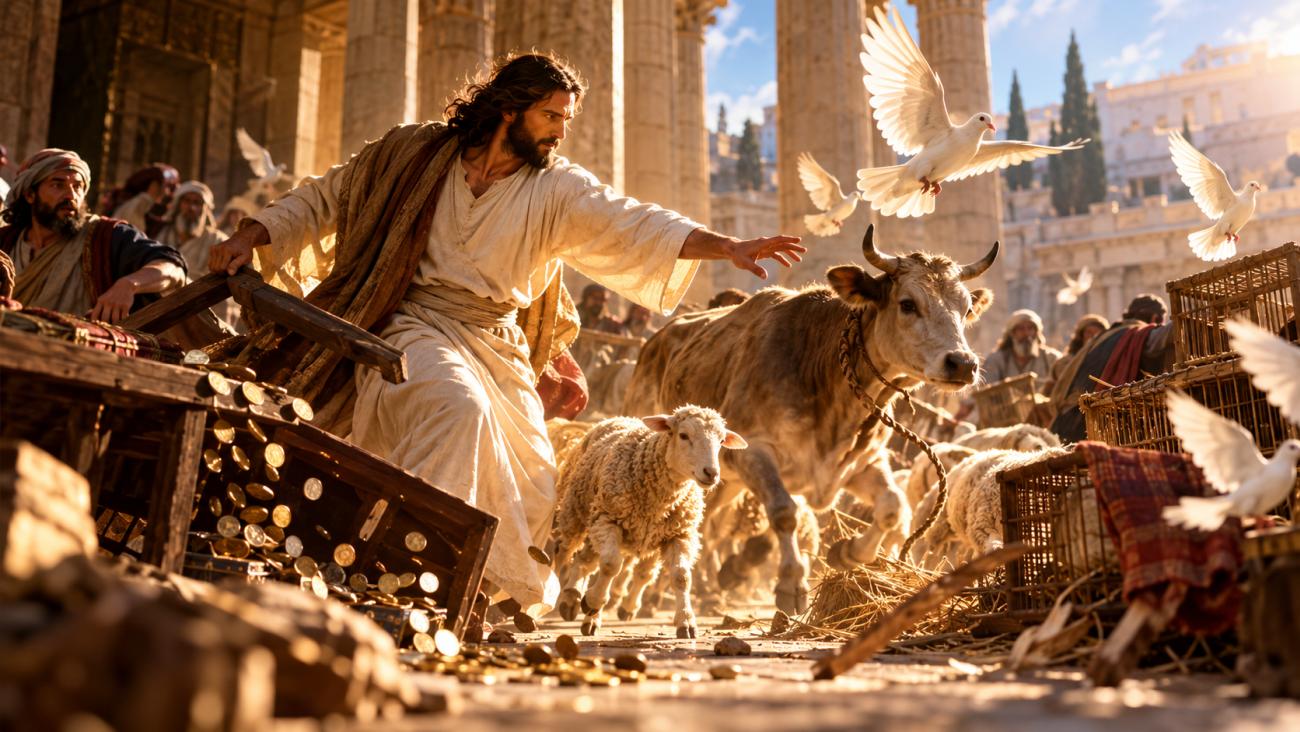
The emotional heart of the film is a fresh look at one of the most famous scenes in the Gospels: Jesus overturning tables in the Temple in Jerusalem.
Most of us grew up with the idea that Jesus was angry about money changers cheating worshippers. But the cleansing of the Temple took place in a courtyard filled with livestock. Cattle, sheep and doves were being sold there to be sacrificed. When Jesus drove out the sellers, he also drove out the animals, setting them free.
The documentary argues that the familiar translation “den of thieves” softens what the Greek actually conveys, which carries a sense of violent bandits rather than petty pickpockets. Read that way, the scene becomes a protest against the sacrificial trade itself. This is not a fringe idea. The scholar John Dominic Crossan has argued that the Temple incident was a radical rejection of animal sacrifice, which offered people a transactional route to forgiveness in place of real inner change.
Crucially, Matthew, Mark and Luke all present this as the act that set the authorities against him. Within days, he was arrested and crucified. The film invites us to consider that Jesus may have died, in part, for standing between the knife and the animal.
Another fascinating part of Christspiracy features the biblical scholar James Tabor, who discusses the earliest Jewish followers of Jesus. One group, known as the Ebionites, was later labelled heretical by the developing church. Early sources describe some of them as opposing animal sacrifice and avoiding meat altogether, and their version of the Gospel portrays both John the Baptist and Jesus as vegetarian.
Tabor suggests these believers looked back to the world before the Flood as their ideal, a time when, according to Genesis, humans did not eat animals at all. Whether or not every detail of their story can be recovered, the existence of such communities so close to the time of Jesus is striking. It suggests that compassion toward animals was not invented by modern activists. It may have been woven into the faith from very near its beginning, then quietly set aside.
Although its title points at Christianity, the film travels widely. It examines Hindu, Buddhist, Jewish and Islamic practice, and it meets the same pattern again and again. The founding teachings speak of mercy toward all life. The later institutions often bless, regulate or even ritualise killing.
Some of the most powerful moments come from encounters with spiritual teachers who have reflected deeply on this gap, and some of the most painful come from those who have not. The film does not single out one tradition as uniquely guilty. Instead, it holds up a mirror to all of them, and to us.
For those of us who believe consciousness is evolving, that we are here to learn to choose love over fear, this is the real power of Christspiracy. It shows that the problem is not religion as such. The problem is that we have learned to switch our compassion on and off depending on who, or what, is in front of us.
It would be easy to dismiss all of this as theology, interesting but abstract. The film makes sure we cannot.
According to Our World in Data’s analysis of UN food data, around 900,000 cows, 3.8 million pigs and more than 200 million chickens are slaughtered every single day. That works out to roughly 140,000 chickens every minute. Fish are harder to count, but the number killed daily is certainly in the hundreds of millions.
Behind each number is a living being with a nervous system, capable of fear and pain. The documentary does not shy away from showing what this looks like, and some scenes are genuinely hard to watch. But perhaps that is the point. We have built a world in which this suffering happens out of sight, so that it never has to touch our hearts. Christspiracy simply brings it back into the light.
What stays with you after the credits is not guilt but an invitation. If love is the foundation of every authentic spiritual path, then love cannot stop at the edge of our own species. Kindness to animals is not a side issue or a dietary preference. It is a measure of how far our spirituality has actually reached into daily life.
The tradition of Christian vegetarianism has existed quietly for centuries, alongside similar currents in almost every faith. This film gives that tradition a new voice and a much larger audience. You do not have to agree with every claim it makes to feel the force of its central message: that a truly awakened heart extends mercy to every creature that can feel.
Unlike Andersen’s earlier films, Christspiracy is not on Netflix. The filmmakers chose to buy back the rights and release it independently so that it could be shown uncut. It now streams on its own platform through a pay-it-forward model, where viewers who can afford to contribute help others watch for free.
Watch it with an open mind and an open heart. Then ask yourself the same question the filmmakers asked at the start of their journey, and notice what your own conscience answers.