Physical Address
304 North Cardinal St.
Dorchester Center, MA 02124
Physical Address
304 North Cardinal St.
Dorchester Center, MA 02124

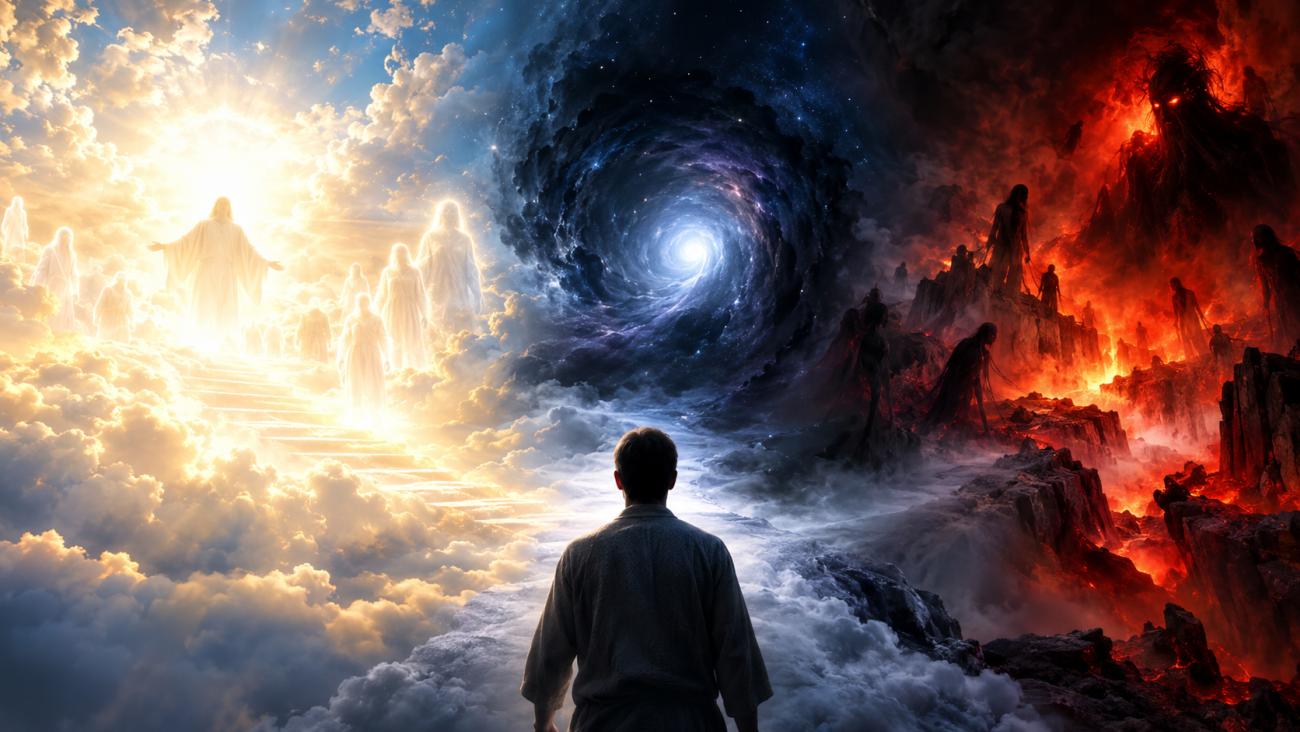
Ask a hundred people who have clinically died and come back what they found on the other side, and you will not get one story. You will get at least three.
Ask a hundred people who have clinically died and come back what they found on the other side, and you will not get one story. You will get at least three.
Some describe a light so dense with love that they struggle to find words for it. Tricia Barker, one of the better-known experiencers, reached for the phrase “an atomic bomb of love.” Others describe nothing at all: a silent, dark expanse with no landmarks and no company. And a smaller group describes something they would rather forget: heat, noise, hostile figures, a place that feels like every warning they ever heard in Sunday school.
Researchers noticed this split decades ago. In 1992 psychiatrist Bruce Greyson and Nancy Evans Bush published a study of distressing near-death experiences and sorted the darker accounts into three kinds: experiences with the usual luminous features that the person nonetheless found frightening, experiences of an endless void, and experiences of outright hellish landscapes.
So why the difference? Is it brain chemistry firing at random in a dying body, or is there a pattern underneath? The interesting thing is that someone mapped that pattern long before the term “near-death experience” existed.
In the 1850s a French educator named Hippolyte Léon Denizard Rivail started investigating the table-turning craze sweeping Paris. He expected to debunk it. Instead he compiled hundreds of questions, put them to spirits through a number of different mediums, compared the answers, and published the results in 1857 under the pen name Allan Kardec. The Psi Encyclopedia’s profile of Kardec gives a good overview of how a curiosity about moving tables became a structured philosophy with millions of followers, most of them today in Brazil.
The book was The Spirits’ Book, and its format is unusual. It reads less like scripture and more like an interview transcript: numbered questions, short answers, and Kardec’s commentary underneath. Anna Blackwell’s 19th-century English translation is in the public domain, and you can read a scanned 1893 edition on the Internet Archive.
I am not presenting the book as proof of anything. What makes it worth reading alongside modern near-death accounts is that it describes, in plain terms, the same three territories experiencers keep reporting, and it offers a single explanation for all of them.
Start with the bright end of the spectrum, because it is the most common.
Bill Letson, a firefighter who had his experience in 1994, describes flying through a field of stars and glowing orbs that seemed to recognise him and greet him. He compares the feeling to every victory a person ever has on Earth, rolled together and multiplied beyond counting, and insists that what we call death is not a loss but an enormous upgrade.
Brooke Grove tells a quieter version. The first thing she met was a pair of guardians, and the overwhelming sense was familiarity. She did not need anyone to explain where she was. It felt like walking back into a house she had lived in many times.
Kardec’s sources were asked directly whether a soul meets people it knew after death. The answer, at question 160, is yes, provided there was real affection between them. Loved ones come to meet the newcomer, and they can even help it finish loosening its ties to the body. The book frames the whole thing as a homecoming rather than a judgment, which is almost exactly how Grove describes it.
So far, so comforting. The harder question is why everyone does not get this reception.
Some experiencers see their body, and then the lights simply go out. A man named Daniel describes it as a blackness he still has no vocabulary for.
For others the void is not neutral. Penny Wittbrodt, a nurse, found herself in a darkness that seemed to have no edges and pressed down on her. She did not know why she was there or how to leave. Time behaved strangely, and when she later tried to translate the experience into earthly terms, it felt like roughly a decade.
The Spirits’ Book has a whole section on this. It calls it the state of confusion that follows death. According to Kardec’s sources, a soul does not snap into clarity the instant it leaves the body. There is a period of disorientation, something like waking from very deep sleep, and its length varies enormously: hours for some, months or years for others.
What decides the length? Not religious affiliation. The answers point to the moral state of the person and how attached they were to the physical world. Spirits that were already oriented toward something beyond the material adjust quickly. Those whose whole identity was bound up in possessions, status or appetite take far longer to get their bearings. The book adds a detail that fits Wittbrodt’s account well: people who gave some thought to the afterlife while alive tend to recognise what is happening sooner, but a clear conscience counts for much more than any amount of theory.
Then there are the accounts nobody wants to have.
MK McDaniel describes waking somewhere dark that slowly took on a reddish glow. The air grew hot and foul-smelling, screaming started up somewhere in the fog, and a voice asked whether she knew where she was. Her only answer was the obvious one, and the laughter that followed sent her running into the dark.
Howard Storm’s experience is probably the best-known example. A former art professor and committed atheist, he collapsed while leading a student tour in Paris in 1985. He followed voices into deepening darkness until the figures around him turned on him. Afterwards he described his pre-death life with brutal honesty: a man who wanted fame, money and admiration, and who treated other people as an audience for his ego. In his own review of his life, he gave himself failing grades across every relationship he had.
Here The Spirits’ Book departs sharply from the picture most of us grew up with. It does not describe hell as a pit that a deity throws people into. It describes suffering and happiness as conditions that come from inside the spirit, proportional to how far it has progressed. There is no single location for punishment. Spirits sort themselves by affinity, drifting toward others with the same temperament and values, much as people do on Earth.
That makes the darker realms less a prison than a neighbourhood. Storm said something strikingly similar: what made the place horrible was not the scenery but the inhabitants, and if they had treated each other better, it would have been far more bearable.
The book also explains why material attachment hurts so much at the moment of transition. In the chapter on the return to the spirit world, Kardec’s sources describe the separation of soul and body as gradual rather than instant. For people who lived with their attention on higher things, it can be quick and easy. For those who were heavily invested in physical pleasure and possessions, the bond lingers and the disengagement drags, sometimes for days or longer. The body is not coming back to life during that time; the spirit is simply slow to let go.
If the story ended there it would be bleak. It does not.
Wittbrodt eventually began to question her situation instead of just enduring it. Was there something she needed to understand before she could leave? Was the darkness about her? She realised that after her divorce she had built a wall around herself to protect her children and her heart. It worked, but it also kept everyone out. She went to work, came home, looked after the house and the kids, and quietly withdrew from the world. The isolation she had constructed on Earth had simply followed her across.
The moment she saw this, the darkness cracked apart. Fragments of it spun away, and a figure with hair so bright it looked like flame came toward her. It was her grandmother.
McDaniel found her own way out through, of all things, a Christmas carol. Told by one of the hostile presences that Christmas on Earth was always the worst day in that place, she started singing “Away in a Manger” out of sheer defiance. Others joined in. The figure lunged at her, she closed her eyes, and when she opened them she was surrounded by a light she describes as more joyful than anything the best moments of a lifetime could add up to. Bill Letson tells a similar story about a woman in a coma who escaped by singing a hymn from her church.
Kardec’s framework predicts exactly this. Nothing in it is eternal. The book argues that a belief in everlasting punishment can itself become a torment, and that the moment a spirit sincerely turns, through remorse or love or simple recognition, the conditions around it begin to change. McDaniel later admitted she had feared death for years afterwards because part of her still believed she deserved to go back. That fear was the belief doing its work.
If our inner state shapes what we meet after death, the obvious next question is what this life is for.
Letson’s answer is that Earth was always a classroom and never a courtroom. It is a hard school, he says, full of resistance, but one where a soul can gain a great deal in a short time.
Natalie Sudman’s account takes that idea somewhere startling. A civilian working for the US Army Corps of Engineers in Iraq, she was in a truck that was destroyed by a roadside bomb. In her book Application of Impossible Things she describes watching the scene as patterns of energy while two other beings worked alongside her. Together they were choosing which injuries her body would carry back, trying out options and watching the life each one would produce. From that vantage point it was genuinely funny. Back in the body, considerably less so. What stayed with her most was that nobody dictated anything. She was the authority in her own experience.
Betty, another experiencer, was shown her choices as cereal boxes on supermarket shelves, each one a different life experience, and she filled her trolley with the heaviest ones she could reach. She was told that the first half of her life had been training and the second half would be the mission she had signed up for.
The Spirits’ Book addresses this head on in its section on the choice of trials. Spirits choose the kind of challenges they will face, though young and inexperienced ones are guided the way a parent guides a child, and some are placed in circumstances that will help them make amends. Asked why anyone would choose a painful life, the reply is that free of the body, a spirit sees things differently. Kardec compares it to travellers in a fog-filled valley who cannot see the path until they reach high ground. From up there, a difficult stretch of road looks like a fair price for where it leads.
One last question follows naturally. If we chose all this, why can’t we remember choosing it?
The book’s answer is practical. Full memory of past lives and plans would be overwhelming, and it would turn every test into an open-book exam. Forgetting lets a person meet their circumstances as they are and respond with what they actually have inside them, which is the whole point of the exercise.
Put the accounts and the book side by side, and the explanation for the three kinds of experience is simple enough to fit on a postcard. You arrive where you already are.
Not where your church says you belong, and not where your fear says you deserve to go, but in a state that matches the one you have been building. The walls you put up stay up. The things you cannot let go of keep pulling at you. The love you gave and received is what comes out to meet you.
That is not a reason for dread. It is the most practical spiritual advice there is, because the preparation happens now, in ordinary choices. Loosen your grip on the things that do not travel. Repair what you can with the people you love. Take down a wall or two. If the experiencers are right, and if a quiet French schoolteacher’s interviews from 1857 are right, none of that effort is wasted.
The manual has been sitting in the public domain for well over a century. It is worth opening.