Physical Address
304 North Cardinal St.
Dorchester Center, MA 02124
Physical Address
304 North Cardinal St.
Dorchester Center, MA 02124

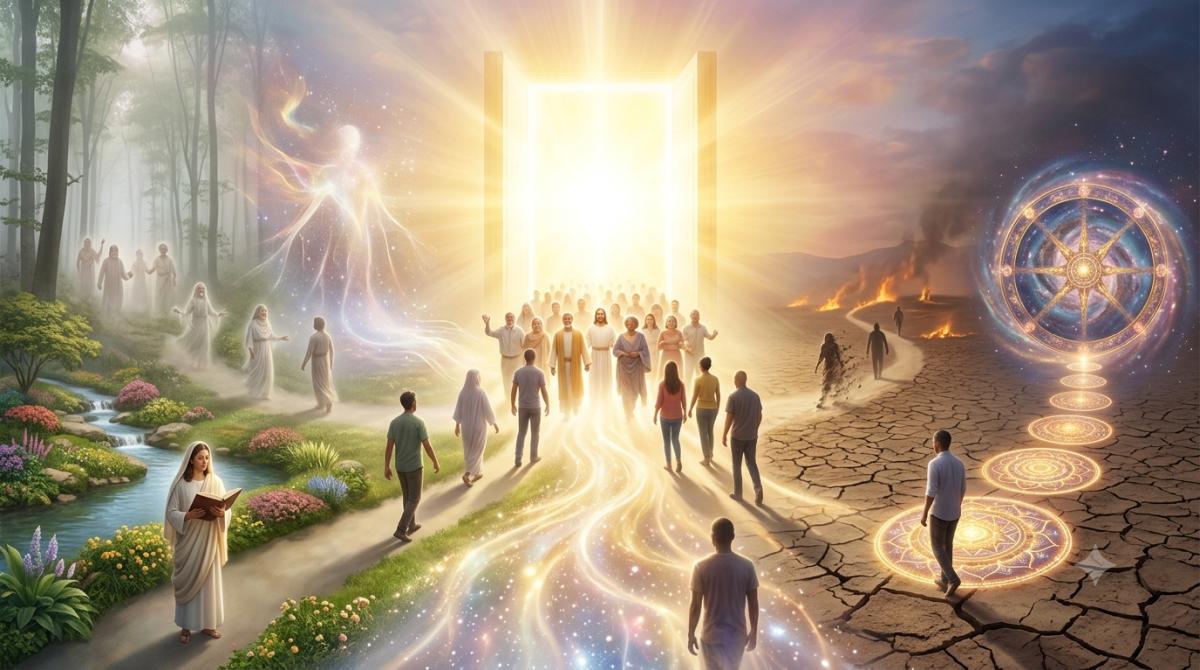
Here is a puzzle that should bother anyone who takes the afterlife seriously. The world’s religions describe wildly different destinations after death. One promises a garden with rivers and companions. Another offers reunion with ancestors, or absorption into a formless absolute, or a throne room, or a wheel of rebirth.
Here is a puzzle that should bother anyone who takes the afterlife seriously. The world’s religions describe wildly different destinations after death. One promises a garden with rivers and companions. Another offers reunion with ancestors, or absorption into a formless absolute, or a throne room, or a wheel of rebirth. If any single one of these were simply true, you might expect the testimony of people who have actually brushed against death to sort it out. They would come back reporting the correct address.
That is not what happens. The closer researchers look at near-death experiences, the more they find the same core showing up again and again, regardless of what the person believed before they nearly died. The destinations in the brochures are many. The doorway people actually describe is, to a striking degree, one doorway. That tension is the real subject of this article, and following it carefully leads somewhere more interesting than either the skeptics or the true believers usually go.
When the cardiologist Pim van Lommel ran a rigorous prospective study of cardiac arrest survivors across ten Dutch hospitals, published in The Lancet in 2001, he was not collecting cherry-picked stories. He interviewed consecutive patients within days of resuscitation, including the ones who remembered nothing, which gave him a built-in control group. A meaningful minority reported a near-death experience, and the features clustered tightly: a sense of leaving the body, movement through darkness toward light, an encounter with an overwhelming and unconditional love, a meeting with deceased relatives, sometimes a review of one’s life.
What you do not generally find in this data is doctrine. The devout do not, as a rule, arrive in the specific heaven their tradition advertised. The experience tends to dissolve their prior framework rather than rubber-stamp it. People come back convinced of survival and of love, not of the fine print of their childhood catechism. This is the strongest single objection to any theory that says you go straight to a custom-built afterlife stitched from your beliefs. The entry, for most people, looks more like a shared human birthright than a personalized stage set.
So far this cuts against the idea that belief builds the afterlife. Hold onto that, because the picture is about to complicate itself.
Most near-death experiences are luminous. A smaller set are not. Researchers Bruce Greyson and Nancy Evans Bush spent years documenting the distressing minority, and their classic 1992 typology sorts these difficult experiences into three kinds: ones with the same features as the peaceful type but experienced as terrifying, a sense of falling into an eternal nothingness or void, and graphic hellish landscapes populated by menacing entities. These are not common, but they are real, they are documented, and they refuse to fit a tidy “everyone meets the light” story. One of the stranger findings, summarized in the Psi Encyclopedia overview of Greyson’s work, is that the aftereffects of hellish experiences are often just as transformative and positive as those of blissful ones, as though the value lay in the encounter itself rather than in its emotional weather.
Consider one such case, which I have written about elsewhere on this site. A lifelong Catholic went into a coma lasting roughly three weeks and woke up reporting not the love and light of the typical account, but fire, an endless road, and demonic figures at the edges. You can read her full story in the piece She Was a Lifelong Catholic. Then She Woke Up in Hell. What stands out is not just that her experience was distressing. It is that the distress took the exact shape her upbringing had drawn for it. A woman raised on a vivid, literal hell woke up inside precisely that hell, rather than in a neutral void or a generic darkness.
That detail is the hinge. The uniform-core data says belief does not dictate the experience. This case says belief shaped the experience profoundly. Both observations are accurate. The way to hold them together is to stop treating “the afterlife” as a single moment and start treating it as having layers.
The resolution that best fits all the evidence is this: there appears to be a universal substrate, the light and the love and the sense of homecoming, sitting beneath a culturally patterned surface that varies from person to person.
You can see the surface layer even within the blissful experiences, not only the frightening ones. The being of light is nearly universal, but who people identify it as is not. A Christian may name it Christ. Another person reads the same presence as an angel, an ancestor, a sphere of intelligence, or simply love with no name attached. Curiously, the identification does not even track neatly with the person’s own religion. People of every religious affiliation and none report NDEs, including atheists who come back describing an encounter they had no framework to expect, and the figure interpreted as Jesus turns up across a surprising range of backgrounds while the founders of other traditions rarely appear in their expected forms. The encounter looks common. The label looks local, and it does not distribute the way a simple “you see what you were taught” rule would predict. The data is messier and more interesting than that.
This is exactly where belief does its work. Not by choosing the destination wholesale, but by supplying the costume the encounter wears. For most people, an experience of overwhelming love gets dressed in gentle, familiar clothing. For someone primed by fear and a literal doctrine of punishment, the same threshold can be read through dread, and the imagery curdles into something hellish. The substrate may be shared. The interpretation is yours, and it is built from what you carried in.
This is the point at which Robert Monroe’s explorations become useful, provided we are careful about what we are claiming. Across his out-of-body work, Monroe described regions beyond the threshold that he called belief system territories, areas of the nonphysical built up out of human thought and expectation.Ultimate Journey lays out his model of these regions as part of the wider Earth Life System, organized constructs in what he termed the M Field rather than fixed terrain. In his account, a personality that cannot release its earthly attachments can settle into a region that matches those attachments, a kind of resonance where like is drawn to like. He described these as constructs rather than ultimate reality, scenery generated by minds rather than fixed geography.
Read literally, as a catalogue of branded afterlives waiting to receive their correct believers, Monroe’s territories run straight into the uniform-core objection. The NDE data simply does not show people sorting into doctrinal heavens at the doorway. But read as a model of the shaping mechanism, the same idea fits the evidence well. Monroe is describing, in his own idiom, the very thing the distressing cases demonstrate: that consciousness can construct the environment it then experiences as solid, and that attachment and expectation are the raw materials it builds with. His map is best treated not as a literal floor plan of the beyond, but as one lens on how the local surface gets generated on top of the shared substrate.
It is worth saying plainly what this does not mean. It does not mean hell is a real place lying in wait to swallow the wrong believers. The woman who woke in fire did not come back warning others to fear damnation. She came back having understood that the hell was something her own mind had assembled, which is precisely why it lost its power over her. If belief can build a torment, then awareness can dissolve it, and that is a far more hopeful conclusion than the doctrines that frightened her in the first place.
The reason any of this matters before you die is that the same mechanism is almost certainly running right now. The afterlife may dramatize it, but belief shaping experience is not a special feature of death. It is the ordinary condition of being a conscious creature. You already live inside interpretive frameworks you did not consciously choose, inherited from family, culture, and old fear, and they quietly determine which version of each day you wake up in. The person braced for threat finds threat. The person open to grace tends to find more of it.
The practical teaching that falls out of all this is not a technique for navigating the bardo. It is a discipline for navigating Tuesday. Notice the costumes your own mind reaches for. Hold your inherited frameworks loosely enough that a moment of love can register as love rather than getting overwritten by an old story about what you deserve. The accounts suggest that what waits at the threshold, for most people, is overwhelmingly kind. The work, here and possibly there, is learning to clutch your beliefs gently enough to let that kindness through.
The heavens in the brochures are many because we are many, and we each paint the encounter in the colors we brought. But underneath the paint, the testimony keeps pointing at the same quiet thing: light, and a love that does not appear to care what you called it.