Physical Address
304 North Cardinal St.
Dorchester Center, MA 02124
Physical Address
304 North Cardinal St.
Dorchester Center, MA 02124

Most of the near-death stories that circulate online follow a comforting arc. A tunnel, a warm light, a reunion with loved ones, a reluctant return. We rarely hear about...
Most of the near-death stories that circulate online follow a comforting arc. A tunnel, a warm light, a reunion with loved ones, a reluctant return. We rarely hear about the other kind. Yet researchers have known for decades that a meaningful minority of people who brush against death come back describing something closer to terror than to bliss. One woman who lived through exactly that, and spent years trying to make sense of it, is M.K. McDaniel, known to friends as Kathy and the author of the memoir Misfit in Hell to Heaven Expat.
Her account is worth sitting with, not because it confirms anyone’s theology, but because of where she eventually landed after the worst night of her existence.
Kathy grew up about as devout as a person can be. Cradle Catholic parents, Catholic schools run by nuns and priests, Mass every Sunday, and a faith she never thought to question. In her early fifties, life pulled her north. Her closest friend had leukemia and needed two caregivers to qualify for treatment at a Seattle research hospital, so she left California and settled in a few blocks away. A stay that was supposed to last two or three months stretched past eight. Her friend rallied, then declined, then rallied again. The other caregiver broke her foot, and suddenly Kathy was nursing two people around the clock. In November, her friend died.
By her own description she was wrung out on every level, mentally, physically, emotionally, and spiritually. Soon after, she caught a vicious flu making the rounds. It became pneumonia, then acute respiratory distress syndrome. Doctors gave her a thirty-eight percent chance of surviving. She was placed on a ventilator and into a drug-induced coma for three weeks while her family gathered from across the country and prepared to say goodbye. A doctor told her he would administer something to erase any memory of the experimental measures they were about to attempt. She said her goodbyes and expected to sleep.
That is not what happened.
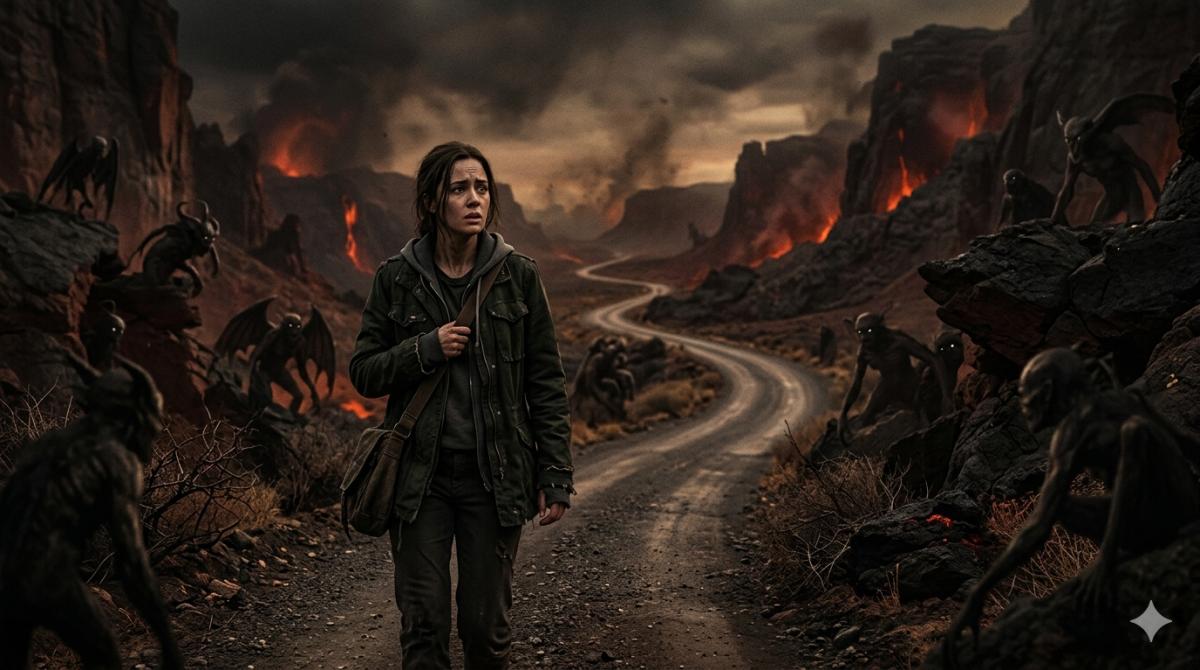
Somewhere inside those three weeks, her awareness switched on. There was total darkness, no sound, no sense of whether she was sitting or standing. At first she assumed someone had played a prank and shut her in a closet, so she waited. Then a reddish glow appeared and grew, but instead of daylight it brought swirling fog, an unpleasant heat, a foul smell, and the sound of shrieking and moaning. A booming voice asked her where she was. When she answered with the word she dreaded, it laughed back at her, and she bolted into the blackness.
What followed was a sequence of scenes, each ending when the lights cut out and rose again somewhere new. A ruined city on fire, its buildings collapsing, populated by ragged figures who told her they were all alone. A mocking encounter with a vain relative who insisted that looking good was all that mattered. A demonic figure who promised her freedom if she would clear an enormous field of thorny blackberry canes, then handed her a pair of child’s safety scissors and laughed as each cane she severed grew instantly back. A road with no end that taught her, as she later put it, why people speak of eternity, because there was simply no time there at all.
The cruelty escalated. A banquet of beautiful food guarded by a woman who told her it was reserved for important people. A crowd that beat her and declared she now shared their disease and could never die, only suffer. A march through chest-deep snow that gave fresh meaning to the phrase cold as hell. When a half-demon guide told her the heaviness in the air was because it was Christmas on Earth, always the worst day below, something in Kathy refused to break. She began to sing Away in a Manger. The figure shrieked and lunged, and the lights went out again.
This time the darkness gave way to something utterly different. She described being saturated in love, every molecule of her swimming in it, all the horror simply gone from memory. The space resolved into something like a white cathedral, and standing there was her friend, the one who had died only a month earlier. Gone was the ravaged face of his illness. He looked decades younger, radiant, wearing the sweater she had given him, almost dancing with eagerness to tell her things. Near him stood a table holding a large open book.
She realized, watching his joy, that if he was here and dead, then so was she, and that this must be the heaven she had been raised to expect. But before she could stay, he gently told her she had too much left to do, and she was sent back. There was a brief, dreamlike interlude beside a stream where women speaking an unfamiliar language handed her small gifts, and then she surfaced in a hospital room surrounded by the family who had been praying over her. She had shrunk to eighty-six pounds, could move only a single finger, and carried a message she had no idea how to act on.
Kathy’s story matters partly because hellish accounts are not the anomaly many assume. The psychiatrist Bruce Greyson and researcher Nancy Evans Bush <a href=”https://www.tandfonline.com/doi/abs/10.1080/00332747.1992.11024583″>gathered fifty distressing cases and sorted them into recognizable types</a>, ranging from frightening versions of the classic tunnel to a void of utter aloneness and explicitly hellish landscapes. Their work, summarized in an accessible <a href=”https://pmc.ncbi.nlm.nih.gov/articles/PMC6173534/”>overview of distressing near-death experiences</a>, notes how the Western image of hell as eternal physical torment leaves experiencers like Kathy struggling to rebuild a life around something so durable and so isolating.
Crucially, the researchers found <a href=”https://research.iands.org/distressing-near-death-experiences.html”>no clean correlation between a person’s character and whether their experience was pleasant or terrifying</a>. Devout believers expecting comfort sometimes meet horror, and people braced for judgment sometimes meet pure love. Everyone, they concluded, carries the potential for either. That alone undercuts the moralized idea that a frightening passage is a verdict on the person passing through it.
What happens afterward tends to follow a consistent pattern regardless of how dark the experience was. Survivors commonly report a <a href=”https://iands.org/near-death-experiences/aftereffects-of-near-death-experiences/”>loss of the fear of death and a deep shift away from status and material concern toward compassion and service</a>. Many become, in the familiar phrase, more spiritual but less religious, a description that fits Kathy almost exactly. It took her more than a decade and the company of others at International Association for Near-Death Studies gatherings before she could begin to integrate what she had been through, a slow timeline that researchers describe as <a href=”https://noetic.org/blog/nde/”>entirely normal for an event this intense</a>.
Her own conclusion is the part that lingers. She came to believe that her soul is a part of God, that God is wholly loving and forgiving and condemns no one, and that the place she visited was not a destination imposed from above but something she manifested because, as a lifelong Catholic, she fully expected it to exist. In her reading, she chose to come here to learn, and even her worst suffering became information rather than punishment. Whether or not one shares her metaphysics, there is something freeing in her refusal to see herself as a victim of the universe. That orientation, the sense that consciousness is doing something purposeful rather than merely enduring, runs through a great deal of the territory we explore here, including our look at <a href=”https://backtoplanetki.com/exploring-new-frontiers-ethans-septasync-system-and-its-place-alongside-the-monroe-institutes-gateway-tapes/”>audio systems designed to deliberately shift states of awareness</a>.
Kathy does not push her beliefs on anyone. She tells the story and lets people take what they need from it. The line she carried back, that she still had too much left to do, reads less like a threat than an invitation. Whatever the place she visited actually was, the woman who returned from it is no longer afraid of dying, no longer keeping score against the world, and convinced she is on her way home.
That may be the most useful thing a story about hell can offer. Not a map of the afterlife, but a loosening of the grip that fear holds on the life we are living right now.