Physical Address
304 North Cardinal St.
Dorchester Center, MA 02124
Physical Address
304 North Cardinal St.
Dorchester Center, MA 02124

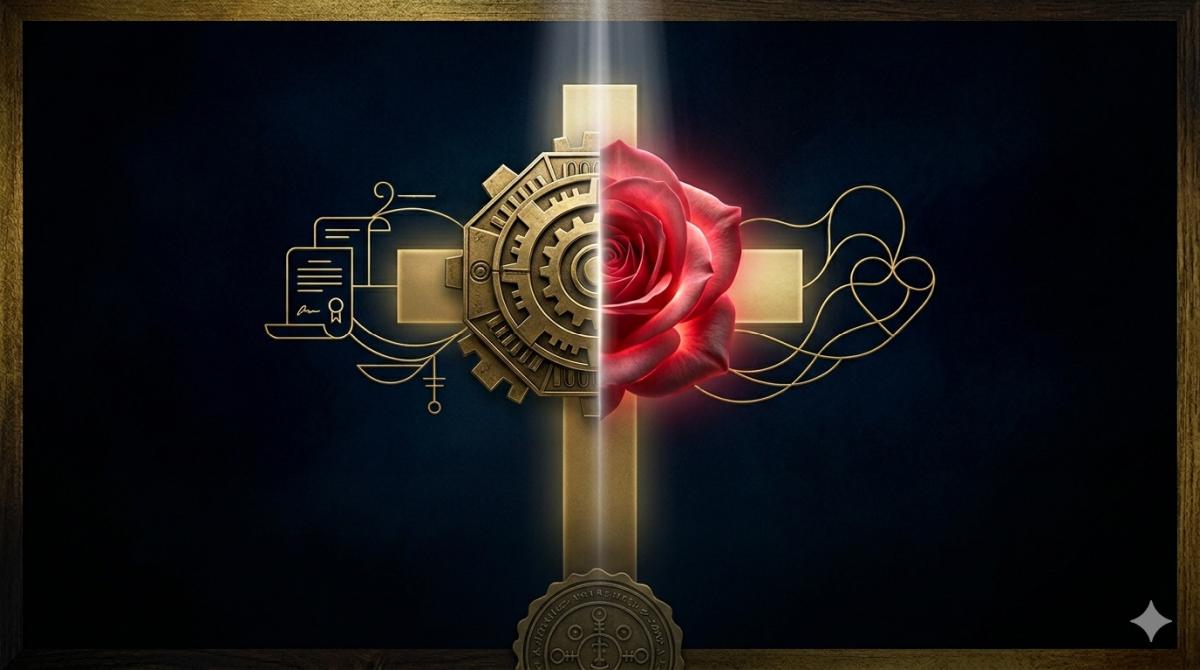
There is a peculiar problem at the heart of the Western mystery tradition. The more famous a path becomes, the easier it is to counterfeit. And few paths have been counterfeited as thoroughly as Rosicrucianism — a tradition whose very name conjures rose-entwined crosses, sealed vaults lit by artificial suns, and a brotherhood sworn to heal the sick for free and keep its existence hidden for a hundred years.
There is a peculiar problem at the heart of the Western mystery tradition. The more famous a path becomes, the easier it is to counterfeit. And few paths have been counterfeited as thoroughly as Rosicrucianism — a tradition whose very name conjures rose-entwined crosses, sealed vaults lit by artificial suns, and a brotherhood sworn to heal the sick for free and keep its existence hidden for a hundred years.
The romance is real. So is the substance beneath it. But so, unfortunately, is the imitation. For every genuine current of initiatory transmission, there are a dozen organizations that have learned to look Rosicrucian — to build the museums, collect the scrolls, print the certificates — without ever touching the inner work the tradition exists to transmit. If you are drawn to this path, the single most useful skill you can develop is discernment: the ability to tell the living thing from its taxidermied likeness.
This article is about how to do exactly that.
Before we can spot a fake, we need a clear picture of the real. Rosicrucianism presents itself not as a single organization founded on a particular afternoon, but as a perennial tradition — the latest surfacing of a spiritual science that claims roots in ancient Egypt, the Kabbalah of the Jewish and Greek worlds, and the Grail currents of the medieval West. Its public emergence is usually dated to three documents that detonated across early-seventeenth-century Europe: the Fama Fraternitatis (1614), the Confessio Fraternitatis (1615), and The Chemical Wedding of Christian Rosenkreuz (1616).
These texts told the story of Christian Rosenkreuz, the legendary founder reportedly born in 1378, who travelled east to Damascus, the mysterious city of Damcar, and Fez in Morocco, gathering medicine, mathematics, and the wisdom of Arab and Persian masters before returning to Germany to found the House of the Holy Spirit. The crucial point of the legend is that Rosenkreuz invented nothing. He recognized — he saw that one ancient current ran beneath Egyptian, Hermetic, and Islamic teaching alike, and he gathered it into a Western vessel.
This matters for our purposes because it tells you what the tradition values: not novelty, not institutional grandeur, but transmission — the passing-on of something living. The scholar Frances Yates, in her landmark study of the period, emphasized the allegorical intent of the manifestos rather than treating them as literal corporate history — and that allegorical reading is itself a clue to what the path is really about. The vault, the founder, the brotherhood: these are images of inner processes, not entries in a registry of clubs.
Authentic Rosicrucianism is initiatory and experiential — a path of inner transformation rather than a doctrine to be believed or a library to be memorized. Its central concern is what the tradition calls the structuring of the subtle body: the conscious organizing of the aetheric, astral, causal, and spiritual planes of the human being so that they cohere into something capable of surviving the Gate of Death and carrying its accumulated wisdom forward.
The practical engine of this work is a set of inner exercises focused on the heart. The tradition describes six essential disciplines — observing and directing one’s thinking, one’s feeling, and one’s will; cultivating unbreakable positivity that treats even hardship as an initiation trial; maintaining a radical openness or “beginner’s mind”; and finally harmonizing all of these into a unified state. Where some Eastern systems work “bottom-up” from the base of the spine and some Christian mystical streams work “top-down” from the crown, the Rosicrucian method is distinctively “center-out”: it begins at the heart and lets the heart become the organizing center for the whole energy body.
The reason this is worth spelling out is that none of it can be bought. You cannot acquire a structured subtle body by purchasing a membership tier or owning a rare manuscript. The work is done in the silence of daily practice, over years, through the patient observation of your own thinking and feeling. As one of the great twentieth-century interpreters of the path, Paul Foster Case, argued in The True and Invisible Rosicrucian Order, Rosicrucianism is based not on earthly organizations but on personal unfoldment. Hold that sentence close — it is the master key to everything that follows.
If genuine Rosicrucianism is defined by inner transmission, then counterfeit Rosicrucianism is defined by everything that substitutes for it. Here are the patterns to watch for.
The facade of authenticity. The most common counterfeit builds an impressive exterior — museums, archives, ancient scrolls, imposing architecture — to manufacture the appearance of legitimacy while lacking any genuine initiatory system. The artifacts become the point. But a collection of historical objects is not a living lineage, and a beautifully curated library is not the same as a teacher who can actually pass something on. The Hermetic Academy, writing on the difference between genuine Rosicrucian lineage and imitation, makes the distinction sharply: a genuine order adheres to a graded path of initiation and does not offer indiscriminate access to its mysteries to anyone who turns up with a fee.
The book occultist. A related figure is what we might call the book occultist — someone who engages with Hermeticism, alchemy, and Kabbalah purely at the theoretical level, accumulating information without ever submitting to the transformation the information is supposed to provoke. There is nothing wrong with study; study is necessary. The corruption sets in when reading replaces practice, when knowing about the Great Work becomes a comfortable substitute for actually undergoing it.
Symbol-blending and New Age dilution. Watch, too, for orders that strip Rosicrucian symbols out of their context and blend them indiscriminately with unrelated New Age material, producing a kind of spiritual smoothie in which nothing retains its potency. There is a real critique here even of well-known, well-organized bodies. The eclectic, syncretic approach — the attempt to amalgamate Egyptian, Hermetic, Qabalistic, and assorted other elements into a single universal framework — can, as critics of the synthetic methods of certain modern orders have argued, dilute the specificity and potency of each tradition it absorbs. Even the largest and most reputable Rosicrucian body in the world, AMORC, has weathered serious questions about lineage — including succession disputes and schisms after the death of Ralph M. Lewis in 1987 — which it ultimately resolved through legal affirmations of organizational continuity. Whether legal continuity is the same as spiritual continuity is precisely the kind of question a discerning seeker has to sit with.
Here a word of balance is owed. To say that imitations exist is not to say that every organized order is fraudulent, nor that every museum or public-facing body is a sham. AMORC, for one, openly describes its own history as having both a traditional and a chronological dimension, and many sincere people have found genuine value within structured orders. The point is not paranoia but discernment — the willingness to ask, of any group, whether it transmits something living or merely curates something dead.
External fakery is the easy case. The harder and more interesting danger is internal — the ways a sincere seeker on a genuine path can still be pulled off-course. Here the tradition’s metaphysics becomes genuinely useful, because it names the two forces that distort almost all spiritual life.
The first is the Luciferic impulse: the pull toward unbalanced spirituality. It expresses itself as the craving for constant ecstatic states, as ego inflation dressed up in spiritual language, and as the seductive conviction that the physical world is mere illusion — maya — to be escaped rather than redeemed. The second is the Ahrimanic impulse: the pull toward unbalanced materiality, the conviction that only matter is real and that the human being is nothing more than an accident of chemicals. This framework comes most fully from Rudolf Steiner, who described these two powers as the scales of a balance that we ourselves must hold in equipoise. Crucially, Steiner warned that these forces do not work in isolation; they increasingly work together, and our task is not to defeat one and side with the other but to permeate each with the other and walk the middle path between them.
This is where Rosicrucianism’s deepest practical wisdom lives. The tradition speaks of balancing the Spirit of Love — the force that draws us to merge back into the One, the spiritual or Luciferic pole — against the Spirit of Freedom, the independence that comes from being a separate individual in the material world. Neither pole is the enemy. Love without freedom dissolves the self; freedom without love isolates it. The whole art is the equipoise.
A few specific traps follow from getting this balance wrong:
The guru trap is premature ego inflation. A seeker gains a little knowledge, perhaps a few genuine experiences or minor powers, and is tempted to present themselves as a master. This turns toxic the moment a teacher makes claims to authority that leave their followers unfree — dependent, diminished, surrendered. The tradition contains a sobering warning here: spiritual gifts are not granted permanently. If a teacher or a lineage becomes corrupt, the living spiritual connection simply withdraws, even as the external institution carries on looking exactly as it did. The shell remains; the life has gone.
The trap of premature purification is subtler still. A practitioner tries to suppress their sexual or emotional nature through what the tradition calls “purification in place” — forcing a purity they have not actually grown into. Because the underlying forces have been suppressed rather than lived through and integrated, the energy does not disappear; it goes underground and re-emerges in distorted, manipulative, or scandalous forms. The recurring sexual scandals of spiritual communities are, on this reading, not random failures of individual character but the predictable result of a sex-negative impulse that treats the body’s processes as shameful rather than as forces to be consciously integrated. The contemporary writer at Angelorum, exploring discernment and the Luciferic impulse in Steiner’s framework, frames the antidote well: the work is to cultivate an inner capacity to recognize when one is being pulled toward either extreme, rather than to amputate the parts of ourselves we find inconvenient.
So how does a seeker stay genuine in a field so thick with imitation? The tradition’s own answer is strikingly anti-institutional. The authentic Rosicrucian approach is trans-religious and trans-denominational — it cooperates across boundaries rather than demanding exclusive allegiance. And its deepest instruction is that the individual should connect directly to what it calls the “column of spirit” above their own head, rather than outsourcing that connection to any external authority or institution.
This is the cleanest possible test. A genuine path increases your freedom and your direct connection to the source. A counterfeit one decreases it, inserting itself as a necessary middleman between you and the Divine, and making you dependent on its continued approval. Real initiation hands you back to yourself, enlarged. Fake initiation keeps you coming back to the clubhouse.
The teleological aim of the whole endeavour — the destination toward which all the exercises and disciplines point — is to become a “crystallized spirit” with a unique inner geometry, capable of serving humanity as a free agent in the cosmos. Not an obedient member. A free agent. Any order or teacher that cannot tolerate your freedom has already told you what it is.
There is an alchemical saying that sits at the center of this tradition: the lead must die before the gold can emerge. The uninitiated self — the self built from fear, vanity, and unexamined habit — has to be surrendered before the Philosopher’s Stone of elevated consciousness can appear within. This is demanding, slow, and frequently uncomfortable work, which is precisely why the counterfeits are so attractive. It is far easier to buy a certificate than to let the lead die.
The fake orders, the book occultists, the inflated gurus, and the suppressed and scandal-prone communities all share a single root: they want the gold without the dying. They want the appearance of transformation without the cost of it. And so the most reliable discernment of all turns out to be embarrassingly simple. Ask of any path, any teacher, any order: Is this asking me to surrender my ego, or to inflate it? Is it handing me back to myself as a freer being, or binding me more tightly to itself?
The genuine Rosicrucian current — whatever building it does or doesn’t operate out of — has only ever had one mission: the general reformation of the world through the awakening of the individual soul. Everything that serves that awakening is, in the deepest sense, authentic. Everything that merely impersonates it is the lead, refusing to die.