Physical Address
304 North Cardinal St.
Dorchester Center, MA 02124
Physical Address
304 North Cardinal St.
Dorchester Center, MA 02124

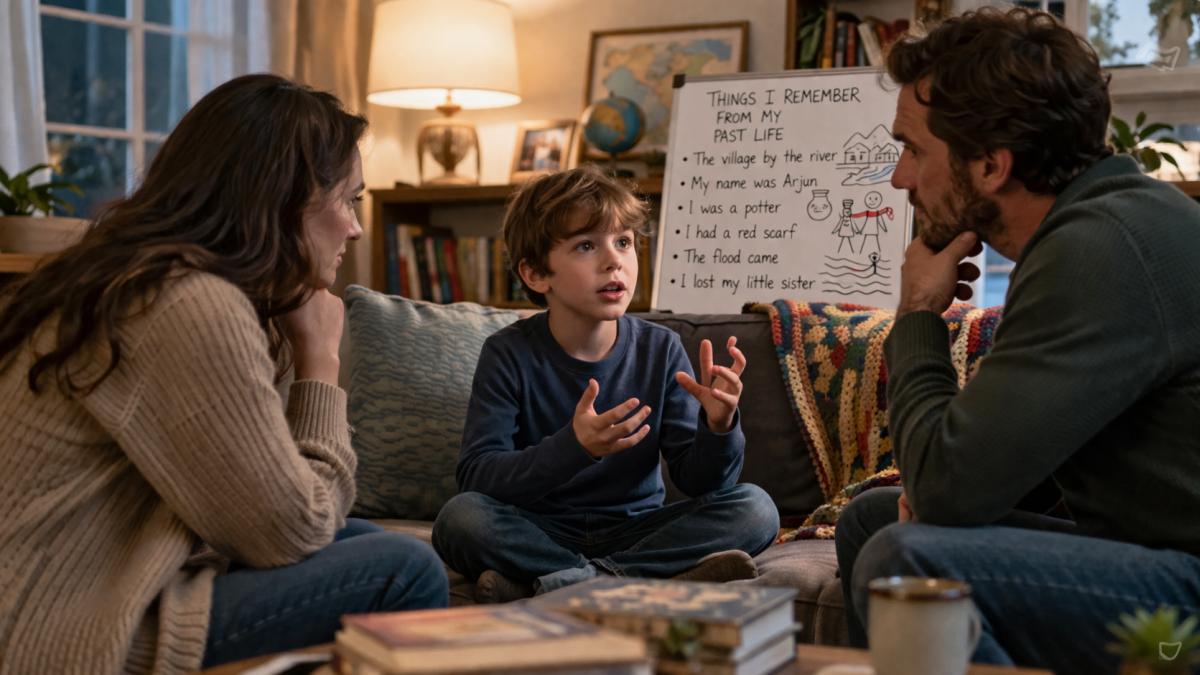
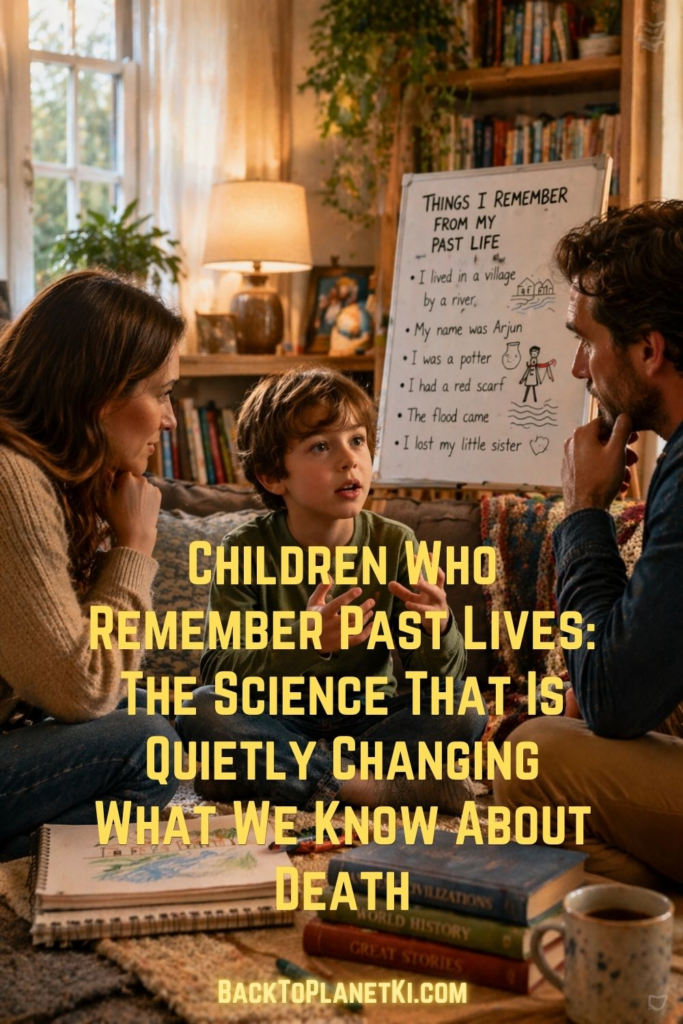
There is a moment that happens in homes across the world, in dozens of cultures and languages, that parents are often completely unprepared for. A two-year-old looks up from their cereal and describes, with unnerving calm, the house they used to live in before this one. They name people nobody in the family has ever mentioned. They describe how they died.
It is happening more often than most people realise. And researchers at one of the most respected medical institutions in the United States have been collecting and verifying these accounts for over sixty years.
There is a moment that happens in homes across the world, in dozens of cultures and languages, that parents are often completely unprepared for. A two-year-old looks up from their cereal and describes, with unnerving calm, the house they used to live in before this one. They name people nobody in the family has ever mentioned. They describe how they died.
It is happening more often than most people realise. And researchers at one of the most respected medical institutions in the United States have been collecting and verifying these accounts for over sixty years.
Dr. Ian Stevenson spent four decades as a psychiatrist and head of perceptual studies at UVA doing something the academic establishment was deeply uncomfortable with: he followed the evidence wherever it led. Over his career he documented approximately 3,000 cases of children across five continents who spontaneously recalled past lives with a level of specificity that defied conventional explanation.
These were not vague impressions. Children were naming specific streets, identifying deceased relatives in photographs, describing the circumstances of their death, and in some cases speaking fragments of languages they had never been exposed to. This last phenomenon, known as responsive xenoglossy, is particularly difficult to explain away.
Stevenson was not a credulous man. He approached each case as a scientist, actively looking for fraud, parental suggestion, cryptomnesia, and cultural contamination. In cases that survived his scrutiny, the child’s statements were cross-verified against public records, family accounts, and in many instances direct visits to the claimed past-life location. His seminal book, Twenty Cases Suggestive of Reincarnation, published in 1966 and later expanded, remains one of the most methodologically rigorous pieces of anomalous research ever produced.
One of the most striking threads in Stevenson’s research involves physical correspondences. In hundreds of cases, children carried birthmarks or congenital defects that aligned precisely with fatal wounds from their claimed previous incarnation. A child who described being shot in the chest in a previous life was found to have a birthmark in the precise location. Children who described drowning exhibited severe water phobias with no traumatic event in their current life to explain it.
This is significant because it suggests that whatever is being carried between lives is not purely informational. It appears to be somatic, imprinted at the level of the body itself. Many spiritual traditions would describe this as the causal body or the subtle body retaining impressions from previous incarnations. From a purely scientific standpoint, it remains unexplained.
What Stevenson and his successors noticed is a consistent developmental window. Children typically begin speaking of their previous life between the ages of two and five, with memories fading naturally around age seven or eight as the current life identity consolidates. This pattern holds across cultures as different as Lebanon, Sri Lanka, India, Turkey, and the United States, which makes cultural transmission an unlikely explanation.
One of the most thoroughly documented modern cases involves a boy from Ohio named Luke Ruehlman, who from around age two began describing a previous life as a woman named Pamela Robinson. He described her appearance, her death in a fire, the experience of going to heaven, and being reborn. He was precise enough about details that his parents were able to locate historical records of Pamela Robinson, a woman who perished in the 1993 Paxton Hotel fire in Chicago. The details Luke provided aligned with what could be verified.
External link: Jim Tucker’s work at UVA on American reincarnation cases
Cases like Luke’s resonate so deeply because they involve something a young child simply should not be able to fabricate. The specificity, the emotional weight behind the recollections, and the verifiable details all converge in a way that demands serious inquiry rather than reflexive dismissal.
Stevenson’s work was not a historical curiosity that ended with him. Dr. Jim Tucker, his successor at the University of Virginia, has continued building on the archive, which now exceeds 2,500 cases, each catalogued across more than 200 variables to identify cross-cultural patterns. Tucker’s own book, Life Before Life, examines the American cases specifically and finds the same consistent features that Stevenson documented globally.
External link: Jim Tucker’s Life Before Life
What emerges from this body of research is not proof in the absolute scientific sense, because reincarnation as a phenomenon challenges our most fundamental assumptions about consciousness, time, and individual identity. But it is something more discomfiting than wishful thinking. It is a sustained, methodologically careful body of evidence that resists easy dismissal.
The Law of One material, which forms one of the foundational frameworks on this site, describes the soul’s journey through multiple incarnations as a process of learning and service, with each lifetime offering specific lessons chosen before entry. The forgetting at birth is described as a deliberate veil, not a flaw in the system. The rare child who pierces that veil briefly before it closes again may be offering the rest of us something rare: a glimpse of the continuity that underlies what we experience as separate lives.
For a deeper look at how this maps to channelled teaching, see our piece on what the Law of One says about the soul’s journey between incarnations.
These cases do not ask anyone to immediately restructure their worldview. They ask something simpler and more profound: to stay curious. To resist the reflexive certainty that consciousness ends at death simply because that is the default assumption of the culture we were born into.
Stevenson himself was careful never to claim his research proved reincarnation. He said it suggested it. He believed the question deserved the same rigorous, open-minded scientific attention as any other anomalous phenomenon. What he could not do was unsee what he had seen across sixty years and three thousand cases: that some children arrive into this life already carrying echoes of another one.
The boundary between lives, if these accounts are to be believed, is more permeable than we have been taught to think. And the children who speak of it, with their matter-of-fact clarity and their fading memories, may be the closest thing we have to direct testimony from the other side of that boundary.
If the soul truly continues after death, then what we are doing here, in this life, in this body, carries a weight and a purpose that extends far beyond what is visible. That is not a terrifying idea. It is, when you sit with it, a quietly magnificent one.