Physical Address
304 North Cardinal St.
Dorchester Center, MA 02124
Physical Address
304 North Cardinal St.
Dorchester Center, MA 02124

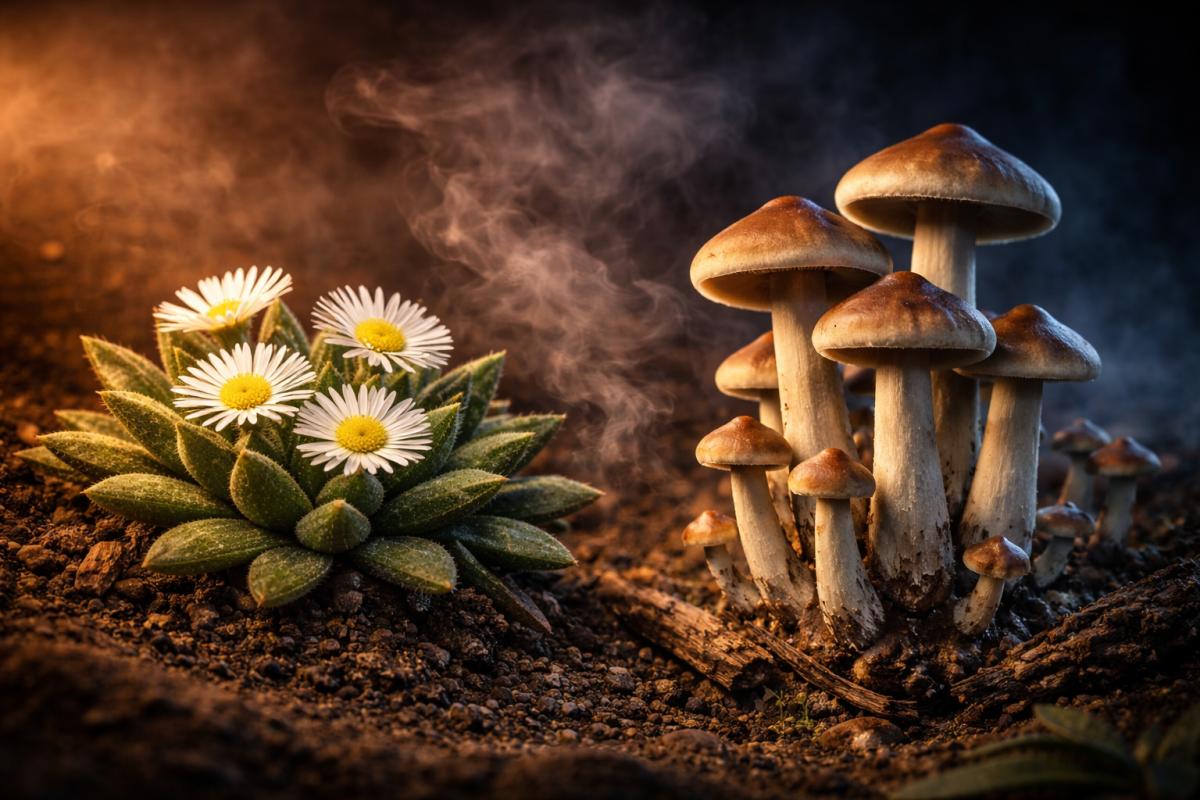
The microdosing conversation has never been more alive. From research labs at Johns Hopkins and Imperial College London to wellness communities across the world, the idea that tiny, sub-perceptual doses of plant medicines can meaningfully shift mental health, cognition, and daily wellbeing is gaining serious scientific traction. Most of that conversation has centred on psilocybin -- and for good reason. But a growing body of research is pointing to something equally interesting: a small South African succulent called Sceletium tortuosum, known as Kanna, that works through entirely different neurological pathways and may serve as a powerful complement to, rather than a substitute for, psilocybin in a conscious wellness practice.
The microdosing conversation has never been more alive. From research labs at Johns Hopkins and Imperial College London to wellness communities across the world, the idea that tiny, sub-perceptual doses of plant medicines can meaningfully shift mental health, cognition, and daily wellbeing is gaining serious scientific traction. Most of that conversation has centred on psilocybin — and for good reason. But a growing body of research is pointing to something equally interesting: a small South African succulent called Sceletium tortuosum, known as Kanna, that works through entirely different neurological pathways and may serve as a powerful complement to, rather than a substitute for, psilocybin in a conscious wellness practice.
This article explores what the science says about how each plant works, where their benefits genuinely overlap, where they diverge, and why the most sophisticated approach may be to work with both — each in its own lane, each doing what it does best.
The most significant finding to emerge from the modern psilocybin research wave is not simply that it reduces depression or anxiety, though the evidence for that is increasingly compelling. It is that psilocybin appears to physically restructure the brain by promoting neuroplasticity — the growth of new synaptic connections and dendritic spines that allow entrenched mental and emotional patterns to be released and replaced.
A 2025 review published in PubMed summarised the mechanism clearly: psilocin, the active compound in psilocybin mushrooms, is a potent serotonin agonist that acts on the 5-HT2A receptor, promotes neuroplasticity, reduces neuroinflammation, and decreases overactivity in the default mode network — the brain’s habitual self-referential loop that underlies rumination, anxiety, and depressive thinking.
This neuroplastic effect is what makes psilocybin uniquely powerful for conditions rooted in deeply entrenched patterns: treatment-resistant depression, PTSD, addiction, and long-term anxiety disorders. Research from Johns Hopkins has demonstrated sustained antidepressant effects lasting up to six months from a single guided session. A Lancet follow-up study published in 2024 comparing psilocybin therapy to the SSRI escitalopram found that psilocybin produced more durable improvements in psychological wellbeing at six months, with researchers pointing to neuroplasticity and transformative experience as likely contributors.
Microdosing psilocybin, by working at sub-hallucinogenic doses over extended periods, appears to access some of this neuroplastic potential in a more gradual, sustainable way. The cumulative effect reported by consistent microdosers — reduced emotional reactivity, increased openness, greater cognitive flexibility, a quieter inner critic — points to slow, gentle rewiring of the default patterns that drive suffering.
This is something Kanna, for all its considerable merits, does not appear to replicate. Kanna does not act on the 5-HT2A receptor. It does not produce neuroplasticity in the same direct sense. What it does instead is quite different — and equally valuable when understood on its own terms.
As explored in our in-depth guide to microdosing Kanna, the plant works through four primary neurological mechanisms simultaneously: serotonin reuptake inhibition, phosphodiesterase-4 (PDE4) inhibition, upregulation of noradrenaline, and downregulation of GABA. This four-pathway action, confirmed by 2026 research from Stellenbosch University published in the Journal of Ethnopharmacology, distinguishes Kanna from both conventional SSRIs and from psychedelics.
The serotonin reuptake effect softens emotional reactivity and lifts baseline mood. The noradrenaline increase sharpens focus and supports sustained attention. The PDE4 inhibition reduces neuroinflammation and supports cognitive function. The GABA modulation, at microdose levels, contributes to mental clarity without sedation. Together they create what might be described as a state of optimised presence — less reactive, more attentive, more emotionally available — without any perceptual alteration.
A 2021 peer-reviewed paper in Molecules reviewed the full spectrum of Kanna’s biological properties and found evidence for antidepressant, anxiolytic, anti-inflammatory, and cognitive-enhancing effects across in vitro, animal, and human studies. A brain imaging study found that a standardised Kanna extract reduced amygdala activity, the brain’s threat-detection centre, while a separate controlled trial found improved cognitive flexibility, executive function, mood, and sleep after three weeks of use.
The crucial point is that Kanna is not a lesser version of psilocybin. It is a different tool for a different job. Psilocybin renovates. Kanna maintains and tunes. And in a thoughtful wellness protocol, both are needed.
For the large majority of people who are not dealing with treatment-resistant depression or acute trauma, but who are simply trying to function better in a high-demand modern life, psilocybin microdosing and Kanna microdosing aim at similar targets through different routes.
Both reduce anxiety at functional doses. Both improve mood and emotional stability. Both appear to support cognitive flexibility and reduce the kind of rigid thinking that keeps people stuck. Both have a long history of use in indigenous cultures as tools for accessing expanded states of awareness and social connection.
The difference is in how they get there and what they leave behind. Psilocybin, even at microdose levels, produces some degree of altered perspective — a loosening of the frame through which you see yourself and the world. Many microdosers report this as a positive feature: a day when things seem slightly more interconnected, slightly more meaningful. Others find it mildly disorienting on high-demand days. Kanna produces no such perceptual shift. The experience is more like the world becoming quieter and clearer, with no sense of anything being unusual at all.
This makes Kanna significantly more compatible with daily professional life, demanding social situations, and sustained cognitive work. Psilocybin microdosing, even on a structured protocol like one day on and two days off, tends to work best when there is some space around it for reflection and integration.
The most exciting possibility is not choosing between these two plant medicines but designing a protocol that uses each for what it genuinely does best.
A thoughtful complementary approach might look something like this:
Kanna as the daily foundation. At a genuine microdose of 10mg to 30mg of wild-harvested powder, taken three to four days per week, Kanna provides a steady, functional baseline: cleaner mood, sharper attention, reduced stress reactivity. It is the daily maintenance protocol — supporting the nervous system in the background while life continues uninterrupted.
Psilocybin as the periodic reset. Once every four to six weeks, a mindful psilocybin microdosing period of two to three weeks following a structured approach like the Fadiman protocol can do the deeper work: loosening habitual emotional patterns, increasing openness to new ways of thinking, and promoting the kind of neuroplastic flexibility that allows genuine psychological growth. These periods benefit from more intentional space, reflective practice, journaling, and time in nature.
The two do not need to be taken simultaneously. In fact, given that both involve serotonin pathways, combining them could risk serotonin overload and is not recommended. The value is in cycling: Kanna as the everyday tool, psilocybin as the seasonal or monthly catalyst.
It is worth being clear-eyed about where each plant stands legally and in terms of the evidence base. Psilocybin remains a Schedule I substance in most countries, including South Africa, meaning that microdosing it sits outside the law in most jurisdictions regardless of the therapeutic intent behind it. The science is advancing faster than the regulation, and that gap creates real practical and legal complexity.
Kanna is legal, widely available, and has a safety profile supported by both centuries of traditional use and modern toxicological testing. It does carry important interaction cautions — it should not be combined with SSRIs, MAOIs, tramadol, or lithium — but within those parameters it is one of the more accessible plant medicines available to anyone exploring this space.
On the evidence side, it is also worth being honest: neither psilocybin microdosing nor Kanna microdosing has a large body of rigorous human clinical trial data behind it yet. The psilocybin research is further along, particularly at full therapeutic doses. The Kanna evidence is growing but still relies heavily on animal studies and small human trials. What both share is a long track record of traditional human use, a plausible and increasingly well-understood mechanism, and a safety profile that compares favourably with pharmaceutical alternatives.
What the convergence of Kanna and psilocybin research invites is a more nuanced language for plant medicine — one that moves beyond the binary of “psychedelic” versus “not psychedelic” and into a more functional vocabulary of what different plants do, at what doses, for what purposes.
Psilocybin is a renovator. It breaks open the fixed and allows something new to form. Kanna is an optimiser. It works with what is already there and helps it run better. Both are ancient. Both are rooted in indigenous wisdom traditions that knew exactly how to use them. Both are now being validated by modern neuroscience in ways that deserve genuine respect and careful attention.
The San hunter-gatherers who chewed Kanna across the Karoo and the Mazatec curanderas who worked with psilocybin mushrooms in the mountains of Oaxaca were not doing the same thing. But they were pursuing the same fundamental intention: supporting human beings in being more fully present, more resilient, and more connected to the living world around them.
That intention is as urgent now as it has ever been.
Please note: This article is for educational and informational purposes only. Psilocybin is a controlled substance in most jurisdictions. Kanna should not be combined with SSRIs, MAOIs, tramadol, or lithium. Consult a qualified health practitioner before incorporating any plant medicine into your wellness routine. Nothing in this article constitutes medical or legal advice.