Physical Address
304 North Cardinal St.
Dorchester Center, MA 02124
Physical Address
304 North Cardinal St.
Dorchester Center, MA 02124

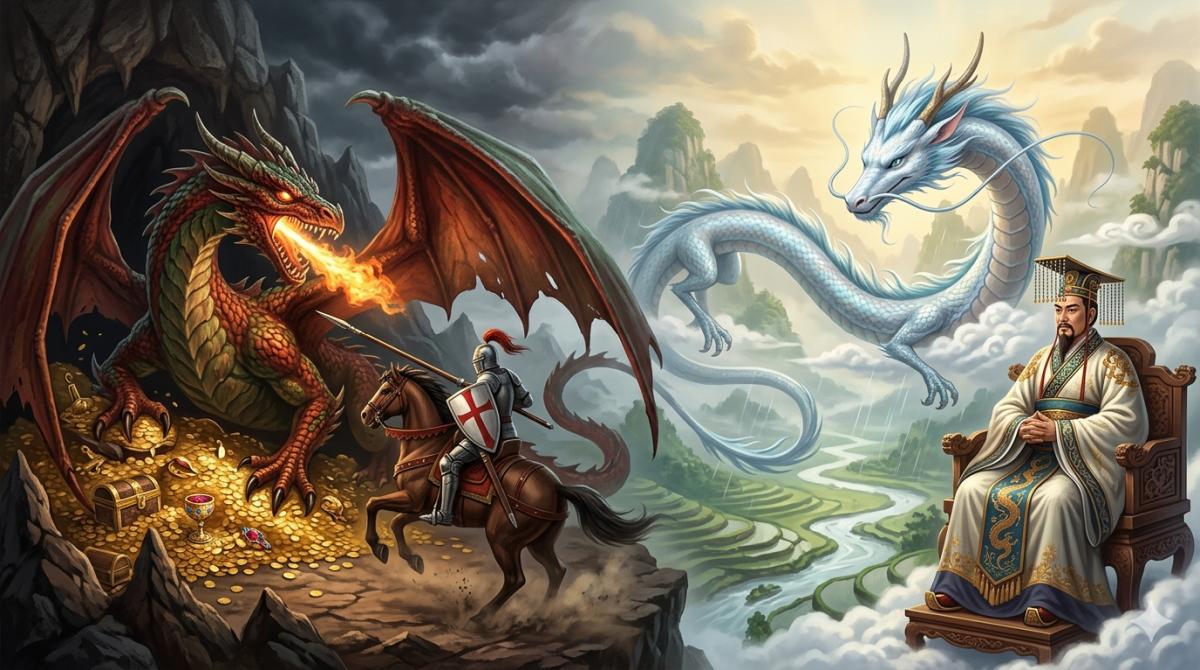
Picture a dragon. For many of you reading this, the image that surfaces is already telling. Some of you see a beast of fire and scales, coiled around treasure, waiting to be defeated. Others see a luminous body winding through clouds, bringing rain over ancient rivers, ascending beside an emperor. The same creature. Two civilisations. Opposite philosophies on how to live with power. And neither of you noticed until just now how your own story lives inside the picture you chose.
Picture a dragon. For many of you reading this, the image that surfaces is already telling. Some of you see a beast of fire and scales, coiled around treasure, waiting to be defeated. Others see a luminous body winding through clouds, bringing rain over ancient rivers, ascending beside an emperor. The same creature. Two civilisations. Opposite philosophies on how to live with power. And neither of you noticed until just now how your own story lives inside the picture you chose.
In the West, the dragon hides the treasure. It blocks the path. To become the hero, you must kill it. St George drives his lance through the beast to save a kingdom. Beowulf wades into battle against the fire-drake to protect his people, even though it costs him his life. In the Book of Revelation, the dragon becomes Satan himself, the ultimate adversary, and its destruction signals the dawn of a new age.
[Also See: An Anime on Youtube Explains Our Metaphysical Reality]
These stories share a structure that is older than any one of them. Something vast and terrible stands between you and your wholeness. You must face it. You must defeat it. You must earn your passage. The dragon is not meant to be understood. It is meant to be conquered. Once it is dead, the treasure becomes yours. The princess is freed. The kingdom survives.
This pattern runs so deep through Western storytelling that most people stop noticing it is a pattern at all. Every action hero, every underdog sports film, every startup founder disrupting an old industry carries the same mythic skeleton. Stand against the beast. Destroy it. Claim what lies beyond.
Now look east. In China, the dragon does not guard treasure. It is the treasure. The dragon brings rain to parched fields. It rules the rivers and commands the seasons. The emperor does not slay it. He sits on the throne it lends its name to, the Dragon Throne in the Hall of Supreme Harmony, and he learns to govern through alignment rather than force.
The fifth of humanity that calls itself the dragon’s descendants, Lóng de chuán rén, does not define itself through conquest of a mythical enemy. It defines itself through kinship. The dragon is ancestor, not adversary. The path to greatness does not require a corpse. It requires attunement.
What if the force you are fighting is the very force that could carry you?
The Chinese tradition would never ask how to kill the dragon. It would ask how to understand its movements, when it rises, when it rests, what weather it brings, and whether you have built a relationship with it that serves rather than destroys. Comparative readings of the symbol bear this out, with the dragon in Eastern thought standing as an auspicious bringer of rain and harvest while its Western counterpart becomes a figure of chaos and threat.
The West built its identity on conquest. Conquer nature, conquer the unknown, conquer rival nations, conquer your own weaknesses. This is a powerful way of living. It produces engineers, explorers, and revolution. It also produces people who are exhausted, because everything is a battle, and every force they encounter must be subdued before they can rest.
The Chinese tradition asks a different question. Not how to dominate, but how to harmonise. Not how to defeat the current, but how to read it and sail with it. The Tao Te Ching teaches in its meditation on water that the soft and yielding wears down the hard and unbending, not through force but through persistence. The dragon shares that principle. It is powerful precisely because it cannot be pinned down, controlled, or owned. It can only be approached with respect.
This article explores how the dragon functions as an archetype of unconscious energies and a mirror for the journey inward.
In Western psychology, the dragon has become shorthand for the shadow self. Carl Jung described the shadow as the repository of everything we refuse to acknowledge about ourselves. Our rage, our envy, our unspent grief, the parts of our personality we buried because someone told us they were unacceptable. Yet the shadow holds far more than what we judge as dark, carrying buried instincts, creative impulses, and unclaimed strengths alongside the rest. The shadow is not evil. It is unclaimed.
When a shadow rises through you as a pattern of chronic illness, as an addiction, as a cycle of self-sabotage in your relationships, the Western instinct is to annihilate it. Fight harder. Cut it out. Beat it. Willpower becomes the sword. The harder you fight, the more cunning the shadow becomes, because everything you resist grows stronger through the intensity of your resistance.
Eastern traditions approach this differently. The shadow is not an intruder to be expelled. It is a signal. Chronic tension in the shoulders tells you where you are carrying responsibility that is not yours. Recurring anger in certain conversations points to boundaries you never learned to set. Dreams that revisit the same landscape year after year are not nightmares to be survived. They are messengers that knock until you answer the door.
Shadow work that actually shifts a life does not happen on an intellectual level. It happens through body-based feedback that you can feel right now. Sit quietly and scan your physical self. Where is there tension that has become so constant you forgot it was there? Your jaw, your upper back, your stomach, your throat? That tension is a fossilised decision. At some point in your life, holding still felt safer than speaking up. Clenching felt safer than grieving. Holding your breath felt safer than admitting fear.
The dragon in your body is not a problem to solve. It is a language to learn.
When you feel reactive emotional surges toward someone close to you, pause. The intensity of your reaction often points to something old. That colleague who triggers your irritation might carry the same energy as a parent who dismissed your needs as a child. The dragon has returned, wearing a different face. Western heroes would destroy it through confrontation. The Eastern approach would invite you to recognise it, name the old wound underneath, and let the recognition do the work that fighting never could.
If you dream of being chased, of falling, of being trapped, of losing your teeth, these are not random images your sleeping brain threw together. They are dragons. They return when you ignore them. They grow louder when you pretend they do not exist. The hosts of one Jungian podcast frame this well in their conversation on the dragon as both monster and ally within the psyche, a force we are asked to face and befriend rather than simply slay.
A woman who dreams every month of being locked inside a house she cannot escape is not suffering from bad sleep. She is living inside a structure in waking life, a marriage, a career, a belief system, and her dreaming mind is sending the most honest report she has available to her. The dragon is speaking through the locked door.
The Western response would be to break the door down. Through sheer force of will, the dreamer might finally escape, only to carry the same internal architecture into the next chapter. The Eastern response would be to study the house. What rooms have you never opened? Who built the walls? When did you stop checking whether the door was locked from the inside?
The emperor of China did not become emperor by killing the dragon. He became emperor because someone taught him how to sit on its throne. The Dragon Throne in the Hall of Supreme Harmony was a seat of cosmic alignment rather than domination over nature. The emperor was called Son of Heaven, and his legitimacy depended on reading the patterns of heaven and earth correctly. When natural disasters struck, the emperor had to perform public ceremonies of self-examination, because disruption in the kingdom was understood as misalignment between the ruler and the cosmic order.
Imagine a leader today admitting that drought or flood signals a failure of internal attunement, not just a failure of policy. It sounds foreign precisely because the Western story taught us so completely that power means control, and control means force applied to the external world. But what if real sovereignty is the ability to listen to forces larger than yourself and respond with humility rather than dominance?
Lóng de chuán rén. Descendants of the dragon. Roughly one fifth of humanity traces its identity to this myth, and that myth carries no origin story of violence against the divine. The dragon is the origin. The dragon is what makes the river flow, what determines whether crops survive a season, what the people gathered around to celebrate during New Year with paper lanterns and drumming through the streets.
When a civilisation builds itself around kinship with a mythic force rather than victory over it, the psychology of its people shifts. Not in obvious ways, not on a surface level, but in the quiet choices they make when no one is watching. How they treat their elders. How they respond to someone else’s misfortune. How they define success. The dragon shaped the soil, and the soil shaped the crop.
You have your own dragons. A relationship you cannot fix no matter how much energy you pour into it. A body that does not respond to the diet plan you followed with discipline and willpower. A creative project that refuses to take shape despite every technique you studied. A spiritual practice that brought insight for a season and then went quiet. A career path that seemed perfect until it became a cage.
Every one of these encounters offers you a choice. You can keep slaying. You can double down on strategies that have not worked, tell yourself you simply have not tried hard enough, and enter the next round of the same fight. This is not weakness. This is the hero pattern playing itself out faithfully, exactly as Western mythology designed it to.
Or you can pause. You can ask whether this force, the one you have been exhausting yourself against, might be asking for something else entirely. Not surrender. Not defeat. But a different quality of attention. What does the dragon want to show you? What movement does it follow? What does it protect that you might not have noticed because you were too busy preparing the sword?
This was never really about dragons. The creatures are ink and imagination. They do not exist, and they exist everywhere, because the dragon is a shape that human beings cast onto any force they cannot fully command. The West built its heroes by killing that force. The Chinese built its emperors by sitting beside it.
You do not have to abandon your Western heritage to find value here. You do have to notice where the hero pattern has become a trap. Somewhere in your life, right now, you are wrestling a dragon that would gladly carry you across the river if you would stop driving the lance into its ribs.
That might be your own grief, which you have been treating as a weakness instead of a doorway. That might be your partner, whose differences from you are not a battleground but a bridge. That might be the spiritual emptiness you keep trying to fill with more practice, more books, more techniques, when what the emptiness wants is simply to be acknowledged as the space in which something new will grow.
The dragon is waiting. Not for your sword. For your attention. And that, perhaps, is the oldest secret that both civilisations discovered, buried in opposite directions. The force you encounter was never the problem. The posture you bring to it was.