Physical Address
304 North Cardinal St.
Dorchester Center, MA 02124
Physical Address
304 North Cardinal St.
Dorchester Center, MA 02124

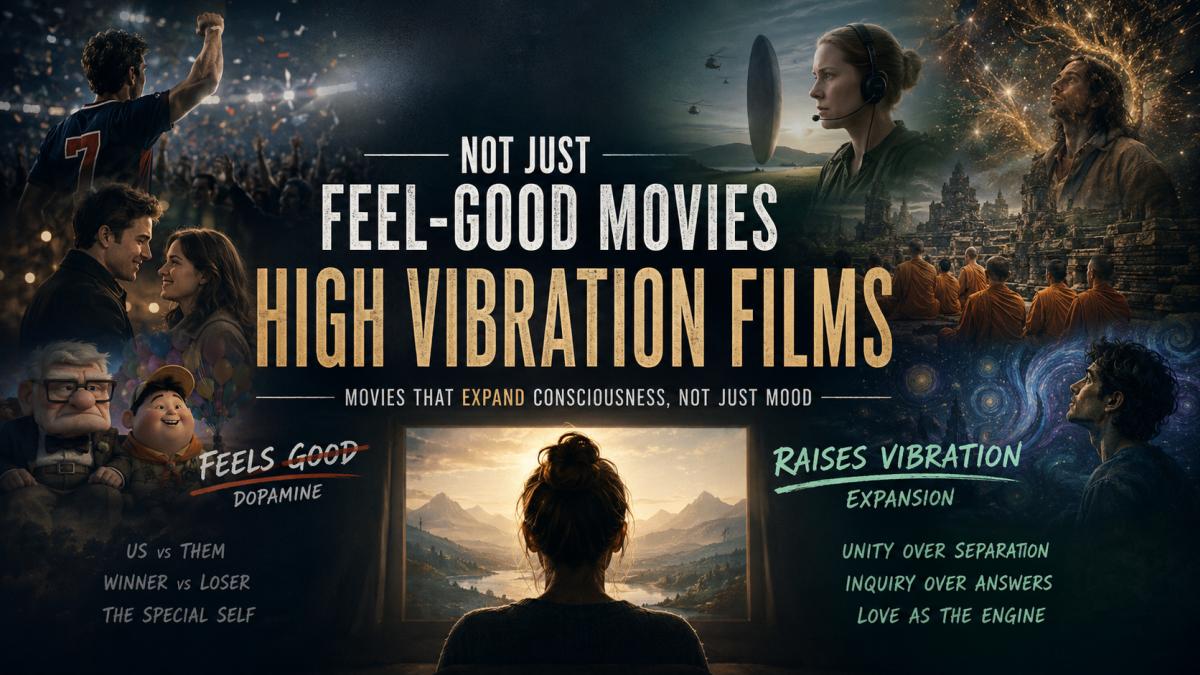
There is no shortage of "feel-good movie" lists on the internet. Type "high vibration films" into any search bar and you will get a hundred variations of the same comfortable recommendations — uplifting biopics, gentle romances, the dependable Pixar tear-jerker. They are pleasant. Most of them are also vibrationally flat.
There is no shortage of “feel-good movie” lists on the internet. Type “high vibration films” into any search bar and you will get a hundred variations of the same comfortable recommendations — uplifting biopics, gentle romances, the dependable Pixar tear-jerker. They are pleasant. Most of them are also vibrationally flat.
Here is the distinction that almost nobody draws: feeling nice and shifting consciousness are not the same axis. A film can flood you with warm sentiment and leave your underlying view of reality completely untouched. Another film can unsettle you, even frighten you, and yet quietly dissolve a boundary you did not know you were holding. The first is dopamine. The second is expansion.
So this is not a list of movies that make you happy. It is an attempt to ask a harder question of each film: does it raise your vibration, or only your mood?
Let me be honest about the frame before using it, because credibility matters. When I say a film “raises vibration,” I am not making a measurable physical claim about hertz or frequency. I am describing something phenomenological — the felt quality of consciousness a work leaves you in once the credits roll. That is a real, reportable experience even if it does not show up on an instrument.
In the language of the Ra material’s discussion of the ego and the energy centres, the movement that matters is from the contracted, defended, separate self toward something more open and unified. A high-vibration film nudges you up that gradient. A low-vibration one drags you back down it, usually by feeding the part of you that wants to feel separate, superior, or afraid.
To keep this from being pure vibes-about-vibes, I score each film on five questions:
A film can be brilliant cinema and still score low. A film can be flawed and still score high. We are measuring one specific thing.
Arrival is the rare mainstream film built around a real shift in perception. Its central device borrows from the Sapir-Whorf hypothesis and its treatment of linguistic relativity on screen — the idea that the language you absorb reshapes how you experience reality itself. As the protagonist learns a language with no linear sense of time, her consciousness reorganises around simultaneity rather than sequence.
What makes it high-vibration is not the plot mechanic but where it deposits you. The film’s emotional climax asks whether you would still choose love knowing the loss that comes with it — and answers from a place beyond fear. It leaves you in a quiet, expansive, slightly unmoored state, the boundary between past and future briefly softened. That is consciousness shift, not mood lift.
Scores high on: inquiry, unity, love-as-engine, after-frequency.
Darren Aronofsky’s most divisive film is, viewed through this lens, one of his most coherent. Across its three interwoven timelines it circles a single subject: the refusal to accept death, and the liberation that arrives when that refusal finally collapses. The reading offered in this study of how the film legitimates the anomy of death captures the arc precisely — the protagonist’s torment is the grasping, and his peace is the surrender.
“Death is the road to awe” is not a comforting line. It is a vibration-raising one, because it points directly at the ego’s deepest contraction — its terror of its own ending — and offers release rather than reassurance. The film does not make you feel good. It makes you feel larger.
Scores high on: ego dissolution, inquiry, after-frequency. Lower on immediate comfort, which is the point.
Films like Samsara and Baraka contain no dialogue, no plot, no characters to identify with — and that is exactly why they work on consciousness rather than narrative. Stripped of story, the mind has nothing to grip. What remains is pure perception: ritual, decay, industry, beauty, suffering, all held in the same unjudging gaze.
This is closer to a meditation than a movie. The wordless documentary bypasses the analytical, separating mind and addresses something underneath it. You do not leave with an opinion. You leave quieter.
Scores high on: unity, ego dissolution, after-frequency. Not applicable on spoon-feeding, since it never tells you anything.
Richard Linklater’s rotoscoped dream-walk is almost pure inquiry. It barely has a story — a man drifts through a lucid dream encountering people who philosophise about consciousness, free will, and the nature of the dream itself. It does not resolve. It does not conclude. It simply opens question after question and trusts you to sit inside them.
Some viewers find this exhausting. But on the inquiry axis it scores near the top, precisely because it refuses to spoon-feed. It treats you as a participant in the questioning rather than a recipient of answers.
Scores high on: inquiry. Mixed on after-frequency — it can leave you energised or unmoored depending on what you brought in.
This is the more interesting category, and the one that distinguishes a consciousness-first review from a comfort-food list.
A great deal of “inspirational” cinema is built on separation dressed as uplift. The underdog sports film, the triumphant biopic, the redemption arc that ends in victory over a clearly-marked enemy — these feel wonderful. They also quietly reinforce the most basic ego structure there is: us versus them, winner versus loser, the special self elevated above the ordinary crowd. The emotional engine is often the desire to feel superior, even if the surface message is kindness.
Likewise, a lot of spiritually-branded content scores low because it feeds the seeker’s ego rather than dissolving it. Anything that flatters you for being more awake, more conscious, more chosen than the sleeping masses is running on separation, no matter how much incense is involved. The vibration of “I have transcended” is lower than the vibration of genuine humility, even when the former wears spiritual costume.
The test is not the subject matter. It is the direction of the pull. A war film can raise your vibration if it dissolves the boundary between enemies. A meditation retreat documentary can lower it if it leaves you feeling spiritually superior. Always watch the engine, not the dressing.
You do not need my list. You need the questions. Next time the credits roll, ignore whether you “enjoyed” it and ask instead: where am I now? Am I more contracted or more open? Did this soften the boundary between me and the world, or harden it? Was I being invited to question, or handed something to swallow?
The films worth returning to are the ones that leave you, however subtly, a little less defended than you were two hours ago. Those are the ones doing the real work — and you will notice they are rarely the ones marketed as feel-good.
Watch with that question running quietly in the background, and your whole relationship to screens begins to change. The screen stops being a place you go to escape consciousness, and becomes, occasionally, a place you go to expand it.