Physical Address
304 North Cardinal St.
Dorchester Center, MA 02124
Physical Address
304 North Cardinal St.
Dorchester Center, MA 02124

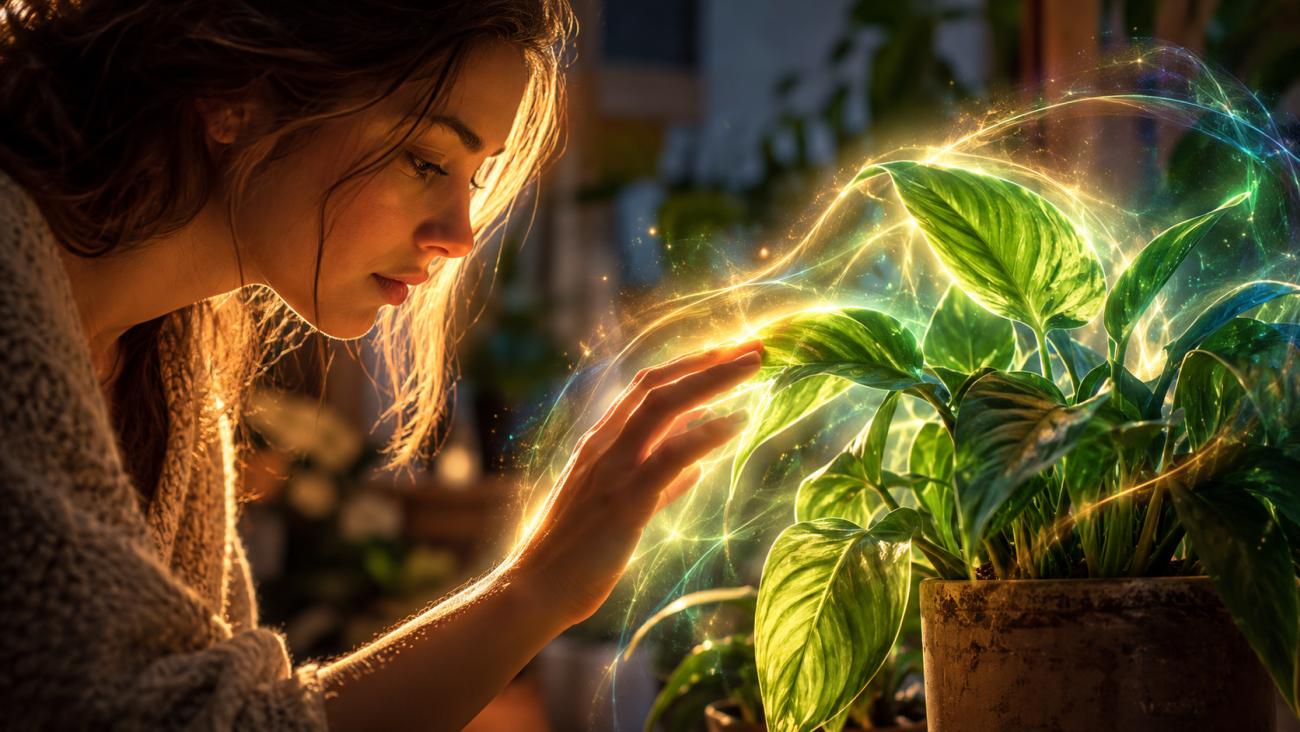
There is a particular kind of loneliness in sitting across from someone who describes, with complete sincerity, a warm buzzing field between their palms, while you hold your own hands the same way and notice nothing at all. Two hands. Some air. That’s it.
[Also Read: Subtle Body Energy Mapping for Beginners]
Many people quit right there. They decide energy work is either a gift handed out to a lucky few or a story people tell themselves. Spiritual teacher Kristen Peairs describes reaching exactly that moment early in her life, and in a recent video she explains why she chose a third option. She didn’t argue, and she didn’t give up. She got curious. That single shift, from frustration to fascination, turned out to be the doorway to a lifetime of bodywork, healing practice and what she now calls being “energy forward.”
Her story is worth unpacking, because it quietly dismantles one of the most persistent myths in spiritual circles: that sensitivity is something you either have or you don’t.
When a newcomer reports zero sensation, it is tempting to read that as a verdict. It isn’t. It is simply a baseline, the same as a beginner musician who can’t yet hear the difference between two close notes.
Think about how much of ordinary perception is trained rather than given. A sommelier was not born tasting oak and blackcurrant in a glass of red. A mechanic was not born hearing a worn bearing in an idling engine. Both learned to notice signals that were always present but had never been given attention. Subtle energy sensing seems to follow the same rule. The signal may be faint, the mind is noisy, and attention has spent decades being pointed elsewhere.
So if you have tried the classic “feel the space between your hands” exercise and come up empty, you are not broken, blocked or unspiritual. You are at day one. Peairs makes the point that the things most worth having tend to arrive through patience, repetition and an open mind rather than instant success.
Here is where things get interesting for the skeptic and the seeker alike. Researchers study a capacity called interoception, which is your ability to perceive signals arising inside your own body: your heartbeat, your breath, the subtle shifts of tension and warmth that most of us filter out all day long.
For a long time, interoceptive ability was treated as fairly fixed. That view is changing. A large, nine-month study known as the ReSource Project found that people’s accuracy at perceiving their own heartbeat increased steadily through contemplative mental training, with improvements tracking alongside better emotional awareness. A separate line of research found that an eight-week body scan practice measurably improved interoceptive accuracy compared with people who did no training.
Whatever you believe about subtle energy, this matters. It means the instrument you use to feel anything at all, your own nervous system and attention, is trainable. When an energy worker tells you that practice makes the tingling stronger, at the very least part of what is growing is your capacity to notice.
One of the most charming details in Peairs’s account is her starting point. Inspired by Barbara Brennan’s classic Hands of Light, she didn’t begin with people at all. She began with a houseplant, in a darkened dorm room, slowly bringing a single fingertip close to the leaves and waiting.
At first, nothing. After days of returning to it, a faint tingle. Later, with soft light and relaxed, half-closed eyes, a subtle haze seemed to sit around the foliage. Different plants felt different. Eventually she could sense roughly where one plant’s field seemed to end.
There is real wisdom in this choice of practice partner. A plant doesn’t judge you, doesn’t get impatient, and doesn’t need you to perform. It lets you play.
And intriguingly, plants are not electrically silent. Researchers at the University of Bristol showed that flowers carry weak electric fields and that bumblebees can detect and learn to tell them apart, using that information to judge whether a bloom is worth visiting. Follow-up work found that the fine hairs on a bumblebee’s body physically respond to these fields, and that the hairs, more than the antennae, pass the signal on to the bee’s nervous system. As science writer Ed Yong put it in his National Geographic report on the discovery, flowers turn out to be electric billboards as well as visual and scented ones.
Nobody is claiming that what a bee senses is the same thing an energy practitioner describes as an aura. But it is a humbling reminder that living things are surrounded by more information than our everyday senses register.
When your inner critic pipes up with “this is ridiculous,” you don’t need to win the argument. Peairs suggests simply acknowledging the thought and telling your mind you’re only playing. Playfulness lowers the stakes, and lower stakes make for better attention.
Once a plant starts to feel like a familiar companion, the next step is a living creature with its own opinions. Cats and dogs can be wonderful teachers, provided you respect their boundaries. A pointed finger hovering near a cat’s face is unlikely to be welcome. An open palm held a short distance from the fur is gentler.
Watch what happens. Some animals lean in. Some twitch, give you a puzzled look and walk away. Either way, you are learning something about how living beings register your approach before you ever make contact.
After that comes a willing human partner. Ask permission first and keep it light. One of you holds out a finger, the other slowly brings a fingertip toward it without touching, and you both report what you notice. Swap roles. Sometimes there is a buzz, sometimes warmth, sometimes only the anticipation of touch. All of it is information.
The most practical insight in Peairs’s account has nothing to do with healing sessions. It is about everyday courtesy.
Through all that practice, she came to sense that people, like plants, seem to carry a zone of presence some distance out from the skin. She now consciously greets that space before she greets the body, and finds that both she and others tend to experience the connection as gentler and more welcome.
You don’t have to adopt any particular belief system to find value here. Most of us know the discomfort of someone who barges into our personal space, and the ease of someone who pauses, reads the room and arrives softly. Treating another person’s energy as real, and worth acknowledging first, turns that intuitive social skill into a deliberate practice.
For Peairs, early experiments eventually led to structured training, including Reiki and craniosacral therapy. Craniosacral work uses an exceptionally light, hands-on touch around the head, neck and spine, and practitioners spend years refining their ability to perceive tiny rhythms and shifts under their hands. It was this discipline, she says, that made her fall in love with bodywork.
If you feel drawn in this direction, formal training gives you structure, feedback and a community of fellow learners. Just keep your discernment switched on. The U.S. National Center for Complementary and Integrative Health notes that high-quality evidence for Reiki’s health effects is lacking and that the proposed energy field has not been scientifically demonstrated, while also finding no evidence of harm. Energy work can be a beautiful complement to your wellbeing, but it should never replace proper medical care.
Meanwhile, a growing group of researchers is trying to build bridges between ancient healing traditions and modern biology. The concept of the biofield, described in a widely cited overview of biofield science, proposes that living systems are organised in part by complex fields of energy and information. It remains an emerging and debated area, but it shows that serious people are asking the same questions the curious beginner asks with a fingertip near a leaf.
Peairs offers a lovely framework for understanding why some people seem to “get” energy instantly and others don’t. Some of us lead with words: we process the world by talking, reading and naming things. Some lead with the body: movement, touch and physical sensation are our first language. And some lead with energy, sensing atmosphere, mood and presence before anything else.
None of these is superior. A words-forward person may never feel a dramatic buzz, yet may develop a precise, reliable vocabulary for subtle shifts in a room. A body-forward person may experience energy mostly as muscle tension releasing or warmth spreading. Knowing your natural lead helps you stop comparing your experience to someone else’s and start trusting your own channel.
From a consciousness-first perspective, such as the one Thomas Campbell develops in My Big TOE, this makes even more sense. If awareness is the fundamental reality and the physical body is one of its interfaces, then sensitivity to subtle information is less a supernatural talent and more a matter of where, and how patiently, you point your attention.
Perhaps the deepest lesson in this story is not technical at all. Peairs describes a kind of inner flame that, once lit, keeps nudging you to explore until your questions feel answered. She followed hers through books, classes and countless quiet sessions, and it shaped the whole direction of her life.
If you have felt that same pull, honour it. Begin with a plant. Be patient with the silence. Celebrate the first faint tingle as the small miracle it is. Sensitivity, it turns out, is less a gift you are handed than a relationship you build, one curious moment at a time.