Physical Address
304 North Cardinal St.
Dorchester Center, MA 02124
Physical Address
304 North Cardinal St.
Dorchester Center, MA 02124

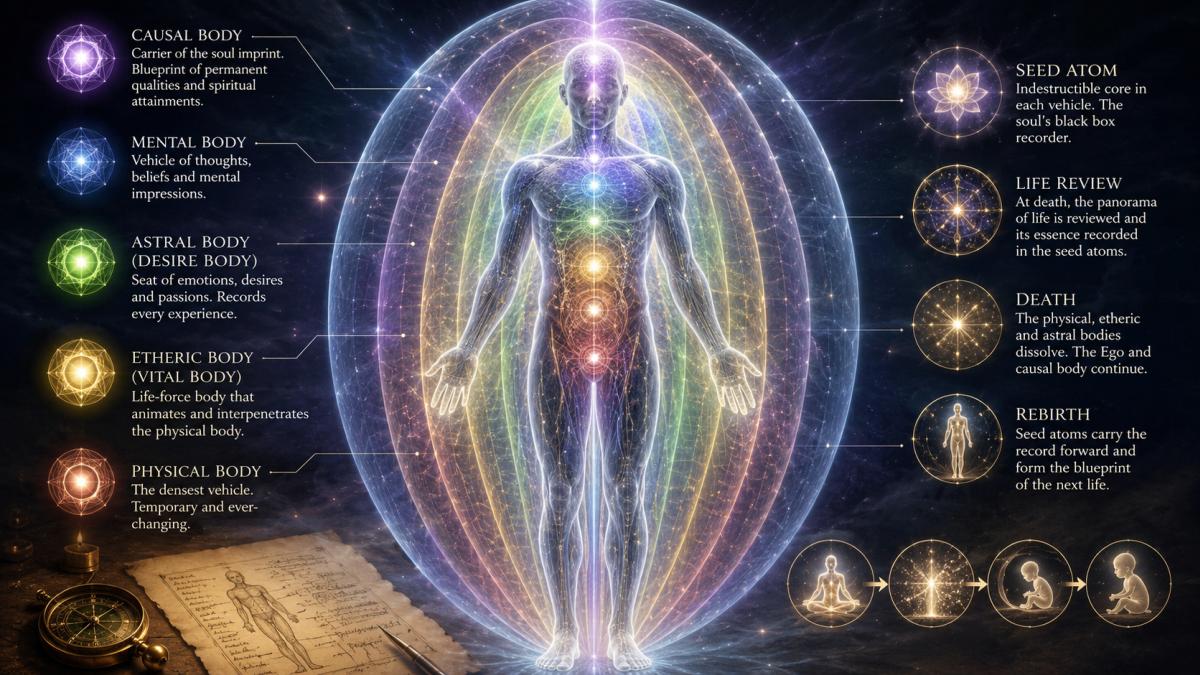
You already own the vehicle you will use after death. That is the startling claim at the heart of both Theosophical and Rosicrucian teaching, and it turns the popular image of the astral body on its head. Most people who have heard the term at all think of it as a ghostly double, something you slip into for a night flight during an out of body experience. The older esoteric traditions saw it as something far more consequential: a subtle anatomy that records everything you are, carries the essence of your experience through death, and hands the blueprint to your next incarnation.
You already own the vehicle you will use after death. That is the startling claim at the heart of both Theosophical and Rosicrucian teaching, and it turns the popular image of the astral body on its head. Most people who have heard the term at all think of it as a ghostly double, something you slip into for a night flight during an out of body experience. The older esoteric traditions saw it as something far more consequential: a subtle anatomy that records everything you are, carries the essence of your experience through death, and hands the blueprint to your next incarnation.
If that is true, then learning to sense your subtle body is not a parlour trick. It is a first look at the map of your own continuity.
The pop culture version of the astral body is thin gruel compared to what the source literature describes. In the original Theosophical teaching of H.P. Blavatsky and William Q. Judge, the astral body, or linga sharira, is the ethereal counterpart or double of the physical form, a design body of fine, electrical, magnetic matter around which the visible body is built. It changes very little during a lifetime, while the physical body replaces itself constantly. In this older view the astral is not a costume you put on. It is the mould your flesh is poured into.
Blavatsky treated the human being as a sevenfold composite, and she was careful to keep the temporary parts separate from the immortal ones. In The Key to Theosophy she distinguishes the astral double, which produces séance phenomena and post-mortem apparitions, from the reincarnating Ego, the spiritual individuality that actually travels from life to life. The double is a garment. The Ego is the wearer. Later Theosophical writers such as Annie Besant and C.W. Leadbeater refined the vocabulary, splitting off an etheric double on the physical plane from a true astral body of desire, a shift traced in detail in the Theosophical Society’s own study of the human principles in early Theosophical literature.
The terminology wars matter less than the shared architecture. Every version agrees on three points. You have more than one body. The subtle ones interpenetrate the physical rather than floating above it. And at least one component of you persists when the rest is discarded.
The Rosicrucian teacher Max Heindel gave this architecture its most mechanical, almost engineering-grade description. In his 1909 masterwork, the Rosicrucian Cosmo-Conception, he describes how memory and soul growth operate across the vital and desire bodies, with every experience of a lifetime etched into subtle matter the way sound is etched into a recording.
The key device in Heindel’s system is the seed atom. Each of your vehicles, dense, vital, desire and mental, is built around a single permanent atom that acts as an indestructible archive. At death, the panorama of the life just lived plays backward before the departing spirit, and the essence of that record is stamped into the seed atoms. The bodies themselves dissolve. The seed atoms do not. They are withdrawn, carried through the after-death worlds, and used as the nuclei around which the vehicles of the next incarnation crystallise.
Think of it as a black box recorder for the soul. The aircraft is lost, the flight data survives, and the next aircraft is built to a specification informed by every previous flight. Heindel lays out the rebirth side of this process in his chapter on rebirth and the law of consequence, where reincarnation and karma are presented not as mystical rewards and punishments but as the same kind of orderly causation we accept in physics, applied to consciousness.
Here the traditions offer a sobering correction to casual afterlife talk. Not everything about you survives, and the esotericists were blunt about which parts do not.
In Theosophy, the astral double disintegrates near the physical corpse. The desire nature lingers for a time in kama-loka as a fading shell, which is why Blavatsky insisted that most séance-room spirits are not your grandmother but her discarded psychic residue. What continues is the reincarnating Ego wrapped in what later writers called the causal body. Leadbeater, in Man Visible and Invisible, describes this causal vehicle as a luminous form that is not the likeness of any single incarnation but a glorified blending of what was noblest in all of them.
That phrase deserves a slow reading. The body that persists between lives is a composite portrait, painted one incarnation at a time. Every act of courage, every cultivated skill, every deepened affection adds a permanent stroke. Everything petty simply fails to register at that level and dies with the shell. In this anatomy, character is literally the only luggage allowed through.
Put the Theosophical and Rosicrucian accounts side by side and a picture emerges that is very different from the vague reincarnation of popular imagination, where souls are shuffled into new bodies like cards into a fresh hand.
In the esoteric model, nothing about your next life is random. The seed atoms carry the exact vibratory record of what you have built and what you have broken. The archetype of the coming body is shaped from that record. Your future brain, temperament and even predispositions to health or illness are, in this teaching, the direct architectural output of your present habits of thought and feeling. The subtle body is the map to your next life in the most literal sense available: it is the surveyor’s document from which the next terrain is drawn.
This reframes spiritual practice completely. Meditation, ethical discipline and conscious attention stop being lifestyle accessories. They become drafting work on the blueprint of a future person who will have no choice but to live inside what you are drawing tonight.
Can any of this be perceived rather than merely believed? The traditions say yes, and interestingly they point to the same borderland state that modern sleep science has been mapping. Researchers studying the drowsy transition into sleep have documented how hypnagogic imagery and intrusions arise as ordinary waking cognition loosens, complete with measurable EEG signatures. Science treats these as internally generated perceptions. The esotericists treated the same threshold as the moment when consciousness begins to shift its focus from the dense body to the subtle one.
You do not have to settle that argument to use the doorway. Both camps agree the state is real, repeatable and accessible to anyone with a bed.
Try this simple exercise as you fall asleep tonight. It borrows the classic Theosophical visualisation approach and parks it directly in the hypnagogic window.
Lie on your back, hands unclasped, and let the body grow heavy. As the first drifting images appear, move your attention slowly to your right hand without moving it. Picture a hand of pale light occupying the same space, fitting the physical hand like a glove from the inside. Now imagine that hand of light lifting a few centimetres while the physical hand stays still. Feel for any sensation of doubling, tingling or gentle separation. Do the same with the left hand, then the feet, then hold the sense of a complete second body resting just inside the first.
Do not chase results. The goal on night one is not projection but perception, a first felt acquaintance with the vehicle the old texts describe. Most people notice something within a week of consistent practice: warmth, buzzing, a sense of lightness that does not belong to muscle or skin.
If the sensations grow strong and you feel drawn to go further, the natural next step is full separation, and we have covered that ground in depth in our guide to five successful astral projection techniques.
The astral blueprint teaching leaves us with a thought that is both comforting and demanding. Comforting, because in this view death is a change of vehicles, not a termination, and nothing essential that you build is ever lost. Demanding, because the same record that preserves your growth preserves your neglect. The subtle body is keeping the books either way.
The Rosicrucians and Theosophists disagreed on plenty of details, yet on this they spoke with one voice: you are, right now, drafting the map of your next life. Tonight, in the quiet minutes before sleep, you can begin learning to read it.