Physical Address
304 North Cardinal St.
Dorchester Center, MA 02124
Physical Address
304 North Cardinal St.
Dorchester Center, MA 02124

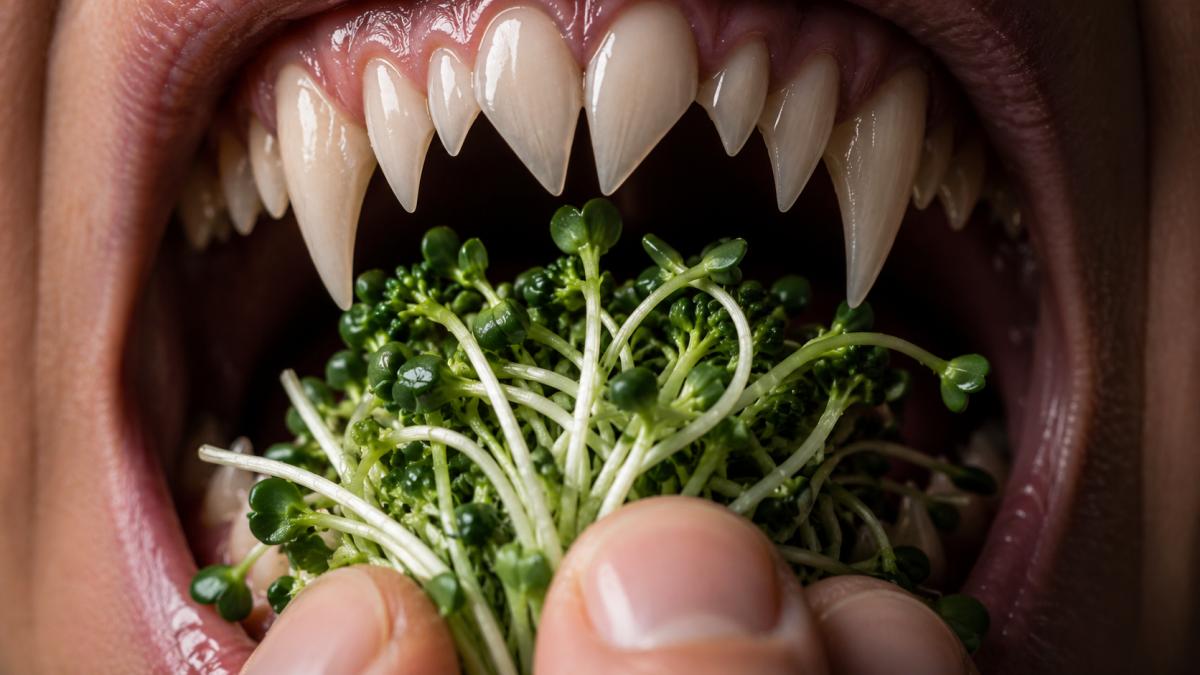
Sprouts sit on a strange pedestal in modern wellness culture. They are praised as one of the most concentrated, enzyme rich, vibrationally alive foods on the planet, and yet the spiritual question hovering behind them is almost never asked out loud. If a sprout is the most alive thing on your plate, what does it actually mean to eat it?
Sprouts sit on a strange pedestal in modern wellness culture. They are praised as one of the most concentrated, enzyme rich, vibrationally alive foods on the planet, and yet the spiritual question hovering behind them is almost never asked out loud. If a sprout is the most alive thing on your plate, what does it actually mean to eat it?
This is not a question of nutrition. It is a question of consciousness, karma, and what we are agreeing to participate in when we crunch through a tray of seven day old broccoli sprouts. The answer turns out to be more layered than the wellness industry tends to admit, and once you start pulling on the thread it becomes difficult to look at a sprout tray the same way again.
Most articles about sprouts focus on chlorophyll, sulforaphane, and digestive enzymes. Almost none of them ask what is happening on a metaphysical level when you intercept a plant at the exact moment it is unfurling into being. The seed has woken up. Cellular division is at its most frantic. Meristematic stem cells are dividing in every direction. Light is pouring into the structure as biophotonic emission spikes to its lifetime maximum.
In nutritional terms this is exactly why sprouts are valuable. In spiritual terms it raises a different question: why is this stage so prized? Are we eating the food, or are we eating the moment of awakening itself? Wellness culture has a habit of taking the most energetically loaded thing it can find and treating it as just another grocery item, and sprouts are perhaps the cleanest example of this blind spot.
A fruit is shed willingly. The mature plant lets go of its offering, often surrounding the seed in flesh designed specifically to be eaten and dispersed. The whole arrangement is a contract written in pollination and gravity, and when you eat a fruit you are completing the cycle the plant set in motion. The plant wanted you to do this. The plant designed itself for this exact transaction.
A sprout is the opposite. The seed has just made a commitment to grow, and the entire vector of its existence is pointed toward becoming a mature plant. Consuming it at this stage breaks something. You are not receiving an offering. You are halting a promise mid sentence. Whether or not you believe plants have soul level continuity, there is a directional energy here that feels qualitatively different from picking an apple from a branch that has already done its job.
Some spiritual practitioners use the phrase vegetal pedophilia to describe the consumption of sprouts, microgreens, and very young plants. The term is deliberately confrontational, and it is meant to shake the listener out of the assumption that all plant food is ethically equivalent.
The argument runs like this. If we accept that there is a spectrum of plant consciousness, and if we accept that the early stages of life are when this consciousness is most concentrated and active, then eating an organism at its earliest possible window of awareness is something other than neutral. The framing is provocative on purpose, but the underlying point deserves consideration. Nascent life is not the same as mature life, and pretending the distinction does not exist is a convenience rather than a truth.
You do not have to accept the term to take the question seriously. The discomfort the phrase produces is itself diagnostic. If the framing makes you flinch, you are quietly admitting that there is something morally significant about the stage of life at which a being is consumed, and that admission is exactly the entry point into the rest of the inquiry.
Jain dietary tradition has thought about this longer and more rigorously than almost any other spiritual lineage. In the Jain framework, different forms of life carry different soul counts. A ripe fruit contains a single soul. A root vegetable contains many. Sprouting seeds, because they are at the moment of multi cellular activation, are considered to contain a particularly high concentration of souls, and Jain monks traditionally avoid them entirely. You can read more about Ahisma dietary principles for the full picture.
Western readers tend to dismiss this as religious extremism without understanding the underlying logic. The logic is actually quite consistent. If your ethical framework prioritises minimising harm to conscious beings, and if you believe consciousness is most abundant where life is most active, then sprouts are not health food. They are a high cost item. The fact that the cost is invisible to most of us does not mean it is not being paid.
The Ra material describes plants as second density beings on a learning trajectory toward third density consciousness. In this model every plant is participating in an experiential arc, accumulating awareness through its existence as a tree, a vine, a vegetable, or a seed. Harvesting a plant is part of how that learning is shaped, and there is no inherent prohibition in the Law of One material against eating plant life.
What does come through clearly is the importance of intention. The Ra material repeatedly emphasises that the act of consuming food is also an act of communion, and that gratitude and awareness change what is happening at the energetic level. If you apply this lens to sprouts specifically, the question becomes simple. Are you eating with the awareness that you are consuming a being at its peak of activation, or are you absent mindedly throwing them on a salad because Instagram told you they are good for you?
The latter is the actual ethical problem. The former is something closer to a relationship.
Hindu and yogic traditions describe plants as stavara jivas, beings with a stationary and subtle form of life force. The traditional understanding is that these beings, lacking the fear and aversion of animal consciousness, offer themselves more readily to be consumed. From this angle, plant food is not violence at all. It is a transmission of life force from one form to another, and the act becomes sacred when received with reverence.
This is where the conversation gets interesting, because the same tradition that recognises stavara jivas also classifies sprouts as deeply sattvic in the yogic sense, meaning pure, light, and conducive to spiritual development. There is a tension here that the wellness industry never resolves. How can a food be simultaneously a willing offering and an early stage interruption? Possibly the answer is that both are true, and that the consciousness of the eater determines which version is actualised.
If you have ever wondered whether plants actually register your presence and intentions, you might enjoy our piece on whether your houseplants sense you, which looks at the research on plant perception and what it implies for how we relate to the green beings sharing our space.
There is a science adjacent angle worth bringing in. Researchers including Fritz Albert Popp have documented that living cells emit measurable biophoton emissions, and that this emission tends to be highest during periods of intense cellular activity. Sprouting seeds, with their explosive rate of division, would by this measure be among the most luminous foods you can consume.
For practitioners who use the language of high vibrational eating, this is empirical validation that sprouts really are more energetically concentrated than mature plants. For practitioners who take ethics seriously, it is also a reminder that high vibration is not the same as ethically free. You are eating light, in a literal photonic sense, and the question is whether you are doing so with reverence or with consumer indifference. The same coin has two faces and both of them matter.
None of this leads to a simple yes or no answer about whether you should eat sprouts. The point of the inquiry is not to produce a rule. It is to slow down a habit that most people perform unconsciously and to ask what would change if it were performed consciously.
Some practical suggestions for those who want to keep sprouts in their diet without being spiritually negligent. Grow them yourself rather than buying mass produced trays, so that you have a relationship with the seeds before you consume them. Offer a moment of acknowledgement before eating, even silently, recognising that what you are about to take in was at its most vivid stage of being. Eat sprouts deliberately rather than reflexively, treating them as the concentrated thing they actually are. Consider varying your sprout intake rather than consuming them daily, both for nutritional reasons and out of respect for the energetic intensity involved.
The wider research on plant intelligence suggests that plants are far more responsive and aware than the mechanistic view ever allowed for, and the more this picture deepens, the more our food choices become small spiritual decisions rather than purely physical ones.
Sprouts are not bad food. They are, in fact, remarkable food. The question worth holding is whether you can let them be remarkable in the way they actually are, which is to say a concentrated point of life caught in the act of becoming itself, rather than just another item on the wellness checklist. The answer, if you find one, will probably change how you eat in ways that go well beyond sprouts.