Physical Address
304 North Cardinal St.
Dorchester Center, MA 02124
Physical Address
304 North Cardinal St.
Dorchester Center, MA 02124

When most viewers finish watching Guardian: The Lonely and Great God (도깨비), they remember the love story. The 939-year-old immortal goblin and the bright-eyed high school girl who can see the sword buried in his chest. The melancholy Grim Reaper and the chicken shop owner with a soul too old for her face. The buckwheat fields, the maple leaves, the doors that open onto other worlds.
When most viewers finish watching Guardian: The Lonely and Great God (도깨비), they remember the love story. The 939-year-old immortal goblin and the bright-eyed high school girl who can see the sword buried in his chest. The melancholy Grim Reaper and the chicken shop owner with a soul too old for her face. The buckwheat fields, the maple leaves, the doors that open onto other worlds.
But underneath the romance, Kim Eun-sook wrote something far more demanding. She wrote a sixteen-episode meditation on what it actually takes to release a soul from a karmic loop. And the answer she keeps returning to, in scene after scene, is not love. It is forgiveness.
Love is the recognition. Forgiveness is the release.
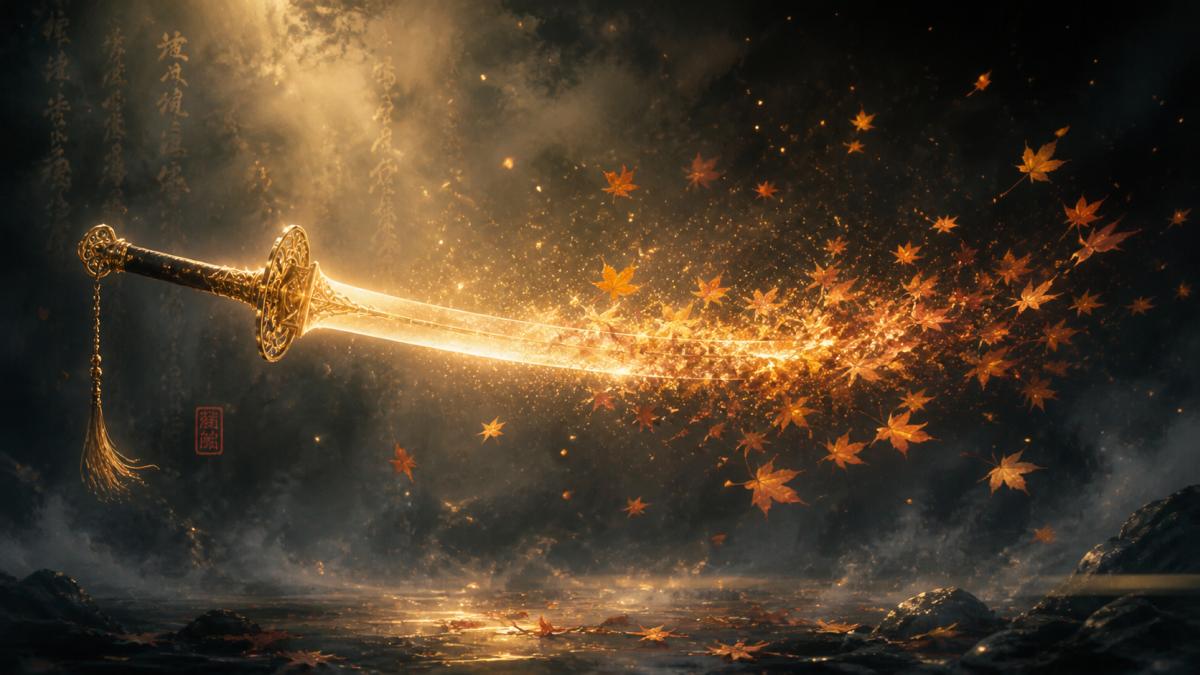
Kim Shin carries a sword in his chest for nine centuries. The show treats it as a curse, a punishment from the deity for the lives he took as a general. But watch the sword more carefully. It does not simply represent his deaths. It represents what he could not let go of. The betrayal. The murder of his sister. The young king he once loved like a brother turning on him under the influence of a corrupt advisor. The rage that follows him through every lifetime he watches pass.
The sword is not removed by love alone. Eun-tak loves him from the moment she meets him, and the sword stays. The sword is not removed by divine decree either, because the deity refuses to interfere with what souls must resolve for themselves. The sword is removed only when Kim Shin stops wanting vengeance. When he chooses to release the wound rather than carry it forward.
This is one of the most quietly radical metaphysical claims in the entire show. Carried resentment, no matter how justified, is itself the curse. The wound was inflicted once. The sword is what we do with the memory of it.
If Kim Shin’s arc is about forgiving the world, Wang Yeo’s arc is about forgiving himself. As the Grim Reaper, he has no memory of who he was. He moves through the modern world performing his duty, accompanying souls to their next life, drinking tea, watching humanity pass through his hands. He is, in his amnesia, almost peaceful.
Then the memories return. He was the boy-king who poisoned his own queen. He was the ruler who ordered Kim Shin’s execution. He was a man who let himself be used by Park Joong-heon’s malice and destroyed the people who loved him. The discovery does not free him. It nearly breaks him.
The show is precise here. Being forgiven by Kim Shin matters, but it does not finish the work. Being forgiven by Sunny matters, but it does not finish the work either. Wang Yeo has to forgive himself. He has to accept that the soul who did those things and the soul standing in this kitchen now are the same continuous being, and that release does not require pretending otherwise.
This is the deepest layer of the show’s spiritual logic. The hardest person to forgive is always yourself, because you cannot get distance from your own crimes. You carry the witness with you. And until you set that witness down, no amount of external absolution will reach the place where the wound actually lives.
Sunny is the reincarnated queen Kim Sun, sister to Kim Shin, murdered by her own husband on the orders of his advisor. When her memories return, she stands in front of Wang Yeo holding the full weight of what he did to her in a previous life. She has every cosmic right to walk away.
She does not.
Her choice to love him anyway, knowing exactly who he is and what he did, is the show arguing something profound. Forgiveness across lifetimes is what severs karmic chains for good. If she had refused him, the loop simply continues. Two souls bound by an unresolved debt would meet again, in another life, under another set of names, until one of them finally chose to release the other.
This is consistent with what many esoteric traditions teach about reincarnation. Souls do not return to random circumstances. They return to the conditions where their unfinished work waits for them, and they meet again the souls they have unfinished work with. Most of what we call trauma in this lifetime is actually unhealed material from previous ones, surfacing in the bodies and relationships best suited to bring it back into view.
Sunny’s forgiveness is the show’s clearest statement that the only way out is through. You cannot escape a karmic relationship by avoiding it. You can only resolve it by entering it consciously and choosing differently than you did last time.
The god in Guardian appears as an old man at a Buddhist temple, as a little girl with a butterfly, as a hand that brushes against fate without ever quite gripping it. She speaks in riddles. She refuses to give answers. She tells the characters repeatedly that she plants questions, not solutions, and that the choices are theirs.
This is not a weak god. This is a precisely drawn one.
The show is rejecting the model of forgiveness as something granted from above. There is no substitutionary atonement here. There is no celestial court issuing pardons. The deity cannot forgive Wang Yeo on Kim Shin’s behalf, because the wound does not live in the deity. The wound lives in Kim Shin. Only Kim Shin can release it.
This aligns with the Law of One teachings on karmic balancing, where unbalanced distortions in a soul’s energetic body must be balanced by the soul itself, through consciously chosen experience. The Creator does not erase distortions. The Creator provides the conditions under which the soul can choose to balance them. Guardian dramatizes this almost exactly. The deity sets up the meetings, arranges the recognitions, allows the memories to surface at the right moment, and then steps back.
The choice belongs to the soul. It always did.
Every major character in Guardian gets some form of release except one. Park Joong-heon, the corrupt advisor who manipulated Wang Yeo into murdering Kim Shin and Kim Sun, refuses to repent. He clings to his malevolence. He returns as a malicious spirit, still scheming, still hungering for power he cannot have.
The show does not punish him. It does not need to. He punishes himself by refusing to set the wound down.
This is one of the most theologically interesting moves in the script. Hell, in the world of Guardian, is not a place. It is a posture. It is the soul that will not release. Park Joong-heon is not damned by any external judgment. He is damned by his own continued grip on grievance and ambition, which keeps him locked out of the cycle of reincarnation, growth, and reunion that every other soul in the show eventually enters.
Suffering, in this frame, is not divine retribution. It is the natural consequence of refusing forgiveness, including self-forgiveness. The bars of the cell are made from the inside.
Step back from the individual arcs and look at the structure of the show as a whole. Every character is carrying a wound. Every character is offered, at some point, the chance to release it. The ones who release it move forward, into new lives, new loves, new bodies, new beginnings. The one who refuses stays exactly where he was, century after century, until even his form begins to dissolve.
The show is not subtle about this once you see it. Forgiveness is the engine. Love is the music it plays. Memory is the map it follows. But the engine is what moves the soul.
This is consistent with what nearly every serious esoteric tradition teaches. The Tibetan Bardo teachings describe the importance of releasing attachments and aversions at the moment of death, because what you cling to determines what you return to. Near-death experiencers describe a life review in which they feel every action they took and every action taken against them, and the release of judgment in both directions is what allows them to move on. The Law of One frames the entire third density experience as a curriculum in choosing service to self or service to others, with the balancing of past distortions as a prerequisite for graduation.
Guardian dramatizes all of this in the form of a love story dressed in red wool coats and falling buckwheat petals. But the spiritual logic underneath is rigorous.
The reason this show resonates so deeply with viewers, often in ways they cannot quite explain, is that it speaks directly to the part of the soul that knows it is carrying something old. Almost everyone is. The relationships that feel charged beyond reason, the patterns that repeat against our will, the wounds that seem disproportionate to anything that happened in this lifetime alone. These are the swords in our chests.
Guardian’s answer is not comfortable. It does not promise that love will dissolve your karma. It does not promise that the right person will arrive and undo what was done. It promises something both simpler and harder. The thing in your chest will come out when you are ready to set it down.
That readiness is forgiveness. Of the people who hurt you. Of the people you hurt. Of the soul who carried the choices you no longer recognize. Of the universe for arranging conditions that asked more of you than seemed fair.
The deity will not do it for you. The beloved cannot do it in your place. Even nine hundred years of waiting does not finish the work.
You finish it. The moment you choose to.