Physical Address
304 North Cardinal St.
Dorchester Center, MA 02124
Physical Address
304 North Cardinal St.
Dorchester Center, MA 02124


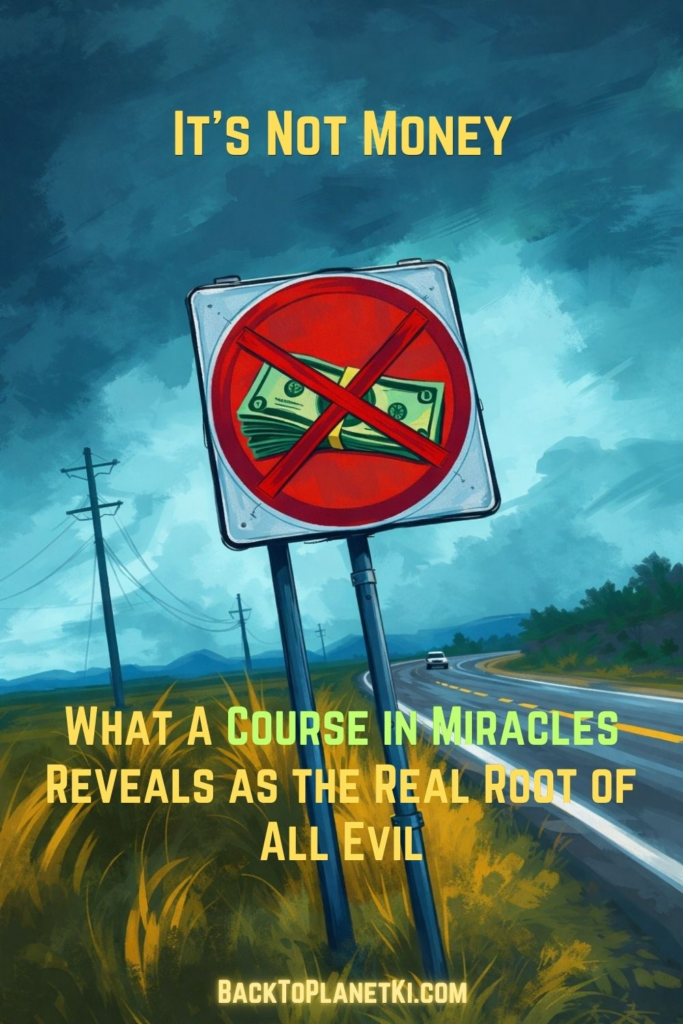
We've all heard the biblical saying that the love of money is the root of all evil. But what if the actual source of human suffering runs much deeper? A Course in Miracles reveals that our greatest obstacle to peace isn't what we possess, but how we perceive ourselves.
We’ve all heard the biblical saying that the love of money is the root of all evil. But what if the actual source of human suffering runs much deeper? A Course in Miracles reveals that our greatest obstacle to peace isn’t what we possess, but how we perceive ourselves.
Chapter 4, titled “The Root of All Evil,” identifies the authority problem as the fundamental source of our struggles, offering a pathway from “fatigue” to “inspiration.”
At the heart of human suffering lies a question most of us never consciously ask: Who is the author of my being? The Course identifies this authority problem as the root of all evil, the fundamental confusion that generates every form of conflict we experience.
The ego makes an audacious claim: it believes it created itself. This self-creation fantasy might sound empowering, but the Course reveals it as terrifying. If we made ourselves, we’ve usurped God’s power and become responsible for our very existence. This creates an impossible burden.
The Soul’s perspective offers a different reality. Our worth was established by God and is therefore not debatable. We didn’t create ourselves any more than a painting creates the artist. Yet because we believe we’re self-made, we spend our lives defending what the Course calls a “shabby and unsheltering home” for our identity.
This false foundation explains why so many live in quiet desperation, constantly trying to prove their value and maintain control over an identity that feels perpetually under threat.
The Course emphasizes that we’re all simultaneously teachers and learners. However, the quality of both depends entirely on which foundation we choose: the ego or the Soul.
Many resist learning because it implies change, and the separated mind perceives any change as further separation from wholeness. This creates a paradox where the very thing that could heal us becomes frightening because we’ve invested so heavily in our current belief system.
A genuine teacher strengthens their own understanding by sharing it. When you speak from the Soul, you affirm knowledge and inspire both yourself and your listener. When you speak from the ego, you “dispirit” yourself and others.
The ultimate goal of any truly devoted teacher is to make themselves unnecessary. Real teaching doesn’t create dependency but helps students find their own internal guidance, in stark contrast to the ego’s teaching, which seeks to maintain hierarchy and control.
The ego isn’t a thing or entity but an idea, a thought system built on the false premise of separation. The Course describes it as creating a delusional system of “false autonomy” that governs how most of us navigate reality.
Central to the ego’s operation is the scarcity principle. The ego believes in fundamental lack and constantly evaluates itself in relation to other egos, generating toxic patterns:
The ego operates on “giving to get,” believing that sharing something means losing it. This makes genuine generosity impossible because every gift becomes a transaction.
Comparison becomes the ego’s primary mode of relating. It cannot grasp equality because it needs “better than” or “worse than” to confirm its existence. All appetites become “getting” mechanisms the ego uses to prove it exists.
Most destructively, the ego promotes the illusion of independence, convincing us the mind is “completely on its own.” This leads to a constant battle for survival where we’re perpetually trying to preserve a self-image that was never real.
One of the Course’s most profound statements appears here: “The Kingdom of Heaven is you.” This isn’t solipsism but recognition of our fundamental unity with all creation.
The basic conflict between love and fear often remains unconscious because the ego cannot tolerate either emotion and represses both. The ego regards the Soul as its mortal enemy because the Soul’s permanence proves the ego’s temporary existence is a lie.
This explains why no human love at the ego level exists without ambivalence. Since the ego is constructed from denial of our Source, genuine love threatens its very foundation. We find ourselves torn between the desire for real connection and fear of the dissolution such connection would bring to our separate identity.
The Course offers practical guidance for dealing with emotional states. Only the mind produces fear, and therefore only the mind can release it.
Depression arises from feeling deprived of something we want. The remedy: decide otherwise. Recognize that you’re deprived of nothing except by your own decisions. This shifts depression from an external problem to an internal choice requiring only clarity.
Anxiety comes from the ego’s capriciousness, its constantly shifting demands. The solution is to become as vigilant against the ego’s dictates as we typically are for them. We defend the ego’s perspective with tremendous energy. What if we used that same energy to question it?
Guilt signals that the ego believes it has violated God’s laws. But the Course insists you have not. The “sins” attributed to you belong to the ego’s fantasy. Leave them to the Atonement, which recognizes they never occurred in truth.
The ego identifies with the body because the body’s vulnerability serves as its “best argument” that you cannot be of God. Yet paradoxically, the ego also hates the body because it represents an “impoverished” home.
The Course suggests we learn to ask one vital question about everything we undertake: “What for?” This simple question cuts through endless complexity. If our purpose is to strengthen the ego, actions result in fatigue. If the purpose is miracle-mindedness (seeing beyond appearances), they result in healing.
This question transforms decision-making from complicated calculation into clear choice: Am I doing this to reinforce separation or remember wholeness?
The chapter concludes with “true rehabilitation,” the process of returning a split mind to wholeness. The Course notes that even well-intentioned healers are often limited by their own egos, perceiving patients as damaged rather than as equals temporarily confused about their identity.
To reach genuine helpfulness, the Course offers a transformative prayer: “I am here only to be truly helpful. I am here to represent Christ, Who sent me. I do not have to worry about what to say or what to do because He Who sent me will direct me. I am content to be wherever He wishes, knowing He goes there with me. I will be healed as I let Him teach me to heal.”
This prayer encapsulates the alternative to the ego’s approach. Instead of seeing ourselves as separate healers fixing broken people, we recognize ourselves as channels for a healing that flows through us, not from us.
The “Root of All Evil” is the belief that we are separate from our Creator and must fight to maintain a false sense of autonomy. This belief generates every form of suffering we experience: loneliness, fear, guilt, anxiety, and the exhausting effort to prove our worth.
The alternative isn’t difficult in requiring years of practice or exceptional ability. It’s difficult only in that it requires us to question our most fundamental assumptions about who we are. It asks us to consider that we might be “wholly worthy” already, that our value was established before we could question it, and that the “shabby home” we’ve constructed can be released in favor of our natural inheritance.
Nothing real can be threatened. Nothing unreal exists. Herein lies the peace of God.
PIN It