Physical Address
304 North Cardinal St.
Dorchester Center, MA 02124
Physical Address
304 North Cardinal St.
Dorchester Center, MA 02124

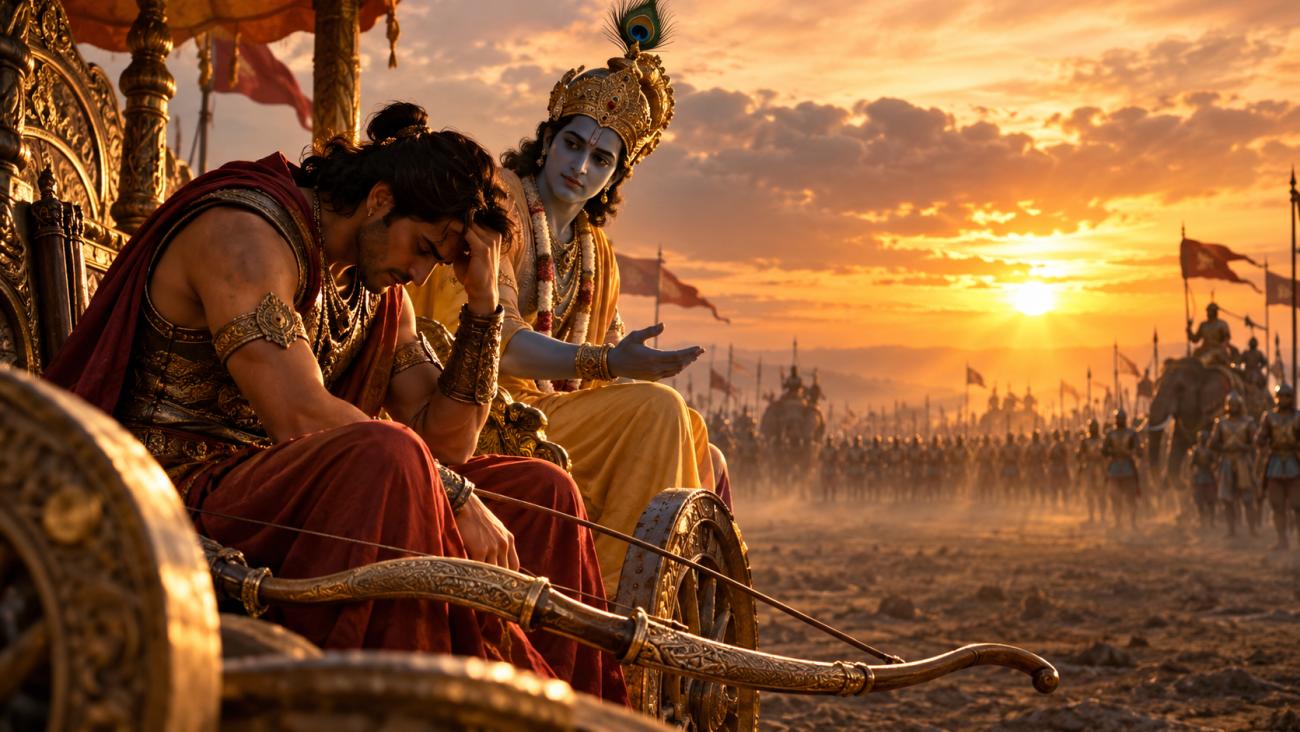
Every great book about the inner life has to open somewhere. Some open in a monastery, some in a garden, some on a mountain. The Bhagavad Gita opens on a battlefield, a few minutes before the killing starts, with its hero sitting down in his chariot and refusing to move.
That choice of setting is deliberate. The Gita has no interest in wisdom that only works when life is quiet. It wants to know what holds up when everything you love is on the line and every option looks wrong. Seven hundred verses later, the man who could not lift his bow stands up again. Nothing around him has changed. He has.
The Gita sits inside the Mahabharata, the vast Indian epic, at the point where a family feud has become a war. Two branches of one royal house, the Pandavas and the Kauravas, have gathered their armies on the plain of Kurukshetra. The Kurukshetra War is about to decide who rules.
Arjuna is the finest archer on the Pandava side. Krishna has agreed to drive his chariot, and Arjuna asks him to pull up between the two armies so he can look at the men he is about to fight. It is a mistake, or perhaps a mercy. Across the field he sees his grandfather’s generation, his old weapons teacher, cousins he grew up with, friends. His limbs go weak, his mouth dries, the bow slides out of his grip. Whatever he wins here, he reasons, will be soaked in the blood of people he loves. Better to walk away. Better even to be killed unresisting.
Then he says something few heroes ever say. He admits he no longer knows what is right, and he asks to be taught.
It is easy to rush past the first chapter to get to the teaching. That would miss the point. The whole book exists because one capable, disciplined person hit a wall that his skills could not get him over.
Most people never stand on a literal battlefield. Nearly everyone, though, meets an Arjuna moment: a decision about a marriage, a career, an ageing parent, a business partner, where loyalty and duty point in opposite directions and every path costs something precious. The paralysis Arjuna feels is not cowardice. It is what happens when the mind has run out of familiar rules.
The Gita does not shame him for it. Krishna’s first move is not to give an order. It is to widen the frame until the problem looks different.
Krishna begins with the largest claim in the book. The one who lives in the body was never born and will never die. Bodies wear out and are set aside, the way a person discards worn clothing and puts on new garments. Weapons cannot cut this deeper self, fire cannot burn it, water cannot soak it. Edwin Arnold’s 1885 verse translation, The Song Celestial, now freely available, renders this chapter with real beauty and is worth reading slowly.
Modern presenters sometimes reach for the conservation of energy to make this sound scientific. The comparison is loose at best. Physics says energy constantly changes form. The Gita claims something stranger: that there is a part of you that does not change at all, a still witness behind every shifting experience. Whether or not you accept it, notice what the teaching does for Arjuna. It loosens his panic by reminding him that the drama in front of him, however real, is not the whole of reality.
Arjuna’s real question is practical. Should he fight or not?
Krishna’s answer is the most quoted line in the book, verse 2.47. You have a claim on your action, he says, and no claim at all on its fruits. Do not let results be your motive, and do not fall into doing nothing either. Later tradition gave this a name, nishkama karma, or desireless action.
Read carelessly, it sounds like an invitation to stop caring. It is closer to the opposite. The teaching asks for full effort with none of the anxious bargaining attached. A surgeon who is obsessed with her reputation shakes. A surgeon focused completely on the incision in front of her does not. The second one cares more about the patient, not less. She has simply stopped spending her attention on the part she cannot control.
Krishna also closes the exit Arjuna was hoping for. Walking away is still an action. Refusing to choose is a choice, with consequences of its own. There is no neutral corner of life to hide in.
In the same chapter, Krishna traces how a person comes undone. It starts small. You dwell on something you want. The dwelling breeds attachment. Attachment hardens into craving. Thwarted craving turns to anger. Anger clouds judgement, clouded judgement scrambles memory, and once you lose track of what you know to be true, you are lost.
What makes this map so useful is that every step on it is visible if you look. You can catch yourself on the first stair, while it is still only a thought you keep returning to. By the fifth stair, you are already shouting.
Arjuna, to his credit, pushes back. This is all fine in theory, he says, but the mind will not cooperate. It is restless, stubborn and violent, as hard to hold still as the wind.
Popular retellings often swap in the image of a monkey leaping from branch to branch. That picture comes from Buddhist teaching, not the Gita. Arjuna’s image is wind, which is arguably more honest. You cannot grab wind. You cannot argue it into stopping.
Krishna does not pretend otherwise. He agrees the mind is hard to master and gives a two-part answer: steady practice and gradual letting go. He is not asking for a single heroic effort. He is asking for a habit, kept up long enough that the wind gradually weakens.
Later chapters give Arjuna a diagnostic tool: the three gunas, the basic qualities that, in this philosophy, run through everything in nature, including your own moods.
[Also See: The Strange Little Book That Asks You To Stop Trying]
Sattva is clarity, calm and balance. Rajas is drive, appetite and restless motion. Tamas is heaviness, dullness and inertia. Every person carries all three in shifting proportions. A rajas day is the one where you cannot sit still and say yes to everything. A tamas day is the one spent scrolling on the couch, unable to start. A sattva day is rare and quiet, when the right next step seems obvious.
The value of the model is not in labelling people. It is in noticing which weather is passing through you right now, so you stop mistaking a passing storm for your permanent climate.
One reason the Gita has endured is its generosity. It does not insist on a single route. Krishna describes several: the path of selfless action for the doers, the path of knowledge and discernment for the thinkers, the path of devotion for those who lead with the heart, along with the disciplines of meditation. He even admits that people turn to the divine for very different reasons. Some come in distress, some out of curiosity, some hoping for success, and a few simply out of love. All of them, he says, are welcome.
This makes the Gita a striking companion to a far more radical text, the Ashtavakra Gita, which hands its reader no paths at all and simply insists you are already free. The Bhagavad Gita meets people where they stand. The Ashtavakra Gita asks who is doing the standing. Many readers find they need both.
Midway through, the conversation shifts. Krishna reveals that he is not merely Arjuna’s friend and driver. In verse 4.7 he explains that whenever righteousness collapses and injustice surges, he takes form to set things right. Indian tradition tells many such stories through the ten avatars of Vishnu: the man-lion who shields the boy Prahlada from his tyrant father, the dwarf whose three strides end the rule of King Bali, Rama defeating Ravana.
In chapter 7, Krishna says he is the taste in water and the light of the sun and moon. The divine, in this picture, is not hidden away in heaven. It is the very quality that makes each thing what it is.
Then, in chapter 11, Arjuna asks to see it all directly, and gets far more than he bargained for. The Vishvarupa, the universal form, appears: countless faces, endless arms, the whole cosmos with all its creatures, and time itself swallowing armies whole. Arjuna is terrified and begs Krishna to return to his familiar shape. Centuries later, the physicist J. Robert Oppenheimer, who had studied Sanskrit at Berkeley, recalled a line from this vision while watching the first atomic test in 1945: now I am become Death, the destroyer of worlds.
Strip away the cosmic drama and the Gita keeps returning to one quality. Verse 2.48 calls it samatvam, evenness of mind, and states plainly that this balance is itself yoga. As the commentary on Bhagavad Gita 2.48 explains, it is the steadiness that lets you stay yourself through success and failure, praise and blame, pleasure and pain.
Chapter 16 sharpens this by contrasting two sets of tendencies. Honesty, compassion, self-restraint and humility lift a person toward clarity. Arrogance, anger and greed drag them down. Neither set is destiny. Each grows with use.
Chapter 8 adds a sobering note. What a person holds in mind at the moment of death shapes where they go next, and what fills the mind at the end is whatever filled it most often along the way. The practical message is simple: you are rehearsing your final moment every ordinary day.
Pick one task you have been dreading because of how it might turn out. Before you start, say quietly to yourself: the effort is mine, the outcome is not. Then give the task your complete attention, as if doing it well were the entire reward.
Afterwards, notice two things. Was your work better or worse than usual? And how much energy did you save by not rehearsing every possible result in advance? Most people find the answers surprising.
Near the very end, Krishna offers his most intimate instruction: set aside every other duty, take refuge in him alone, and do not grieve. It is an invitation to stop trying to hold the whole universe together with your own two hands.
Arjuna’s last words in the dialogue are short. His confusion is gone, he says. He remembers who he is. His doubts have cleared, and he will act.
The war still happens. The relatives are still across the field. The Gita never promises that understanding will make your hardest situation disappear. What it offers is something more durable: a version of you that can walk into that situation steady, clear about what is yours to do and willing to let go of the rest.