Physical Address
304 North Cardinal St.
Dorchester Center, MA 02124
Physical Address
304 North Cardinal St.
Dorchester Center, MA 02124

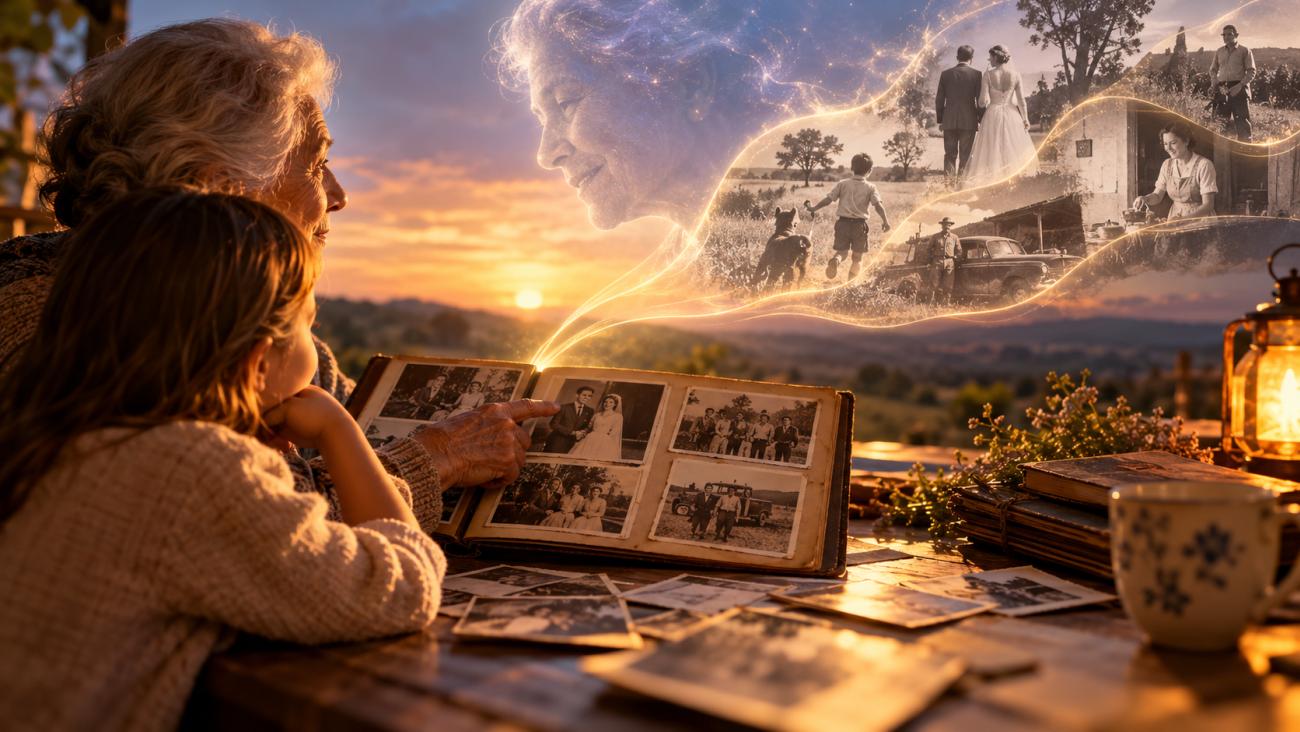
Ask almost anyone what the dead might be afraid of and you will get the same answers. Judgment. Oblivion. The unknown itself. Yet according to psychic medium Matt Fraser, who says he has sat through thousands of readings, the souls who come through treat death itself as the least frightening thing they have faced. What weighs on them, he reports, is something far more ordinary and far more human: the worry that they will be erased from the memory of the people they love.
You do not have to accept mediumship to find that idea worth sitting with. Whether you think the departed are listening or you think memory is simply all that remains, the question lands in the same place. Who will remember your people, and for how long? And what happens to a whole life when nobody is left who can tell it?
Fear of death gets all the attention, but there is an older and quieter fear underneath it. Humans have always built things to outlast themselves: gravestones, family Bibles, names carved into benches, trees planted in someone’s honour. Every one of those is an attempt to say, I was here, and it mattered.
In Fraser’s telling, the souls who come through in readings are less preoccupied with their own survival than with whether their story survives. He describes a pattern of messages that circle back to the same wish: not to be mourned forever, but to remain a living presence in family life. The distinction is subtle and it is worth holding onto. Mourning looks backward at a loss. Being included keeps a person woven into the present, into the dinner table conversation and the jokes that only your family understands.
Consciousness researchers who work from a big-picture view, like Thomas Campbell in his My Big TOE framework, tend to treat fear as the thing a developing consciousness is meant to outgrow. Seen that way, a soul that lingers on the fear of being forgotten might simply be showing us a last piece of unfinished human attachment. That is speculation, of course. What we can say with confidence is how quickly forgetting actually happens on this side.
Try a simple experiment. Think of your great-grandmother and ask yourself what her laugh sounded like. What song did she hum while she cooked? How did she sign her name? How did she meet your great-grandfather?
Most people cannot answer a single one of those questions, and she was not a stranger. She held your grandparent as a baby, and her blood is in your veins right now. Fraser frames this as a rule of thumb, that a life can dissolve from living memory within about two generations after the person is gone.
Scholarship backs up the shape of that claim more than you might expect. The cultural memory researchers Jan and Aleida Assmann distinguish between cultural memory, which lives in monuments, texts and rituals, and what they call communicative memory, the informal remembering passed along by ordinary conversation. According to a summary of their lecture series at the University of São Paulo, communicative memory is limited to roughly eighty to one hundred and ten years, or three to four generations. After that, unless something deliberately preserves the story, it fades out of everyday reach.
Put plainly, ordinary families are in the business of holding a memory for about a century, and then letting it go. The names survive on paper. The people do not.
Grief psychology has shifted noticeably on this subject. For much of the twentieth century the dominant advice was to let go and move on. Then, in the 1990s, the researchers Dennis Klass, Phyllis Silverman and Steven Nickman argued that bereaved people were not failing at grief when they stayed connected to the dead. As the overview of continuing bonds theory explains, they observed that maintaining a lasting connection with a deceased loved one is a common and often healthy part of grieving. It is worth noting that the research is mixed, and later reviews found that continuing bonds are not automatically helpful for everyone. Outcomes seem to depend on who is grieving, and even on culture.
Then there is the matter of experiences that seem to come from the other side. A Psychology Today piece on after-death communication reports prevalence rates between 31 and 82 percent across studies of different populations, and notes that these experiences are usually described as positive and sometimes therapeutic. One study cited there found that 27 percent of people with such experiences were not grieving at the time, which the authors take as a sign that something more than grief processing may be going on.
None of this proves the dead care whether you tell their stories. It does show that ongoing relationship with the departed is normal, common and often good for the living. If the consciousness-first view is right, then keeping a loved one’s story alive is a form of contact. If it is not, it is still one of the healthiest things a family can do.
Here is where the idea moves from the mystical to the measurable. The psychologists Marshall Duke and Robyn Fivush at Emory University developed a short survey for children called the Do You Know scale, which asks things like where their grandparents grew up and how their parents met. According to a write-up from York University’s trauma research blog, children who knew more family history also scored higher on self-esteem and sense of control, with lower anxiety and fewer behavioural problems.
The most protective kind of family story turned out to be neither triumphant nor tragic. As ParentMap describes it, the researchers identified an oscillating narrative that includes both success and failure, and stories of living through hard times and coming out the other side. In other words, the dead do not need to be polished. A grandfather who lost the farm and started again does more for a grandchild than a saint ever could.
That finding changes what remembering means. You are not only honouring the dead. You are handing the living a map of how people in their own bloodline got through difficulty.
There is another group that quietly benefits when a life story is gathered: the person telling it. A study of life story work with community-dwelling older adults found preliminary evidence that the process improved general mental well-being, especially among those with depressive symptoms. And an overview from IRISS on life story work with dementia reports that it can improve mood, cognition and well-being in people with mild to moderate dementia, and can strengthen the relationship between the person and their carers.
So the practical lesson is not to wait. If someone you love is still alive, asking about their life is not a chore you owe their memory. It is something that may help them right now, and it is the only version of this work that includes their own voice.
Most families never preserve their stories, not because they do not care, but because the task feels enormous. It does not have to be. A few small habits do most of the work.
Whether you use paper, a shared folder or a dedicated digital memorial, the principle is the same. A story that sits in one person’s head has a lifespan of one person.
Fraser’s video ends with a call to action, and it is a good one, whatever you believe about the source. Pick one person who is gone. Say their name out loud today. Share one story about them with someone who never met them, preferably someone young.
If the departed are listening, you have given them what they asked for. If they are not, you have still passed a thread of your family’s story one generation further than it would otherwise have travelled. Either way, someone reduced to a date on a headstone becomes a person again, if only for the length of one conversation.
The question worth asking is not whether the dead fear being forgotten. It is whether we are willing to be the ones who prevent it.