Physical Address
304 North Cardinal St.
Dorchester Center, MA 02124
Physical Address
304 North Cardinal St.
Dorchester Center, MA 02124

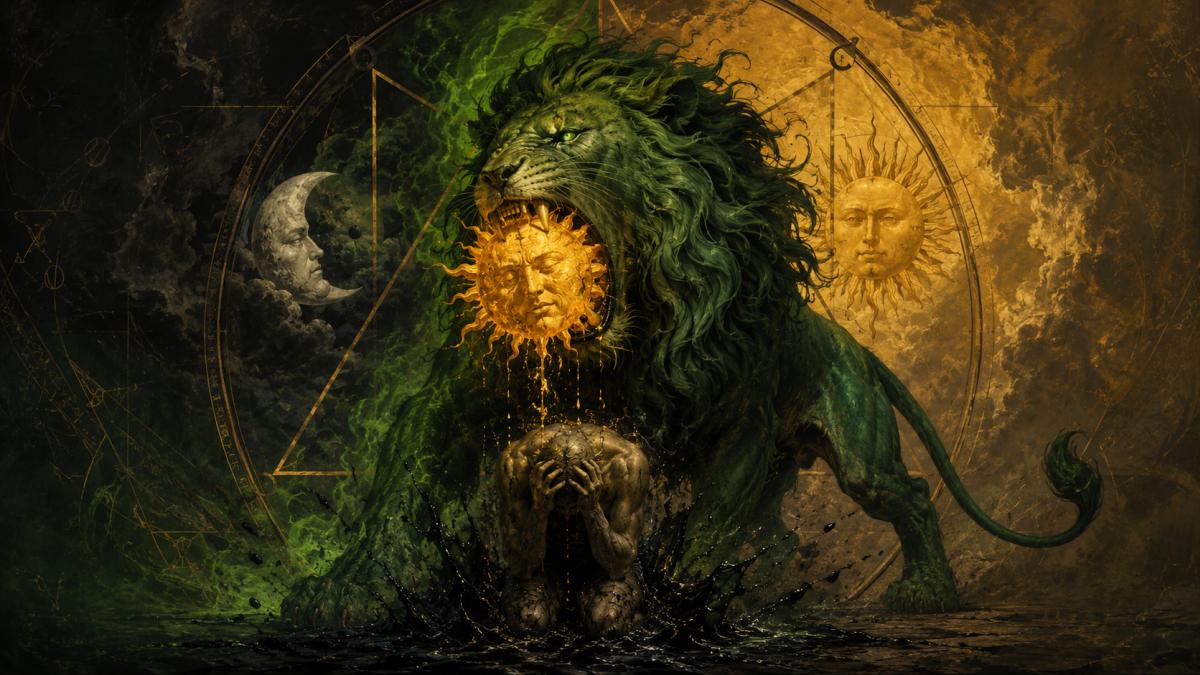
Shakespeare gave envy its most famous costume when Iago warned of the green-eyed monster. What almost nobody notices is that Renaissance occultists were already working with a green beast of their own, and theirs was not a warning. It was an instruction. In alchemical manuscripts from the same era, a green lion appears again and again, jaws locked around the sun, swallowing it whole. The image looks like catastrophe. The alchemists insisted it was the beginning of gold.
Shakespeare gave envy its most famous costume when Iago warned of the green-eyed monster. What almost nobody notices is that Renaissance occultists were already working with a green beast of their own, and theirs was not a warning. It was an instruction. In alchemical manuscripts from the same era, a green lion appears again and again, jaws locked around the sun, swallowing it whole. The image looks like catastrophe. The alchemists insisted it was the beginning of gold.
That collision of images is not a coincidence. It is the key to one of the most practical secrets the occult tradition ever encoded: the raw, ugly, devouring emotions we are taught to suppress are not obstacles to transformation. They are the solvent that makes transformation possible. Grief, envy, rage, and despair are the acids of the soul, and the alchemists built an entire symbolic technology around one question. What happens if, instead of neutralizing the acid, you let it do its work?
The Magnum Opus, the Great Work of turning base metal into gold, was always a double operation. On the laboratory bench, alchemists heated, dissolved, and recombined substances through a sequence of color changes. In the soul, the same sequence described an inner ordeal. The classical stages ran from nigredo, the blackening, through albedo, the whitening, and citrinitas, the yellowing, to rubedo, the final reddening. Carl Jung spent decades with these manuscripts and concluded that the four stages map directly onto the transformation of the conscious personality itself, a process he framed as confession, elucidation, education, and transformation, the road to psychological wholeness he called individuation.
The crucial point is where the work begins. It does not begin with insight, study, or clever technique. It begins with blackening. The material must first fall apart. In the psyche, that falling apart has a familiar name. It is the season of grief, depression, and collapse that the alchemists themselves called melancholia, and one detailed survey of the stages notes that the old masters treated this state as the confrontation with the shadow, corresponding directly to crisis and the death of old identities. The Rosarium Philosophorum, the great illustrated treatise of 1550, even tells the practitioner to rejoice when the matter turns black, because blackening is the proof that transformation has genuinely started. No darkness, no gold.
Read that as emotional instruction and it becomes startling. The tradition is saying that the worst moments of feeling, the ones that look like breakdown, are the confirmed signature of a process that is working.
Now the green beast enters. The image of a green lion consuming the sun is one of the oldest motifs in the entire alchemical corpus, with roots reaching back to a vision recorded by Zosimos of Panopolis around 300 AD, long before it was engraved into the famous Rosarium woodcuts and expanded by later writers like Basil Valentine, who described the lion devouring the sun so that the soul of the king could be liberated and purified.
What does the picture mean? In the language of the tradition, the sun is gold, the fixed and perfected principle, the radiant conscious self. The lion is everything green and untamed, the raw instinctual force that civilization tells us to cage. One modern Jungian meditation on the emblem puts it plainly: the sun represents the ego in all its shining entitlement, and the lion represents the primal instincts that arrive to devour it. The encounter destroys the old personality so that a new sun, a resurrected self, can rise in its place.
Here is the green-eye connection made explicit. Envy, jealousy, rage, and hunger are precisely the lion’s diet of emotions. They are green in every sense the tradition intended: vegetative, wild, alive, and utterly indifferent to how the ego would prefer to see itself. When envy seizes you, something instinctual has grabbed the polished self-image by the throat. The occultists looked at that moment, the moment most of us experience as moral failure, and painted it as the first indispensable act of the Great Work.
The chemistry beneath the symbol sharpens the lesson. The green lion was frequently identified with vitriol, the corrosive green sulfate whose acids could dissolve nearly everything they touched. Our modern word for harsh, biting speech comes straight from this substance. But the alchemists prized vitriol for a specific property: it destroyed the impure and the counterfeit while leaving true gold untouched.
That is a nearly perfect description of what difficult emotion does when it is faced rather than fled. Envy dissolves the comfortable story that you are content with your life, and exposes exactly what you actually long for. Grief dissolves the identity that was built around what has been lost, and reveals what in you cannot be lost. The acid eats the false. Whatever survives the acid is real. The Freemasons and later alchemists compressed this into the famous motto VITRIOL, an acronym instructing the seeker to visit the interior of the earth and, by purifying, find the hidden stone. The interior of the earth is not a cave. It is the underworld of your own feeling life.
For centuries this remained coded in allegory. Jung broke the seal. After more than a decade with the manuscripts, he argued that the alchemists had been unconsciously projecting the drama of the psyche onto their flasks and furnaces, and that the true prima materia was the practitioner. His reading of the emotional mechanics is especially relevant here. Contemporary Jungian analysis emphasizes that growth comes from holding the tension between opposing forces in conscious awareness rather than rushing toward false resolution, a psychological coagulation of opposites. You do not get rid of the envy, and you do not act it out. You hold it, feel it fully, and let the heat of that containment cook the material into something new.
Jung also identified the black sun, the sol niger that marks the nigredo stage of the opus, as the image of consciousness eclipsed by its own darkness. The ego’s light goes out, and in that darkness the deeper work proceeds. Anyone who has passed through real grief knows this eclipse intimately. The tradition’s radical claim is that the eclipse is not a malfunction. It is a stage.
Strip away the retorts and the Latin, and modern shadow work is running the same protocol. Practitioners today treat difficult emotion exactly as the alchemists treated their blackened matter. One contemporary guide to working with jealousy and envy states the principle in a single line: in shadow work, comparison is not treated as weakness, it is treated as information. The sting of envy is a message from a disowned desire. Something you value has been stirred, and the feeling is the only messenger honest enough to tell you.
Remarkably, laboratory psychology has arrived at the same fork in the road that the alchemists painted. Research published in the journal Emotion demonstrated that envy splits into two distinct types with opposite trajectories: benign envy drives a moving-up motivation toward self-improvement, while malicious envy drives a pulling-down motivation to damage the envied person. The same green fire, two destinies. One transmutes the base metal. The other simply corrodes the vessel. The difference is not in the emotion itself but in whether it is worked consciously, which is precisely the distinction the old texts drew between the lion devouring the practitioner who resists and purifying the one who consents to the process.
Therapeutic frameworks add the safety measures the solitary alchemist lacked. Practitioners of Internal Family Systems caution that real integration requires more than journal prompts, because diving into painful material without support can overwhelm or even retraumatize, which is why building safety and compassion comes before depth. The alchemists said the same thing in their own idiom. The vessel must be hermetically sealed and the fire carefully regulated, or the work explodes.
Lay the Renaissance laboratory beside the modern therapy room and one conclusion becomes unavoidable. Both systems teach that the soul’s deepest transformation happens in the crucible of feeling, not thought. You cannot think your way through nigredo. You cannot reason envy into wisdom or analyze grief into peace. The material must be felt at full strength, contained rather than discharged, and allowed to pass through its color changes in its own time. Insight arrives afterward, the way the whiteness of albedo dawns only after the blackness has done its complete work.
This is why the occultists spoke of an elixir rather than an idea. The end product of the Great Work was something living and potent, not a conclusion. Turn grief through the full sequence and it does not become an explanation of loss. It becomes wisdom with weight, compassion that has been through the fire. I explored the broader practice of this inner transmutation in The Alchemy of Shadow Work: Transforming Your Darkest Parts Into Spiritual Gold, and the green-eye teaching sits at its very center. The parts of you that feel most poisonous carry the most concentrated potential.
So the next time the green lion arrives, jaws open, hungry for your carefully polished sun, remember what the old masters painted in the margins of their forbidden books. The devouring is the doorway. Rejoice when you see the matter turn black. The gold was never anywhere else.