Physical Address
304 North Cardinal St.
Dorchester Center, MA 02124
Physical Address
304 North Cardinal St.
Dorchester Center, MA 02124

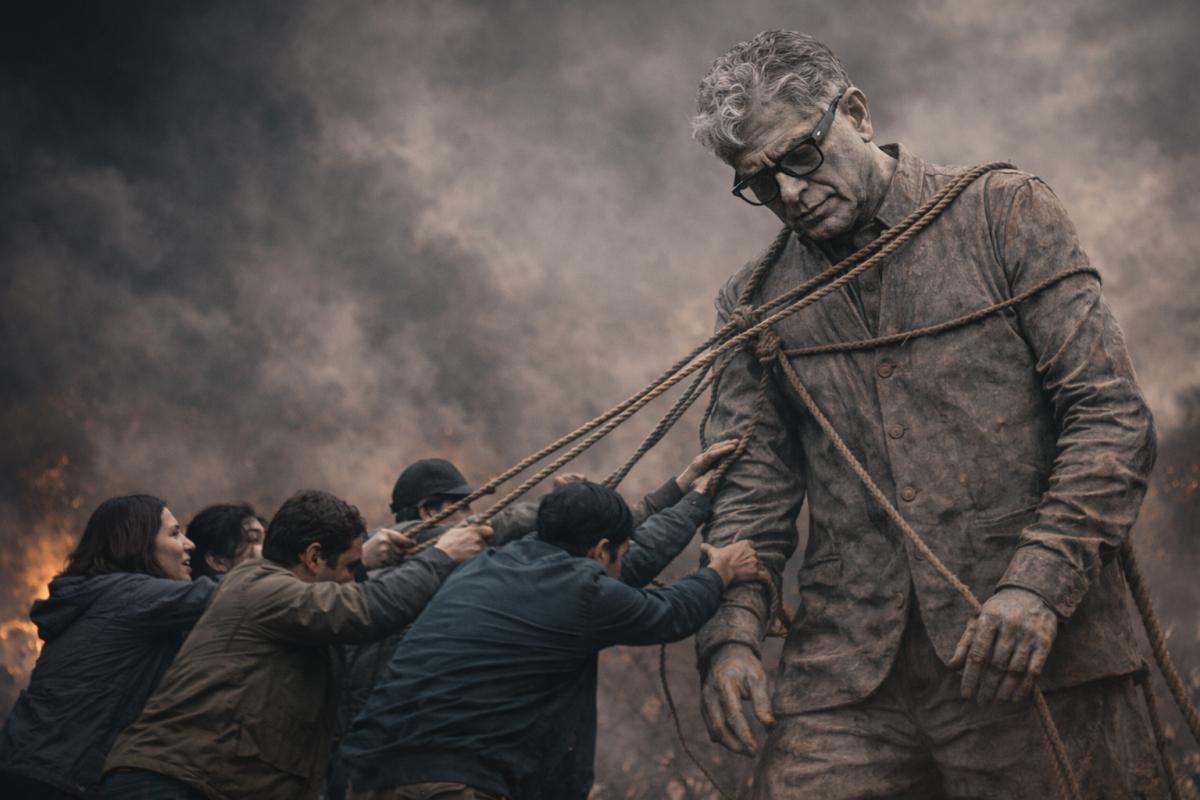
There is a pattern so consistent across human history that it should, by now, be considered a law of spiritual physics. The teacher who inspires millions eventually stumbles. The healer is revealed as wounded. The prophet turns out to have clay feet. We watch it unfold with a strange mixture of horror and satisfaction, as though some part of us always knew the fall was coming. And then we do what we always do: we reduce the entirety of a life's work to the moment of its unravelling, declare the whole thing a fraud, and move on to the next hero, who will inevitably follow the same trajectory.
There is a pattern so consistent across human history that it should, by now, be considered a law of spiritual physics. The teacher who inspires millions eventually stumbles. The healer is revealed as wounded. The prophet turns out to have clay feet. We watch it unfold with a strange mixture of horror and satisfaction, as though some part of us always knew the fall was coming. And then we do what we always do: we reduce the entirety of a life’s work to the moment of its unravelling, declare the whole thing a fraud, and move on to the next hero, who will inevitably follow the same trajectory.
But what if this pattern is not evidence that spiritual leadership is inherently corrupt? What if the pattern itself is the message?
In the Law of One material, channelled through Carla Rueckert in the early 1980s, Ra describes a cosmological framework in which two fundamental polarities operate on this planet: service to others and service to self. Those aligned with service to others (positive polarity) work toward unity, love, and the upliftment of consciousness. Those aligned with service to self (negative polarity, often associated with what Ra calls the negative orientated groups) work toward control, separation, and the harvesting of energy through fear and subjugation.
One of the most striking aspects of this framework is what Ra describes as the intensification of negative attention directed toward positively polarised beings as they grow in influence. This is not a punishment. It is, in Ra’s terms, simply the balancing mechanism of a polarised system. The brighter the light, the more defined the shadow it casts, and the more interest it attracts from those who feed on the extinguishing of that light.
Ra is explicit about this. The group itself experienced psychic greetings and sustained negative interference throughout the channelling process. Don Elkins, the questioner who drove the sessions, ultimately took his own life under circumstances the remaining members attributed in part to this sustained targeting. The very act of bringing through material that could accelerate positive awakening made the entire group a target of extraordinary intensity.
This is not unique to the Ra material. Virtually every esoteric tradition acknowledges this principle in its own language. Christianity calls it spiritual warfare. Sufism speaks of the nafs and the relentless pull of the lower self, intensified precisely at the moments of greatest spiritual opening. The Hindu and Buddhist traditions describe Mara, the tempter, who appeared to Siddhartha not during his years of ordinary seeking but at the exact moment of his enlightenment under the Bodhi tree. The pattern is universal: approach the light, and the darkness will test you with everything it has.
Understanding why visible spiritual figures fall requires understanding what “targeting” actually looks like in practice. It is rarely dramatic. It is almost never the cinematic temptation of a devil offering worldly power in exchange for one’s soul. It is far more subtle and far more effective than that.
The targeting works through the cracks that already exist. Every human being carries unresolved shadow material: childhood wounds, unprocessed grief, sexual shame, unmet needs for validation, the quiet terror of abandonment. In an ordinary life, these cracks cause ordinary problems. In the life of someone who has risen to a position of massive spiritual influence, these same cracks become vectors for catastrophic failure, because the pressure applied to them is no longer ordinary.
Consider what happens to a spiritual teacher who achieves global recognition. They are surrounded by devotees who project perfection onto them. Their every word is treated as scripture. They are isolated from honest feedback by layers of staff and followers who are too reverent or too afraid to challenge them. They are offered money, adulation, sexual availability, and a kind of worship that no human psyche was designed to absorb. And all of this happens while the normal structures of accountability that keep most people in check (peers, critics, equals who will call you out) gradually fall away.
Now layer onto this the metaphysical dimension. If we accept even the possibility that negatively oriented forces operate on this plane, then the individual sitting at the centre of that web of projection and isolation is also receiving sustained psychic interference calibrated precisely to their weakest points. The person with unresolved sexual shadow gets offered an endless stream of sexual temptation. The person with narcissistic tendencies gets fed a steady diet of worship. The person with a saviour complex gets placed on an ever-higher pedestal, until the fall becomes not just likely but almost gravitationally inevitable.
This is not a defence of bad behaviour. It is an explanation of the mechanism. And understanding the mechanism changes how we interpret the outcome.
There is a psychological phenomenon that predates any esoteric framework: the human compulsion to tear down what we have elevated. Freud wrote about it. Jung mapped it in detail through his work on projection and the shadow. The pattern is consistent across cultures and centuries.
We select a figure to carry our idealised self. We project onto them everything we wish we could be: wise, compassionate, fearless, enlightened. For a while, the projection holds, and we bask in reflected glory. But the projection is inherently unstable because it requires the object of our worship to be something no human being can sustain: perfect.
The moment the crack appears, the entire structure of projection collapses, and the energy that once flowed as worship reverses into rage. The fall of the hero is never proportionate to the actual offence. It is proportionate to the height of the pedestal we built, because what we are really angry about is not their failure but the collapse of our own fantasy. We trusted them to be gods, and they turned out to be human, and that feels like a betrayal.
This is why the public destruction of spiritual leaders carries a particular savagery. When a politician is caught in scandal, we shrug. When a celebrity misbehaves, we gossip. But when a spiritual teacher falls, we feel personally wounded, because we gave them something we give no one else: our belief that transcendence is possible. When they fail, it threatens not just our opinion of them but our hope for ourselves.
Willis’s attack on the Dalai Lama and Deepak Chopra carries exactly this energy. It is not a measured assessment of complicated human beings operating under extraordinary pressures. It is the scorched-earth fury of a former believer. “Big phonies,” he calls them. Not flawed, not compromised, not human. Phonies. The word carries the specific venom of someone who once gave their trust and wants it back with interest.
The Epstein network presents a uniquely clarifying case study when viewed through this lens. Whatever the full truth of Epstein’s operation turns out to be, certain features are already clear. It functioned as a web designed to compromise powerful and influential people. It offered access, flattery, intellectual stimulation, and, for those susceptible, sexual enticement involving minors. It then held the evidence of that enticement as leverage.
This is, structurally, a textbook operation: identify beings of influence, locate their vulnerabilities, offer precisely calibrated temptation, and then use the resulting compromise as a mechanism of control. Whether one frames this in geopolitical terms (intelligence operation) or metaphysical terms (negative polarity harvesting), the architecture is identical.
Now consider the spiritual figures whose names appear in connection with this network. Are they guilty of everything alleged? Perhaps. Perhaps not. The legal and journalistic processes will, one hopes, eventually establish the facts. But the more important question for those of us on a conscious path is this: does their proximity to a network designed to compromise influential people tell us that their teachings were always fraudulent? Or does it tell us that the network was doing exactly what such networks do, which is targeting the most visible and influential nodes it could reach?
This distinction matters enormously. If we conclude that association equals total corruption, then we must also conclude that every figure who ever fell to temptation was a fraud from the beginning. That means there are no legitimate teachers, no valid transmissions, no authentic wisdom lineages anywhere in human history. Because every single one of them, from the apostles who abandoned Jesus to the Zen masters who drank too much sake to the yogis who slept with their students, has produced figures who fell.
Willis, and many people who share his disillusionment, operate from what might be called the binary trap: either a teacher is fully authentic or they are a complete fraud. Either the teachings are validated by the teacher’s spotless life, or they are invalidated by the teacher’s failings. There is no middle ground.
This is a remarkably unspiritual way of evaluating spiritual matters. It applies the logic of consumer protection (this product was defective, therefore I want a refund) to the domain of consciousness, which has never operated on such clean lines.
The truth is messier and more demanding. A teacher can transmit genuine wisdom and still be deeply flawed. A lineage can carry authentic light and still produce individuals who misuse their position. A community can foster real awakening in some members and enable real abuse by others. Holding these contradictions simultaneously is not moral relativism. It is spiritual maturity.
The Ra material itself addresses this directly. Ra notes that even negatively oriented entities can inadvertently serve as catalysts for positive growth, and that positively oriented beings can stumble into service-to-self patterns without realising it. The universe, in Ra’s framework, is not a courtroom where beings are sorted into guilty and innocent. It is a classroom where every experience, including betrayal, disillusionment, and the fall of heroes, is catalyst for the evolution of consciousness.
If we accept that no teacher is immune to targeting, that the mechanics of fame and devotion create conditions virtually designed to produce moral failure, and that the human instinct to project and then destroy is baked into our psychology, then how do we navigate the landscape of spiritual guidance without either naive worship or cynical rejection?
A few principles suggest themselves.
First, separate the teaching from the teacher. Evaluate wisdom on its own merits. Does it produce fruit in your life? Does it deepen your compassion, sharpen your discernment, expand your capacity for love? If so, the teaching has value regardless of who transmitted it. You do not need the teacher to be a saint for the teaching to be real. Jesus made this point himself when he said to do as the Pharisees teach but not as they do.
Second, never outsource your sovereignty. The moment you place another human being above your own inner knowing, you have entered a dynamic that is structurally identical to the one Willis describes in his community, where members create the cult leader by surrendering their power. A genuine teacher will always point you back to yourself. A false one will keep you pointing at them.
Third, hold compassion for the fallen. This is perhaps the hardest practice. When a figure you admired is revealed as flawed, the temptation to rage is enormous. But rage is just inverted worship. It keeps you locked in the same dynamic of projection, only now the projection is all shadow instead of all light. True freedom comes from being able to say: this person carried real light and also real darkness, and neither cancels the other.
Fourth, expect the targeting. If you are on a genuine path of awakening, you will be tested. Not because the universe is cruel, but because polarity is real and catalysts are how consciousness evolves. The teachers who fall are not cautionary tales about the futility of the spiritual path. They are reminders that the path is real enough to be opposed.
There is one final point worth sitting with. If the negatively oriented forces of this density were truly all-powerful, there would be no authentic teachings left on this planet. Every transmission would have been corrupted, every lineage destroyed, every teacher fully compromised. The fact that wisdom persists, that the Sermon on the Mount still cracks hearts open two thousand years later, that the Dhammapada still illuminates, that the Law of One still catalyses awakening despite the tragic fate of its own channelling group, tells us something important.
The light survives. Not because the vessels that carry it are perfect, but because the light itself is not dependent on the vessel. It passes through flawed human beings the way sunlight passes through a smudged window. The glass may be dirty, cracked, even partially shattered. But the light that comes through is still light.
The real question is not whether the window is clean. The real question is whether you are willing to stand in the light that makes it through.